



The history of mediaeval and colonial India and its development into a constitutional state have always been presented from a particular angle, by the Nehruvian-Marxist ideology that emerged after India’s independence and exerted a monopolistic influence on the literature created in August 1947. Very few authors have dared to contest the communist narrative, much less offer an academic analysis pointing out India’s blatant bias in history-telling and its ingrained disdain for the development and history of its civilisations.
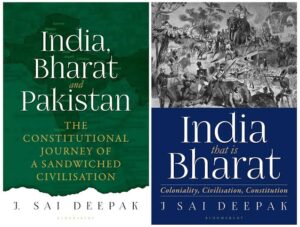
J. Sai Deepak offers a stirring and edifying perspective on issues that have previously been ignored: how coloniality continues to affect Indians’ contemporary consciousness, the urgent need to embrace decolonization as our first step in reclaiming our civilization’s identity, the impact of the combination of European and Middle Eastern coloniality on native consciousness, and its consequent influence. He takes on the less-travelled path in the first two books of the trilogy, “India, that is Bharat: Coloniality, Civilization, Constitution” and “India, Bharat and Pakistan: The Constitutional Journey of a Sandwiched Civilization,” explaining how the idea of “coloniality” goes beyond the actual occupation of land and exploitation of resources and is instead the result of an ingrained mindset that supports colonialism. He explores the individual and combined effects on Indian consciousness of European awareness through British control and Middle Eastern consciousness through centuries of Muslim dominance, as well as their contributions to the development of India’s constitution and the brutal partition of the nation.
J. Sai Deepak, a lawyer and thinker, argues in his book “India, that is Bharat: Coloniality, Civilization, Constitution” that although the colonisation of India’s geographical terrain may have been undone, its people’s minds are still influenced and limited by a historical narrative imposed upon them by outsiders, which he refers to as “coloniality.” Deepak contends that even after seven decades of independence, the native consciousness is still a byproduct of a colonial mindset and is influenced by Western ideals and principles. This is primarily due to the inheritance of the educational system left behind by the coloniser. He makes a strong argument for the fact that the majority of Indians are still held captive by the subliminal colonialism that shapes their beliefs and notions. He also explains how the suppression of indigenous beliefs and the mere desire to express native principles are increasingly characterised as “illiberal” in contrast to other nations where such expressions are praised as courageous and independent acts.
Deepak assumes the role of a daring explorer in “India, That is Bharat.” His investigation takes him to the idea of Bharat’s very foundation, where he immerses himself in an investigation of its fundamental principles. He starts by delving deeply into historical accounts and reveals how this idea has slowly deteriorated through time. Deepak marshals strong data to illustrate the enduring character of Bharat using his extensive legal knowledge. He sets out to create a path towards a decolonized interpretation of the Constitution armed with his discoveries. To restore Bharat’s authenticity and reclaim its proper position, he seeks to correct misconceptions and give it fresh life.
His attempt to refute the generally held assumption that the idea of India as a nation-state did not exist before the 1857 uprising is one of the book’s most significant discoveries. He argues that long before European colonisers and Middle Eastern invaders arrived on its shores, India had a distinct “civilizational identity.” He claims that a primitive “civilization state” had a foundation that was systematically and rapaciously abused by an intrusive mindset. The religious motivations underlying Columbus’ missions and the British government’s casual integration of missionary ideals into the social fabric of India, according to JSD, are hard to dispute and provide irrefutable proof that the British Empire’s conquest of India was motivated by the ‘Christian Exercise’. The two-nation theory put forth by people like Shah Waliullah Dehlawi, Syed Ahmed Khan, Syed Jamal al-Din al-Afghani, and other later Muslim ideologues, among others, played a significant role in suppressing India’s civilisational identity and replacing it with imported notions of “Nation States” and “pan-Islamism,” he continues, citing various instances when the European and Middle Eastern consciousness asserted itself.
In his second book, “India, Bharat, and Pakistan: The Constitutional Journey of a Sandwiched Civilization,” he explores the combined impact of European and Middle Eastern thought on the development of India’s Constitution. The author successfully refutes the idea that the two-nation theory originated in the 19th century by demonstrating how pan-Islamist ideologue Shah Waliullah Dehlawi was among the first to advance the idea that Muslims make up a separate nation. This belief was later advanced by others, such as MA Jinnah, Raja of Mahmudabad, Syed Salimullah, and Muslim League leaders, such as MA Jinnah. Sai Deepak stands out from other authors who have written about this topic because of his innovative thinking, which revealed the real roots of the Two-Nation theory by linking them to the fall of the influential Mughal Empire in India. Islamic scholars sought solace in returning to the core tenets of their faith and working to restore it after it had fallen apart. During this time, Shah Waliullah Dehlawi rose to prominence as a famous cleric who promoted the harsh Wahhabi ideas that he had come across while living in Arabia.
Shah Waliullah exhorted Muslims in the Indian subcontinent to avoid assimilating into society because he thought that doing so would tarnish their adherence to Islam. He urged people to see themselves as members of the worldwide Ummah, the religious community and compelled them to follow the Prophet’s customs and practises. While denying Hindu infidels even this meagre luxury, he permitted Shias to celebrate their holidays in public, albeit with severe moderation. Waliullah harboured such hatred for his own India that he requested Afghan warrior Ahmed Shah Durrani attack there to punish the non-Muslims. He gave a thorough analysis of the Marathas’ and Jats’ advantages and disadvantages in his letter. This laid the foundation for the sprouting of the Two-Nation theory in India.

By thoroughly describing the series of events that led to the partition of Bengal, which he refers to as the two-nation theory’s first incarnation in the early nineteenth century, JSD gives a background for the division of India. The author dispels the myth that Britain’s “Divide and Rule” strategy was the cause of Bengal’s partition by demonstrating how Muslim ideologues, including Muslim League leaders, vehemently demanded the state’s decision to reduce the once-dominant Bengali Hindu population to a minority and establish Muslim dominance. The author also dispels a different myth that was supported by Nehruvian historians, which holds that Hindu-Muslim harmony predated the British occupation of India and was the first victim of the British government’s “Divide and Rule” strategy. Contrary to popular belief, Hindu-Muslim riots before the arrival of Europeans plagued multiple Mughal emperors, from Akbar to Bahadur Shah Zafar.
However, Deepak contends that the race-conscious Britishers’ overt support for the Muslims, whom they considered to be closer to the Christians being the people of the book, to blunt the numerical superiority of more educated and highly rebellious Hindus, deepened the fissures between the two communities. The Hindu-Muslim conflict undoubtedly worsened during the British period due to the colonial policy of pitting one community against the other. However, the leaders of the Hindu and Muslim faiths did work together to achieve their objectives and put on the facade of interfaith cooperation to pressure their colonial overlords into better deals. Deepak explains that while Muslims desired a communal electorate in the proposed democratic form of government for the country, with a higher proportion of seats reserved in every province of the country compared to their numerical strength, Hindus had the realisation of self-government in mind.
The interfaith harmony, according to Deepak, was a mirage because Hindu-Muslim unity always depended on Hindus giving up their opinions and opposition to practises like cow slaughter as well as their attempts to remove the British yoke because the former offended the Muslims’ religious sentiments and the latter would result in Muslims living in India with a majority of Hindus. Even the ostensibly secular Congress party worked with the deeply communal Muslim League, supporting the League’s problematic demand for separate electorates for Muslims and supporting its demand for the release of the Ali brothers between 1916 and 1917. The Ali brothers would later lead the Khilafat movement, which resulted in widespread anti-Hindu riots across India, including the infamous Moplah Genocide, in which 38 Hindus were massacred.
Here, Deepak drops even another truth bomb, revealing that Gandhi did not alone influence Congress’ approach towards pacifying Muslims and bolstering pan-Islamist sentiments among Muslims. Before Gandhi came on the scene and became a “force to be reckoned with,” Congress was sympathetic to the Muslim League, including its “Extremist” leaders like Tilak, Anni Besant, and Pal. Congress passed resolutions supporting the Ottoman Caliphate, which was in decline, particularly in the wake of the Balkan Wars, when the four Balkan states of Greece, Serbia, Montenegro, and Bulgaria declared war upon it.
JSD also highlights the craven role played by the Congress party, which went to great lengths to find common ground with the Muslim League and achieve the chimaera of Hindu-Muslim unity, agreeing to every demand without receiving equivalent benefits in return, while being equally, if not more, submissive towards the British, imbibing the colonizer’s worldview with the belief that India did not have a bright and prosperous future without the ‘benevolent’ presence of the British. The book provides a deeper understanding of Indian history than the reductionist and one-dimensional version peddled offered by reproducing speeches and public statements from both prominent and less-prominent leaders of the time, including views of the British Viceroys and Secretary of State to India, discussions in the British Parliament, correspondences exchanged between British rulers and their Indian counterparts, and so on.
The second book in the trilogy by J Sai Deepak explores the events that took place between 1905 and 1924, thus laying the basis for the third book. The author will meticulously investigate historical events that had a significant impact on the future of the Indian subcontinent as we know it in this upcoming instalment. These include the development of unbridgeable differences between the Muslim League and the Congress party and the culmination of the ongoing exploitation of Indian consciousness by the combined forces of European and Middle Eastern colonialism. The aftereffects of these events continue to influence contemporary Indian thought.
We need more intellectuals like J Sai Deepak who dare to speak the truth and share his knowledge with the younger generation. Don’t miss reading his books and listening to his lectures on you tube. His books are practically the history text books that the government should have published long back.