


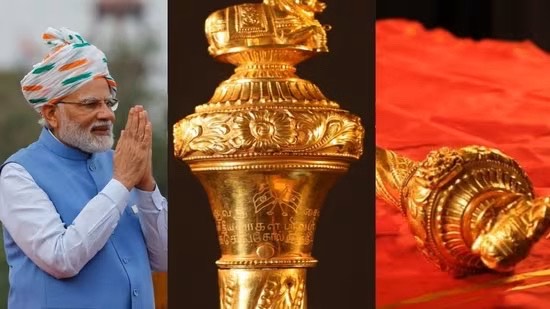
Something important is about to happen. On May 28, Prime Minister Narendra Modi will launch India’s new parliament building. A long-standing custom will be restored on this day when the traditional Tamil sceptre, known as “Sengol,” is positioned in the new legislature. A custom that was lost, a portion of the rich Hindu heritage that was hidden, avoided, dismissed, and humiliated.
The golden sceptre, which was valued at roughly Rs. 15000 at the time of Indian independence, is embellished with gems. The sceptre’s pinnacle is proudly occupied by Nandi, Lord Shiva’s bull vahana and protector who represents justice. The Sengol, a 5-foot-long work of Indian art with exquisite craftsmanship from top to bottom, is a masterpiece. The Sengol will be ceremoniously brought to the House in a large procession during the opening of the new Parliament building. The event is expected to be heavily rooted in Tamil heritage, evoking the long-gone customs of the Chola dynasty. Samayacharyas (spiritual leaders) traditionally presided over kings’ coronations and sanctified the transfer of authority, which is also seen as a form of acknowledgement for the ruler.
Pandit Nehru was consulted by Lord Mountbatten when it was decided that the British would cede control to the Indians. Lord Mountbatten wanted to know what cultural emblem should be chosen to symbolise the handover of sovereignty. Nehru, who was unsure as well, asked for some time to talk with others. He spoke with C Rajagopalachari about the issue. He read several books on history and told Jawaharlal Nehru about the Sengol.
The Sengol was then sent to Nehru by the leader of the Thiruvaduthurai Mutt, Sri La Sri Ambalavana Desika Swamigal, who accepted it to use as a symbol of power. The government had organised a special aeroplane for the seer to send a delegation carrying the sceptre. The Sengol that was passed down to Nehru was made of silver and had gold plating; the Adheenam had specifically requested this. This was made by Madras jeweller Vummidi Bangaru Chetty by hand. Therefore, it was a copy. However, the fact that the Chola tradition was being upheld makes it a divine Sengol that represents the Chola dynasty’s Hindu customs.

Jawaharlal Nehru, India’s first prime minister, accepted Sengol, the traditional sceptre from Tamil Nadu, to signify the handover of sovereignty from the British. This sceptre, however, was quickly forgotten and is now preserved as “Jawahar Lal Nehru’s golden walking stick” in a museum in Prayagraj. Nobody is certain how or why Nehru’s walking stick was maintained in a museum, but it now has a location in the new Parliament that is appropriate for its importance. However, when this revered historical representation of Hindu culture and kingship takes its proper position in the parliament, there are important concerns that we must confront. According to the information at hand, it doesn’t appear that we can definitively state that Congress did this on purpose. In essence, we cannot state with certainty that Congress wished to offend Hindu norms and, as a result, sent this Sengol to a political museum as a political figure’s walking staff.
But one has to wonder about Congress’ ingrained contempt for Hindu customs considering that it ruled for decades and was initially handed down to Jawaharlal Nehru. It must be remembered that Jawaharlal Nehru showed complete disregard—if not outright contempt—for Hindu customs and values.
The Indian army entered Junagarh on November 9, 1947, after the Nawab of Junagarh had fled to Pakistan on October 26, 1947. After the infamous rebellion, Sardar Patel landed in Junagarh on November 13, 1947, to a raucous welcome from the local populace. He had sworn to repair the crumbling Somnath Temple, which had suffered 17 attacks throughout its existence, the most horrific of which came from Islamic invaders. The decision to reconstruct the Somnath temple was approved in a cabinet meeting when Sardar Patel returned to Delhi, and it was decided that the state would shoulder the costs. MK Gandhi insisted that the people be asked to pay for it, which led to the decision being later reversed.
Sardar Patel’s soul left this world in 1950, and Gandhi passed away in 1948. After Sardar Patel passed away, KM Munshi, a cabinet member at the time and the head of the Trust’s advisory committee, was tasked with carrying out the mission of restoring the Somnath Temple. It is a well-known legend that Jawaharlal Nehru said to KM Munshi in 1951, “I don’t appreciate your trying to rehabilitate Somnath. Hindu revivalism is it. Nehru declined to attend the Bhumi Pujan of the Somnath Temple because he claimed to be the head of “secular” India, according to Congress’ own admission. After learning about Rajendra Prasad’s plans through a letter, Nehru opposed them when he got to the inaugural event. In response, President Prasad remarked, “I believe in my religion and cannot cut myself away from it.” The book “India: From Curzon To Nehru And After” by Durga Das described the aforementioned letter exchange.
Panikkar described his opposition to the idea of restoring temples that had been destroyed by Islamic invaders, saying that “no one could have any objections if an unauthorised Hindu society wished to repair that temple. Where does one stop even then? Will the Kutub Minar be demolished and the shrines restored using stones that originated from temples? Is it planned to demolish Aurangzeb’s tomb in Banares and rebuild Kashi Viswanath in all its former splendour? Where are we to stop if we begin on this Path? This mentality is the direct cause of RSS and the aim to bring back Hindupada padishahi in India. The association of some government officials with it caught me off guard, and I must admit that the notion that the President of India serves as the supreme yajaman of this obscurantist revivalism was a little unsettling.
The “Somnathists” were allegedly attempting to erase the period of Indian history following the Muslim conquest, according to the ambassador to China. “These are the actual founders of India of today, and regrettably, our “Somnathists” want to forget about them. I’m sorry to subject you to this, but I feel it is important for you to understand how some of us feel about this risky “revivalism,” which even seems to have influenced people who are directly connected to governments in the provinces and even at the centre.
The letter by Panikkar and the remarks by Nehru provide a clear explanation of how India became deracinated and brutally severed from her roots, as well as the reasons behind the sceptre’s forgetfulness, insult, and rejection. Some aspects of India’s recent political history are starkly apparent from Jawaharlal Nehru’s opinions on the Somnath Temple and the Pannikar letter. When India gained its independence, people who may have led a free India but were imprisoned by their intellectual shackles from colonialism and Abrahamism ruthlessly tortured, slaughtered, and buried Bharat. The idea that India must bury its proud, Hindu history to treat its people fairly, regardless of their collective numerical strength, stems from the British, who still have a Monarchy committed to the Church, forcing an ancient civilisation like India to adopt a skewed version of secularism that was later internalised by white-adjacent masters like Nehru.
This explains why Nehru was so adamantly opposed to the Somnath Mandir’s reconstruction. For this reason, Pannikar felt so ashamed to even mention people like the then-President who refused to forget their roots. The internalised preoccupation that historical atrocities, when spoken about or corrected, would deal a huge blow to the mistaken, inflated, and foreign pride that the Muslim population felt in the oppressive Mughal empire is another reason why Bharat’s great legacy had to be destroyed. You risk offending the Muslims who revel in Aurangzeb’s greatness if you take delight in the Hindavi Swaraj that Chhatrapati Shivaji Maharaj built or the splendour and bravery of Tarabai. You risk offending the Islamists who were converted by the Mughals and who take joy in destroying idolaters and temples if you bring up Ram Janmabhoomi. You run the risk of offending Mahmood Ghazni’s idolaters if you reconstruct Somnath.
The insult of the Sengol is also probably a result of the need to protect the sensibilities of individuals who revere Mahmood Ghazni. The Sengol was offered to Nehru by the leader of the Thiruvaduthurai Mutt, Sri La Sri Ambalavana Desika Swamigal, who accepted it to use as a symbol of power. The government had organised a special aeroplane for the seer to send a delegation carrying the sceptre. The Chola Dynasty’s Sengol is an enduring Hindu custom.
The Somnath attacks of Mahmud Ghazni were attempted to be minimised by blaming the Chola King, Rajendra I, who was a contemporary of Mahmud Ghazni. Romila Thapar has made repeated attempts to do this. However, it is clear and unavoidable that any Hindu traditions passed down by the Cholas would undermine Congress’ narrative. That notion has been comprehensively refuted in this essay by Swarajya.
It does not take much to draw the conclusion that the sceptre was insulted and hidden because of Congress’ complete disregard for Hindu history given that Nehru opposed the reconstruction of the Somnath Mandir and his trusted soldiers decades later denigrated the Chola King and cleared the Somnath Raids of Ghazni (by blaming the Chola Kind instead). The lies of Macaulay historians that the Cholas did not care much about Ghazni destroying the Somnath Temple because they were Kings from the South of India and did not necessarily fight for Temples at all would be destroyed by any acknowledgement of the proud Hindu history of the Cholas.
Think about this: Jawaharlal Nehru was aware of the ancient Hindu legacy that had been passed down to him. Nevertheless, he decided to walk with it instead. The Congress and its lackeys then decided to toss it into a museum, disparaging Bharatiya Sanskrit and the heavenly authority that came with the sceptre by referring to it as nothing more than Nehru’s walking stick. I assert that they did so because every object housed in a museum is thoroughly investigated, documented, and discussed. It is very difficult for me to imagine that those who placed the sceptre there were unaware of its complete history. The fact that Nehru used it as a walking staff, however, may have been more important to them than its identity.
In any case, many historians visited the museum after it was put there and many of them wrote about Nehru and the articles that were displayed there to tell the story of Chacha. How come, to date, none of them has raised concerns that the sceptre held significance to Hindu culture and wasn’t just a walking stick used by their favourite politician? Politicians asserting that Cholas had nothing to do with Hinduism and historians seeking to cover up Ghazni by blaming Rajendra I, the Chola King, were doing this while everyone else turned away and decided to insult the sceptre.
When history is lost, people’s awareness is also lost. You take away the sense of identity that they must possess, knowing that they are descended from great warriors who struggled to uphold the Dharma. You destroy their sense of pride in their heritage and their determination to protect a civilization that has been tenaciously defended against colonialism and Islamic invasion for decades. You destroy their courage to oppose neocolonialism and their desire to confront foreign threats. You are telling the Hindus of this area that the person holding the walking stick is the only one worth remembering and the person from whom your history originates when you convert a divine sceptre to an ornamental walking stick.
The Ram Setu must be razed, Congress said in court, even though Lord Ram was only a mythical character. In an affidavit submitted to the Supreme Court in the Sethusamudram project case in 2007, the government denied the existence of any artificial bridge connecting India and Sri Lanka and even questioned the existence of the Ramayana characters.
For Congress, history is meaningless. For Congress, heritage is meaningless. Hindus are irrelevant to Congress. Congress doesn’t care about the memories or conscience of our civilization. The only thing that matters to Congress is to demonstrate that their leaders were the pinnacle of our magnificent civilization and to do so, the divine sceptre that Nandi Baba sits atop must be turned into a walking cane.