


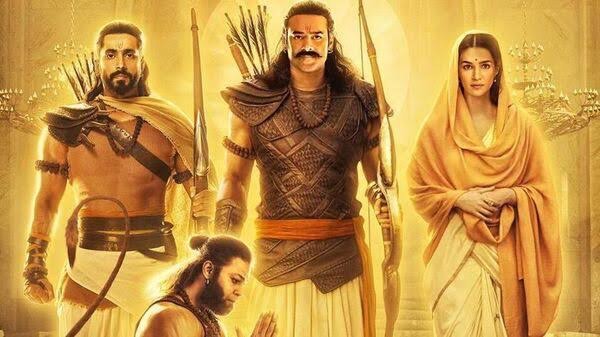
Adipurush is an appalling distortion of Valmiki Ji’s venerable Hindu Mahakavya Ramayana. Director Om Raut has delivered a horrific combination of video-gamified, distorted, and nonsensically jarring satire of the Ramayana, a sacred epic cherished by billions of Hindus worldwide, driven by personal ambition and ego. Without question, this misguided version will go down as one of the most appalling attempts to recreate the Ramayana. The final product is just as disgusting and awful as the movie’s depictions of Lanka’s demonic beasts.
The film provides sporadic, undeniable positive moments over its generally agonising 3-hour runtime. Its soundtrack and background score stand out among them without a doubt. The music temporarily improves the watching experience by inspiring a deep sense of pride and generating an exhilarating emotion, ranging from the soul-stirring chanting of “Jai Shri Ram Raja Ram” to the tremendous resonance of “Shivoham.”
There are a few powerful exchanges delivered by Kriti Sanon as Mata Janki, but other than those, there isn’t much else that is engaging to watch or hits the correct emotional notes with viewers. On the surface, it appears that the filmmakers have adhered to the Ramayana’s narrative from the scene in which Ravana kidnaps Jaanki through to Ravan’s Vadh. However, the film has heedlessly altered Valmiki Ji’s Ramayana to satisfy their whims and fancies. The plot jumps from one scene to another abruptly throughout the story, which suffers from a lack of strong links.
The movie “Adipurush” hardly explores subplots before hurriedly moving on without giving them enough time to grow or making links to the subsequent plot or main plot. Adipurush’s shallow handling of Brahma ji’s blessing to Ravana is a good illustration of this. The boon embraced everything and everyone except humans, but the movie falls short of delving further into its complexities. In his hubris, Ravana rejects the possible danger posed by common people because he incorrectly thinks they are powerless to hurt him, much less kill him.
In a similar vein, the movie entirely leaves out Raghav’s discovery of Maryada Purushottam Shri Ram’s discovery of Ravana’s fatal fault. No, Vibhishan doesn’t explicitly tell Raghav that Ravana’s nabhi (navel) is where the weakness lies. Raghav achieves enlightenment on his own and shoots an arrow at Ravana’s navel. In contrast to the typical narratives, Mata Sabri discovers Raghav in Adipurush rather than the other way around. She quickly commits self-immolation and changes into a celestial angel who directs Raghav in choosing his next course of action.
Regarding the obvious flaws, it is impossible to ignore Adipurush’s terrible VFX, disgusting attire, haircut, and offensive language. The number of actual people depicted in Adipurush may be counted on one hand. It’s interesting to note that Indrajeet’s tattooed appearance reminded me of a mermaid in water, however, this impression may only be my own.
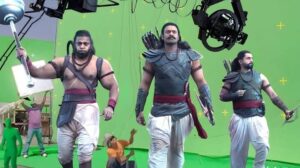
The lack of real human actors is conspicuous because the majority of the cast is made up of computer-generated images (CGI), which are wholly digitally crafted constructs.
The setting of the second half, which takes place in Lanka, is completely dark, emanating an aura of never-ending gloom. In Lanka during the day, hardly anything noteworthy occurs.
In addition, the animated characters are shoddy knockoffs assembled from Hollywood films to appeal to Gen Z audiences. This results in the worst possible “Marvelization” of the Ramayana. As Thor, the Norse God of Thunder, and Ravana share a remarkable resemblance, this is extremely problematic and even ludicrous. Ravana uses a potent blue light sword that is akin to a lightsaber in the Star Wars universe during several heated fight scenes and beyond. Thor’s hammer striking lightning and the blue light sword’s combined effects devastate Vanar Sena and render every character helpless.
Now, the colour blue represents tranquilly (Shitalta), peacefulness, and purity, much like the peaceful attributes embodied by water. Even in his hagiographic depictions, none of these traits can be assigned to Ravana, but Adipurush creators have. Raghav is said to have a reddish-orange colouring, which stands for fury, as opposed to Ravana.
Adipurush’s dialogues were reportedly penned by Manoj Muntashir, and this appears to be the actor’s poorest performance to date. The author appears to have made an effort to completely rewrite the Ramayana, ignoring the highly venerated names of our ancestors. There are no mentions of Prabhu Shri Ram, Mata Sita, Laxman ji, or Hanuman ji in Adipurush’s discourse.

Surprisingly, Prabhu Shri Ram’s name was omitted from the stones even though the renowned Ram Setu bridge was being built. An alternative term, “Jaha Raghav waha Vijay,” has been coined in place of the uplifting shouts of “Jai Shri Ram,” perhaps to make their aesthetic impression. When composing dialogue for Hindu Mahakavya like the Ramayana, numerous impolite exchanges shouldn’t have even been considered. It is shocking that these conversations ever made the final cut and were not removed by the Censor Board in light of the public’s sensibilities.
Characters like “Bete,” “Tere Baap ki Jali,” and “Bua ka Bagicha,” among others, speak in slang. I’ll share a couple of these exchanges with you so you can determine for yourself whether they merit comparison to the Hindu epic Ramayana or not.
“कपड़ा तेरे बाप का! तेल तेरे बाप का! जलेगी भी तेरे बाप की”
“तेरी बुआ का बगीचा है क्या जो हवा खाने चला आया”
“जो हमारी बहनों को हाथ लगाएंगे उनकी लंका लगा देंगे”
“आप अपने काल के लिए कालीन बिछा रहे हैं”
“मेरे एक सपोले ने तुम्हारे शेषनाग को लंबा कर दिया अभी तो पूरा पिटारा भरा पड़ा है”
This tacky tapori jargon looks to be nothing more than a last-ditch effort to appease spectators and a cheap ploy to win over a few applauses from a crowd hooked to Instagram videos. As was already established, the subplots’ text has been altered to give them a unique flavour. By prominently incorporating Prabhu Ram’s name or sticking to the original plot, it is unclear whether the authors were worried about possible plagiarism accusations from Valmiki Ji or Hindu worshippers.
Even the love between Shri Ram and Maa Sita suffered. It was subjected to the harsh treatment of Bollywoodization under Karan Johar. Raghav and Janki are simply there in a man-made natural setting that is constantly changing to display fictitious vegetation that is probably not found anywhere in India or even Sri Lanka. They don’t converse or exchange niceties. The interactions throughout the movie are noticeably shallow, with sparse verbal exchanges that feel hurried and little room for in-depth investigation. The scenes lack poise and tranquilly due to the lack of meaningful interactions, which also prevents them from capturing the quiet and depth that may have improved the whole experience.
Raghav, the main character in Adipurush, greatly deviates from the conventional depiction of Shri Ram in Hindu Janmanas and other narratives. Raghav is represented as lacking grace and charm rather than exhibiting the expected nobility. Maryada Purushottam Shri Ram is known for his elegance and serenity, yet Prabhas’ portrayal of him falls short of these traits. A glaring weakness in the portrayal is the lack of a cheerful and composed demeanour. The actor only seems fully composed and appropriately depicted during battles or other times of heightened intensity, suggesting that he has not been able to discard the remains of his Bahubali image. It’s crucial to remember that Shri Ram’s life consisted of much more than simply these brief outbursts of rage. He had a variety of qualities and experiences that, however, do not come through in the portrayal.
Since the majority of the characters were made using CGI/VFX, it was our fault for expecting precise facial expressions. However, even human figures have given very poor acting performances, including Vibhishan and Laxman Ji (Shesh in this instance). Ravana, in an ironic twist, has a fascinating character arc that oscillates between egotistical and crazy. Except for “flash-mood” Indrajeet, he is the tallest and most powerful figure in regular situations. Saif Ali Khan, as usual, displayed his distinctive gait both during the Ashok Vatica moment and at other times.
Here is a good illustration of the disrespectful treatment Hanuman Ji and others have received from Adipurush in numerous scenes. The dialogue between Bajrang and Shesh during Raghav and Shesh’s first contact with Bajrang (who isn’t even called Bajrang Bali) casts doubt on their relationship. Bajrang’s wisdom is called into question by the triviality and insignificance of the questions. Hanuman Ji, who is adored for conferring the blessings of Vidhya Buddhi (intellectual prowess), comes out in this presentation as being made fun of.
Bajrang and Raghav can instantly recognise one another after responding to Shesh’s aptitude tests, how? no justification at all. Raghav hugs Bajrang and adds, “Kya jaroorat thi is natak ki.” Bajrang also finds it amazing in several scenes to be in a hurry to finish things. The portrayal resembled Adi from Dhamal, who in self-pity wonders why I take offence in such circumstances.

Surprisingly, Shri Ram and his comrades don’t seem to have the expected prowess, and Hanuman Ji doesn’t seem to have the enormous power that is sometimes credited to him. In a simple combat sequence near the end, Indrajeet and Kumbhakarna easily defeat Bajrang, Raghav, Shesh, and Sugreev.
Adipurush also exhibits disrespect for the revered Rishis and Munnis. In contrast to the original account, where sages aid Prabhu Ram in his hunt for Maa Sita, they are absent from the movie. It is striking how few simple homes like Rishi’s kuti and tranquil hermitages there are. In their place, generic caverns are utilised, which detracts from the genuine ambience that these sacred places produce.
There is noticeably no mention of Nal or Neel, and neither the sacrifice of Jatayu nor the conversation between him and Raghav elicits any sort of emotional response. Raghav is seen nearby as Ravana kidnaps Janki, and Jatayu, who was supposed to die, informs him of the situation and directs him in the right direction. Together with Shesh, Raghav does nothing but flee like a helpless husband unable to save his wife. In one episode, Ravana crudely recites a portion of the Shiv Tandav Stotram.

There are notably few mentions of Ram ji making an invocation to Bhagwan Mahadev, doing any Puja, or engaging in religious rites. Another issue is that Ram Ji is portrayed as crying and looking up towards the sky during the struggle, perhaps asking for help from above.
Another change has been made that is utterly pointless. Pushpak Viman is changed into a living being, and not a pretty one either. Viman is fashioned like a bat, which Ravana feeds with a lot of flesh, producing a frightening sight. Ironically, this Pushpak Viman had to be tamed and restrained in one scenario since he wasn’t entirely under control in Lanka. Talking about the sets, costumes, and clothing is utterly pointless because the creators paid little attention to any of things. Ravana is dressed in T-shirts and Capes, and everyone is wearing leather armour. The island of Lanka is not made of gold; instead, it is black with golden linings. Almost every Sri Lankan, shape-shifter or not, got tattoos and eccentric hairstyles to give it a sassy appearance and make it “appealing.”
Adipurush is a horror all around. The filmmaker Om Raut presented a terrible porridge that should be avoided at all costs out of a desire for personal fame and artistic conceit that “I can redefine the Ramayana for Gen Z by altering it at will.” The movie could have worked well if it wasn’t marketed as Ramayana. If making money was the objective it will be fulfilled. But if the agenda was to recreate Ramayana, it has miserably failed.