


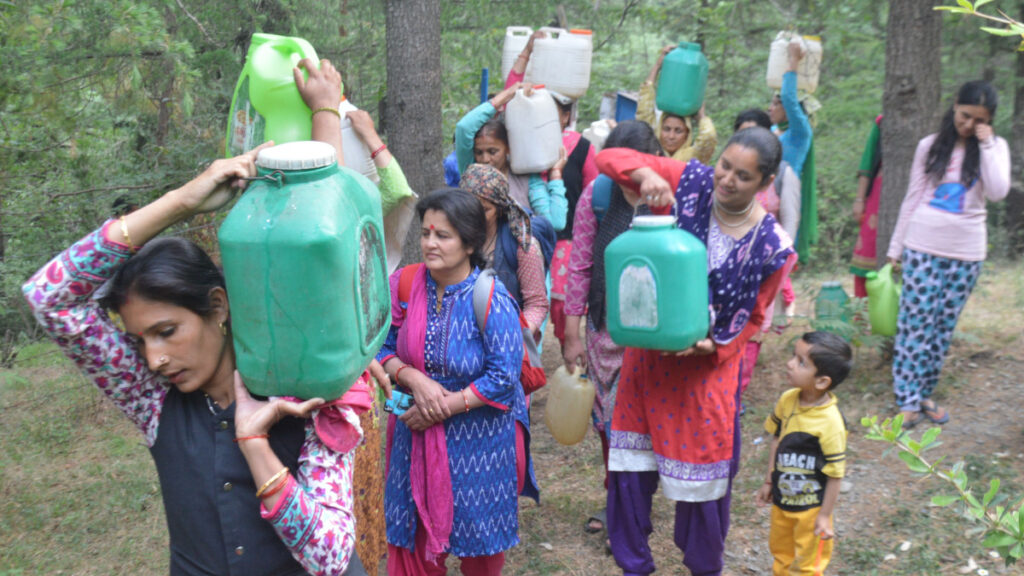
According to a major UN research released on Tuesday, India is predicted to be the country most badly impacted by the anticipated rise in the number of urban dwellers who would face water shortages from 933 million in 2016 to 1.7-2.4 billion by 2050.
Before to the UN 2023 Water Conference, the United Nations released the “Global Water Development Report 2023: Partnerships and Cooperation for Water,” which said that 80% of people who experienced water stress resided in Asia, particularly northeast China, India, and Pakistan.
According to data cited in the report, “the global urban population facing water scarcity is projected to increase from 933 million people (one third of the global urban population) in 2016 to 1.7-2.4 billion people (one third to nearly half of the global urban population) in 2050, with India projected to be the most severely affected.”
According to Audrey Azoulay, director-general of UNESCO, “it is necessary to build robust international structures to stop the global water catastrophe from spiralling out of control.” Water is our shared future, thus it is crucial that we work together to manage it responsibly and distribute it fairly. The survey showed that 3.6 billion people worldwide lack access to securely managed sanitary facilities, and two billion people do not have access to clean drinking water.
During a press conference held at UN Headquarters before to the report’s release, Richard Connor, the report’s editor-in-chief, warned reporters that “uncertainties are growing.”
He warned that “if we don’t solve it, there will absolutely be a worldwide catastrophe,” citing the increasing scarcity that results from decreased supply and greater demand, including urban and industrial expansion as well as agriculture, which alone uses 70% of the global supply.
In the report, UN Secretary General Antonio Guterres said that “Humanity depends on water for its survival. It is essential to life itself and promotes the wellbeing, adaptability, growth, and prosperity of both individuals and the planet.” Guterres expressed worry that mankind is heedlessly moving in a hazardous direction. The lifeblood of mankind is being drained drop by drop by vampire overconsumption, overdevelopment, unsustainable water usage, pollution, and unregulated global warming. The research, he said “reminds us that partnerships are essential to safeguarding and protecting this priceless resource for future generations. Developing and implementing practical solutions requires collaboration between governments, corporations, academics, civil society, and communities, especially indigenous groups, for the wise management and protection of the world’s water resources.” According to Guterres, the 2023 United Nations Water Conference, which will be the first important UN water conference in almost 50 years and a vital step towards achieving Sustainable Development Goal 6: clean water and sanitation for everyone, is a crucial time for collective development.
According to the paper, partnerships and collaboration are essential to integrated approaches to water management that span many important industries since water is a cross-cutting problem.
The intersection of food, energy, and water is crucial in a transboundary setting. The Mahakali Treaty (Pancheshwar Multipurpose Project), an agreement between India and Nepal that seeks to provide water and energy security for both countries, is one collaboration tackling this problem. Despite the Pancheshwar Multipurpose Project’s lengthy delays, it was noted that it had a number of positive effects on irrigation, flood management, and reducing energy shortages.
The study also made the point that partnerships that prioritise knowledge co-creation rather than knowledge transfer attempt to embrace the variety of knowledge systems’ skills and experience. This is especially important when talking about water.
“Many regions of the globe use traditional methods to manage their water resources. These methods range from very complex ones like ancient water planting and harvesting techniques to local expert knowledge on spring water availability and flood frequency (e.g. paar systems in western Rajasthan, India, and amunas in Peru). This may (and should) also take into account the expertise and experience of women, who often play a crucial role in managing water resources, particularly in rural areas “It read.
The report also mentioned that Google launched a flood forecasting initiative in 2018 as part of a crisis response programme that aims to offer reliable information and resources in dire situations. The initiative’s objective is to prevent catastrophic damage by arming those in danger with precise and thorough alerts.
It began by sending out 40 million possibly life-saving notifications in regions of India and Bangladesh with a combined population of 220 million people, in collaboration with the Indian Central Water Commission and the Bangladesh Water Development Board.
Earlier worldwide flood warnings merely gave information on the projected increase in river levels, which was not always useful to those at risk. These vital details are shown by Google’s flood warnings, which overlay the breadth and depth of probable flooding directly onto Google Maps.
The study, which was released by UNESCO, focuses on the twin themes of partnerships and collaboration and emphasises cooperative ways that players may join together to address shared difficulties.
Building relationships and working together, according to Connor, are essential to achieving the human right to water and resolving current issues. In describing the situation, he said that economic water scarcity is a major issue in areas where governments fail to give secure access, such in the centre of Africa, where water flows. The Middle East and northern India are two arid regions where physical scarcity is greatest.
Connor stated the crucial natural resource “tends to lead to peace and collaboration rather than to violence” in answer to inquiries about potential “water wars” in the wake of a worldwide catastrophe.
He said that 153 nations share roughly 900 rivers, lakes, and aquifer systems and that more than half have signed agreements, saying that strengthening transboundary cooperation is the primary instrument to prevent conflict and rising tensions.