


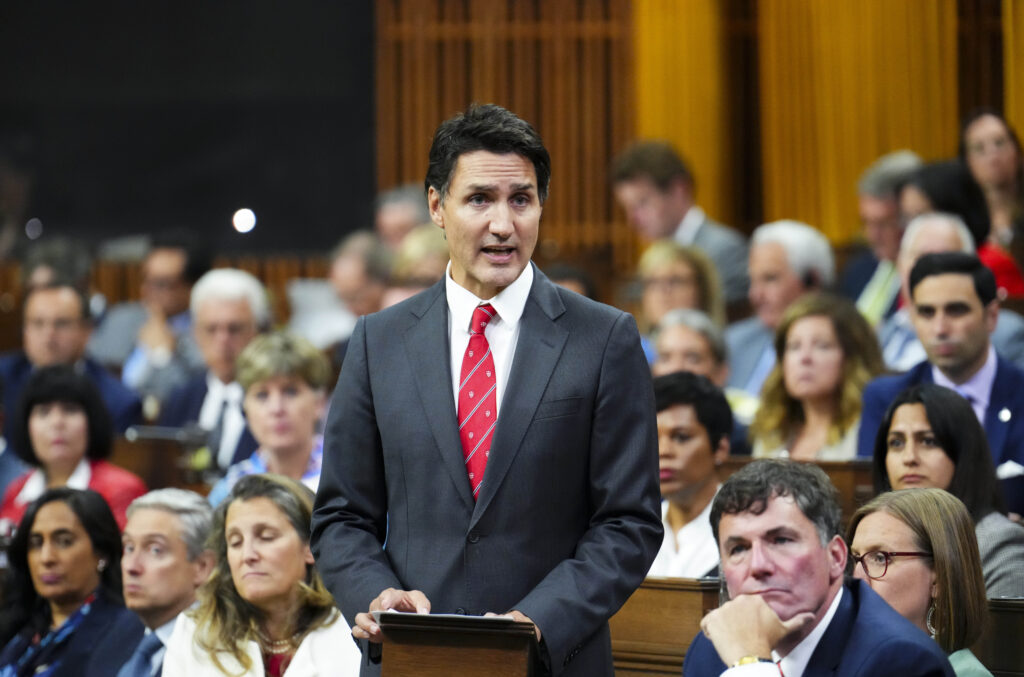
The Prime Minister of Canada, Justin Trudeau, has stated that Canada shared evidence with India “many weeks ago” suggesting that India may have been behind the killing of Khalistan separatist Hardeep Singh Nijjar on Canadian soil. The Prime Minister also expressed his desire for New Delhi to commit constructively with Ottawa to establish the facts in this “very serious matter.” However, Trudeau did not provide any further information on the material that he claims has been provided with India.
“Canada has informed India about the credible charges that were brought up in our conversation on Monday. That was completed a few months ago…We are keeping our fingers crossed that they will cooperate with us so that we can get to the bottom of this really important problem. That is very significant, he said on Friday at a news conference that he was co-hosting with the visiting President of Ukraine, Volodymyr Zelenskyy.
“And what we are asking is for India to commit constructively with Canada to establish the facts on this circumstance. ” “And what we are asking is for India to establish the facts on this scenario. We are there to collaborate with them in some way. In answer to a query, Prime Minister Trudeau said, “And we have been for weeks now.”
The Ministry of External Affairs (MEA) in New Delhi provided the following response when asked whether or not Canada had communicated any information on the issue with India: “No particular information has been supplied by Canada on this subject, either then or before or subsequently. We have, as you know, said before, or at least I believe that we have made it very clear, that we are prepared to look at any particular material. “We have made it plain to the Canadian side that we are happy to look into any particular material that is presented to us, and we have let them know that we have communicated this information to them. However, as of yet, we have not been provided with any information of this kind, the spokesperson for the MEA, Arindam Bagchi, said in New Delhi.
After Trudeau’s explosive charges of the “potential” participation of Indian operatives in the execution of Khalistani terrorist Nijjar on Canadian land on June 18, tensions erupted between India and Canada at the beginning of this week. Nijjar was killed on Canadian soil. The incident occurred in British Columbia.
Nijjar was officially labeled a terrorist by India in the year 2020.
In retaliation for Canada’s decision to remove an Indian official over the matter, India strongly dismissed the claims as “absurd” and “motivated” and expelled a senior Canadian diplomat in a move that was seen as a “tit-for-tat” action.
Trudeau has said that Canada is collaborating with its allies over the issue.
David Cohen, the US Ambassador to Canada, also acknowledged that Trudeau was briefed by “shared intelligence among Five Eyes partners” about the potential participation of Indian operatives in the death of Nijjar.
According to CTV News channel, this is the first acknowledgement made by any government official in the United States on the sharing of intelligence by Five Eyes allies with Canada, even though there have been several unofficial and non-official stories about the same thing.
The countries that make up the ‘Five Eyes’ network include the United States, the United Kingdom, Australia, Canada, and New Zealand. This network is an intelligence partnership. It uses surveillance as its primary method in addition to signals intelligence (SIGINT).
“He (Cohen) made this comment while denying a Washington Post report alleging that weeks before Trudeau’s bombshell declaration, Ottawa asked its closest allies, including the US, to publicly condemn the murder and that overture was rebuffed,” CTV stated. “He (Cohen) made this comment while denying a Washington Post report alleging that Ottawa asked its closest allies, including the US, to publicly condemn the murder.”
Cohen was cited as adding, “Very bluntly, I will say that — and you know me well enough — that I’m not in the habit of commenting on private diplomatic conversations,” and this is what he meant.
It was an issue of shared intelligence information, he said, and added: “There was a lot of communication between Canada and the United States about this, and I think that’s as far as I’m comfortable going,” Cohen said. “Look, I will say this was a matter of shared intelligence information,” he said.
The statements that Cohen made come at the same time that Secretary of State Antony Blinken stated that the United States is “deeply concerned” about the charges that Canadian Prime Minister Justin Trudeau has made against India. Blinken also said that the United States was “closely coordinating” with the government of Canada on the matter and that Washington wants there to be “accountability” in the situation.
At a news conference held on Friday in New York, Blinken said that the United States government has been in direct communication with the Indian government over the matter, and that the conclusion of this probe would be the most fruitful course of action.
“On this matter, we have been consulting with our Canadian colleagues throughout the entire process, and we have not just been consulting with them; we have been coordinating with them.” From our vantage point, it is really vital that the inquiry in Canada go forward, and we believe it would be very beneficial for India to collaborate with the Canadians on this probe. Blinken emphasized the significance of the probe being allowed to complete its task and provide the desired outcome. “We want to see accountability,” he added.
India has also said that it has extremely “specific evidence” about the illegal acts of persons headquartered in Canada and that this evidence has been provided with the authorities in Canada on a regular basis; yet, no action has been taken in response to this evidence.