


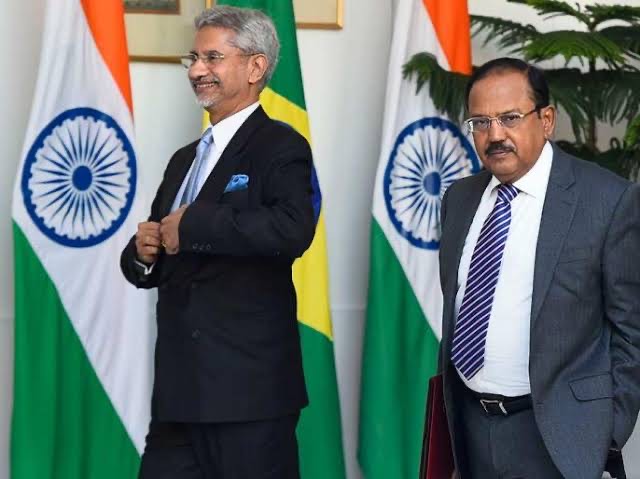
National Security Adviser (NSA) Ajit Doval visited an exhibition on Monday, January 24, which showed the violence and prejudice against minorities in Bangladesh, especially Hindus.
Additionally, Ajit Doval took part in a panel debate about “Bangladesh’s ongoing persecution of minorities.” His think tank, the Vivekananda International Foundation (VIF), organized both events.
The think tank said in a tweet, “The speakers opened the exhibition, and then the panel debate took center stage. Each speaker examined the socio-political and global aspects of the situation while offering critical insights into the past and present persecution of minorities in a Bangladesh that has become increasingly Islamized.
The presence of Shri Ajit Doval, KC, India’s National Security Advisor (NSA), was a major event highlight. India is deeply concerned about the situation of minorities in Bangladesh, as demonstrated by the NSA’s visit to the exhibition and participation in the panel discussion, VIF India noted.
A few days prior, External Affairs Minister S. Jaishankar had questioned Bangladesh on “ridiculous” claims made by the leaders of the interim government led by Muhammad Yunus.
“If someone in the interim administration accuses India of being to blame for everything every day, some of those accusations, if you read the reports, are utterly absurd. Even though you claim that “I would now like to have good relations with you,” I wake up every morning and hold you responsible for every mishap. “They have to make a decision,” he said, pointing out the doublespeak.
“They need to decide what sort of relationship they wish to have with New Delhi in the future. Bangladesh and we have a long history together. Since 1971, we have had a very special relationship with Bangladesh,” S. Jaishankar continued.
“Communal attacks on minorities are one of two aspects of the problem that our bilateral ties are facing,” he noted. The recent wave of attacks against minorities is extremely concerning for India. It affects how we think. We have to voice our opinions on it, and we have.
“The second factor is that they have their domestic politics, which you may or may not agree with, but ultimately, we are their neighbors, and they must decide how they want to view us,” S. Jaishankar said.
India is threatened by the interim government of Bangladesh.
When Sheikh Hasina was overthrown in an undemocratic manner, the interim government in Bangladesh had been acting antagonistically.
A senior advisor in Bangladesh’s interim government threatened the Indian government in October 2024, saying that Bangladesh would stage a “strong protest” if India attempted to block the extradition of former Prime Minister Sheikh Hasina. Asif Nazrul, a law consultant, asserted that India must abide by the extradition treaty’s requirements.
On Vijay Diwas (16 December 2024), a Bangladeshi Islamist known as Sarjis Alam, who gained notoriety during the “student protests” and the illegal overthrow of Sheikh Hasina, subtly threatened Prime Minister Modi.
Alam was heard stating, “I want to let Mr. Modi know that is not Gujarat,” during his speech. This is Bangladesh. His extremist supporters taunted him.
“Here, aggressive communalism does not flourish. “You can’t gain power here by killing people and spreading rumors,” he asserted.
The Islamist also allegedly threatened to “gouge the eyes out” of anyone who raised his eyebrows at Bangladesh, according to media sources.
Sarjis Alam had previously demanded the release of former Prime Minister Sheikh Hasina and threatened India on numerous occasions. The Islamist was appointed head organizer of the Jatiyo Nagorik Committee because of his anti-Indian comments.
Mahfuz Alam, an “adviser” to the interim government of Bangladesh led by Muhammad Yunus, threatened to seize India at about the same time.
A map of Bangladesh that extended far into the Indian states of West Bengal, Assam, and Tripura was uploaded by the Islamist. Later on, Mahfuz Alam realized that his candid acknowledgment of Bangladesh’s ominous geographical growth might cause diplomatic problems.
He subtly removed his post after expressing his dream of annexing India within two hours. Muhammad Yunus had previously used Mahfuz Alam as a “special assistant.”
Lt. Col. Golam Kibria, the commander of Border Guard Bangladesh (BGB), threatened India’s Border Security Force (BSF) in January of this year.
“All the forces are standing here with me. You locals don’t need to come here. I can chop down BSF to size by myself. In a video that went viral, he was heard asking, “Did I manage to make you understand?”
When necessary, the BGB commander said, he will ask the people to ambush the BSF. He said, “I will call the villagers to accompany me and cut down BSF to size when it becomes necessary.”
Attacks on Hindus in Bangladesh since Sheikh Hasina’s overthrow
Since Sheikh Hasina’s overthrow on August 5, 2024, OpIndia has been investigating and documenting instances of atrocities against Hindus.
Within three days of Dhaka’s collapse, there have been at least 205 attacks on Hindu temples, stores, and establishments.
As we previously revealed, Muslim students have compelled up to 60 Hindu professors, teachers, and government professionals to leave their jobs.
Asad Noor, an exiled Bangladeshi blogger and human rights activist, recently disclosed that the minority population is currently being forced to join “Jamaat-e-Islami.”
A procession of Hindu worshipers carrying the statue of Lord Ganesha was attacked on September 6 in the Kadam Mubarak neighborhood of Chittagong City, Bangladesh.
On September 25, a radical Muslim man named Yasin Mia defaced the idols of Goddess Durga and other Hindu deities in Gouripur town, which is located in the Mymensingh region of Bangladesh, ahead of the Durga Puja celebrations.
On September 28 and October 1, respectively, idols of Goddess Durga and other Hindu deities were vandalized at the Manikadi Palpara Barwari Puja Mandap and the Rishipara Barwari Puja Mandap in the most recent round of attacks.
The Sujanagar upazila in the Pabna district of Bangladesh’s Rajshahi Division was the site of the attacks. Five more Hindu idols were smashed in the Manikadi Palpara Barwari Puja Mandap, while four idols were vandalized at the Rishipara Barwari Puja Mandap.
At the Gopinath Jiur Akhara Durga Puja mandap in Kishoreganj, Dhaka Division, Bangladesh, seven idols of Hindu deities were demolished on October 3.
Police and law enforcement officials attacked the Hindu community in Hazari Goli, Chittagong, Bangladesh, on November 5.
In Patharghata, in Bangladesh’s Chittagong area, three temples were vandalized and Hindu minorities were attacked by a violent Muslim crowd on November 29.
The Shantaneshwari Matri Temple, the Shoni Temple, and the Shantaneshwari Kalibari Temple were among the Hindu holy sites that the Muslims targeted. It was the attack that happened right after Jumma Namaz ended.
A well-known Hindu journalist from Bangladesh’s Karwan Bazar, Munni Saha, was taken into custody by the police on November 30.
On December 13, 2024, a group of radicals assaulted the Mahashmashan Kali Mata Mandir, stole gold ornaments, and damaged seven idols of deities.
A Muslim man named Alal Uddin attempted to fabricate an alibi after damaging an idol at the Polashkanda Kali Temple on December 19. The incident took place in Haluaghat upazila, Mymensingh district’s Bangladesh.
Another 37-year-old Muslim man named Azharul damaged several god idols in Bangladesh’s Haluaghat Upazila, which is located in the Mymensingh region.
Systematic persecution under Muhammad Yunus’ interim government is highlighted by the recent arrest of Chinmoy Krishna Das Prabhu and his associates, attempts to abolish the Hindu organization ISKCON, and the use of “sedition” charges to quell Hindu rallies.
Attacks on Hindus have occurred on several occasions under the guise of “blasphemy.” Recent instances of targeted persecution include those of Hridoy Pal, Utsab Mandal, Partha Biswas Pintu, Akash Das, Pranta Talukder, and Utsab Kumar Gian.