


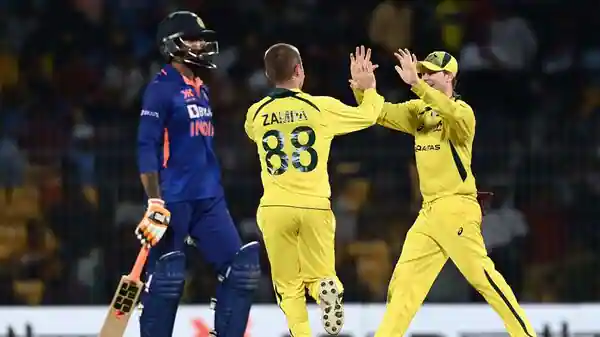
On this instance, the wicket made strokeplay simpler. Mitchell Starc also had a bad day. But, a team cannot expect to win if experienced batsmen lose their wickets and one of them consistently goes out to the first pitch he encounters.
Although having a solid position at one point, India was unable to get its way. At the MA Chidambaram Stadium in Chennai on Wednesday, India lost the last ODI against Australia by 21 runs after its set batsmen squandered their starts and Suryakumar Yadav was knocked for zero off the first ball for the third time in a row.
Australia won the toss and decided to bat first, but their score of 269 wasn’t anywhere close to being enough to win the game. They lacked a second tearaway pacer to assist Starc, but the spin tandem of Adam Zampa (4/45) and Ashton Agar (2/41) stepped up and masterfully took advantage of the circumstances to help Australia win the series 2-1.
It had been four years since India had lost a home bilateral series. Now it’s the gutsy Aussies again who ended India’s domination at home to become the top-ranked team in the ICC ODI rankings.
Starc, who was India’s primary tormentor in the first two ODIs, was unable to use swing because openers Shubman Gill and skipper Rohit Sharma had little trouble letting loose with their strokes. The opening pair left in rapid order after scoring 65 runs in nine overs.
KL Rahul, who was moved up to No. 4, and Virat Kohli then rotated the strike efficiently throughout their easygoing combination, aiding India in maintaining good control. That is, up until Rahul decided to take an unnecessary deep shot off of a Zampa pitch.
The decision by the Indian team management to place Axar Patel at No. 5 with the left-hand-right-hand combination in mind wasn’t a terrible one. When Australia began to regain momentum in the match, Axar was run out due to a misunderstanding with Kohli.
After a strong performance with the ball, Hardik Pandya demonstrated his proficiency with the bat as India began to reclaim control. At that point, Kohli threw it out.
When Agar pitched the ball in the proper places, the ball did grip off the surface. Even though he had hammered the left-arm spinner over extra cover for a six, Kohli wasn’t reading Agar very well. Yet, he struggled to perform that stroke when he attempted it again.
Kohli retried it despite the red flags, but he holed out to long-off this time. The arrival of Surya at No. 7 gave the Aussies even more cause for celebration as he was bowled off the very next ball.
The game-changing wickets came in Agar’s penultimate over, which was back-to-back. In response to his captain’s request, Zampa, a reliable performer against India, defeated both Pandya and Ravindra Jadeja with a flatter trajectory to account for both. India ultimately gave up for 248 with five balls remaining.
No Aussie could reach fifty points, with Mitchell Marsh (47) once again leading the way. Several of their hitters gave Kuldeep Yadav their wickets as well, but the Indian bowlers’ performance on this surface was worse.
When India tours the West Indies in August, they will play their subsequent ODI series. Before to that, the team management has to consider Surya’s position in the overall ODI plan rather than merely giving him “a longer run.” Three first-ball dismissals in a row do suggest technical issues, which Rohit and the team’s head coach Rahul Dravid need to comprehend.
Duck craze
The sixth Indian batsman to record three straight ODI ducks is Suryakumar Yadav. The others who have done so are Sachin Tendulkar (1994), Anil Kumble (1996), Zaheer Khan (2003–04), Ishant Sharma (2010–11), and Jasprit Bumrah (2017–2019).