


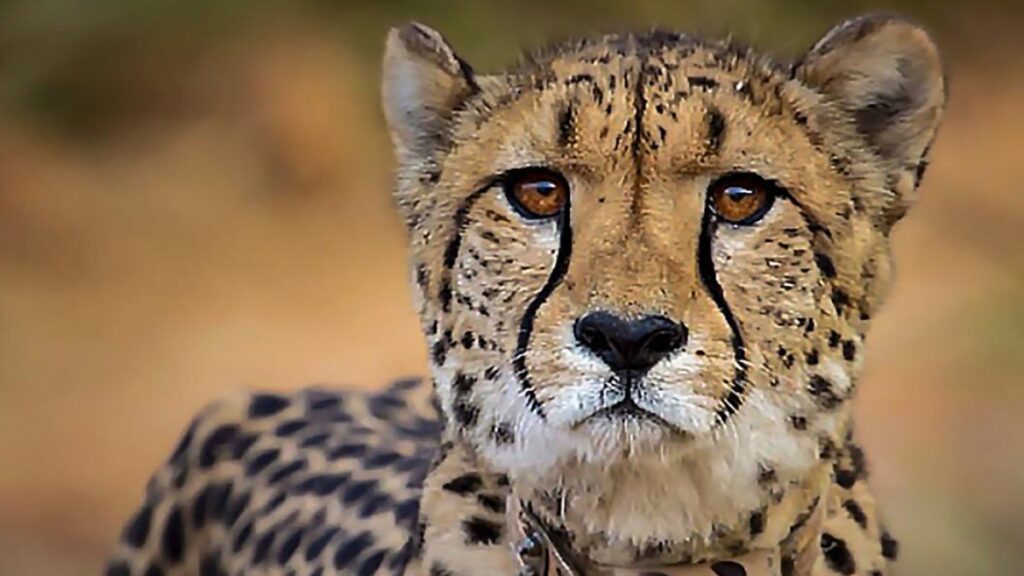
Five cheetahs—three females and two males—will be released from the acclimatisation camps into the Kuno National Park (KNP) in Madhya Pradesh before the start of the monsoon season in June, according to a statement from the Union Environment Ministry on Monday.
What was said by the ministry?
The ministry said in a statement that “five more cheetahs (three females and two males) will be released from the acclimatisation camps into free-roaming conditions in KNP before the beginning of the monsoon rains in June.”
During the monsoon season, animals are often not released into the wild because the severe weather makes it difficult for them to find food and shelter and adjust to their new surroundings.
The cheetahs will be let to leave KNP, according to the government, and won’t necessarily be “recaptured unless they venture into areas where they are in significant danger.”
According to a representative, “areas of significant danger” refer to areas outside of forests where the forest service lacks the necessary management infrastructure.
Four of the eight cheetahs imported from Namibia have already been let loose from their caged acclimatisation camps into the wild KNP landscape.
How will the situation be evaluated?
The choice was made after a study of the “Project Cheetah”‘s present situation by a group of specialists under the guidance of the National Tiger Conservation Authority (NTCA).
Amit Mallick, Inspector General of Forests, National Tiger Conservation Authority, Qamar Qureshi, Lead Scientist, Wildlife Institute of India, and Adrian Tordiffe, Veterinary Wildlife Specialist, University of Pretoria, South Africa, visited KNP on April 30 with a team that also included Vincent van der Merwe, Manager, Cheetah Metapopulation Project, South Africa, and Vincent van der Merwe, Lead Scientist, Wildlife Institute of India.
They said that every cheetah was in excellent physical shape, making kills on a regular basis, and acting naturally.
Based on their behaviours and approachability, the monitoring teams picked which cheetahs to release.
Throughout the monsoon season, the remaining cheetahs will stay in the acclimatisation camps.
The ministry said that “certain internal gates will be left open to allow these cheetahs to utilise more space and for interactions between particular males and females to occur.”
After the monsoon season, the situation will be evaluated, and further releases into KNP or the neighbouring regions will be scheduled in accordance with the Cheetah Conservation Action Plan in order to create meta populations, it stated.
The bulk of the five cheetahs, according to Qureshi, were imported from South Africa. India wants to release all of the cheetahs into the wild as soon as feasible.
If there is an opportunity to do so, we can do another evaluation before the monsoon and release additional cheetahs, he added.
The WII official said, “We are opting for staggered release of cheetahs because we want them to settle down and establish their region.
According to a statement from the ministry, of the four cheetahs that have previously been let free, two (Gaurav and Shaurya) have remained within the park and haven’t showed any interest in exploring the area beyond its boundaries.
Cheetahs scouting new areas
A female cheetah by the name of Aasha has made two exploratory trips east of KNP across the buffer zone, but she has stayed within the larger Kuno landscape and avoided regions where people are concentrated.
Pawan, another male, went on two excursions well beyond the park’s borders, travelling into fields close to the Uttar Pradesh border on the second trip. He was returned to an acclimatisation camp in KNP after being darted by the veterinary staff.
According to the ministry, cheetahs’ movements, like those of other big predators, are known to vary greatly in the first few months after being reintroduced to foreign open habitats.
These motions are unexpected and subject to a variety of influences. The cheetahs should develop their own communication networks and settle into rather stable home ranges over a period of time.
During this period, it is crucial that individual cheetahs do not completely isolate themselves from the reintroduced group because if they do, they won’t be able to reproduce and will become genetically isolated.
Once they have settled, their level of isolation will be evaluated, and the necessary steps will be done to improve their connectedness to the group.
According to a number of wildlife specialists, Project Cheetah underestimated the carrying capacity of KNP and connected this to the instances when Pawan wandered out into other parts of the national park.
The expert panel noted that unless suitable home ranges have been established, it is difficult to know with certainty the carrying capacity of cheetahs in KNP. They also noted that depending on prey density and a number of other variables, cheetah home ranges may greatly overlap.
“While many have made predictions about the anticipated carrying capacity of cheetahs in KNP based on other ecosystems in Namibia and east Africa, the actual number of animals that the reserve can accommodate can only be assessed after the animals are released and have established home ranges,” the statement read.
For obvious reasons, we do not currently have good spatial ecology data for cheetahs in India, according to the ministry. “Cheetah home-range sizes and population densities vary tremendously for different cheetah populations in Africa,” the ministry added.
Based on its current prey base, Kuno has the capacity to support up to 21 cheetahs, according to the cheetah restoration plan.
The number may increase to 40 people with repair, protection, and administration.
Kuno can manage 21 cheetahs, according to Qureshi, and “there is no second thought on that.”
On September 17, 2017, the day before his 72nd birthday, Prime Minister Narendra Modi released the first group of eight spotted cats from Namibia into a quarantine cage in Kuno in Madhya Pradesh as part of the ambitious Cheetah reintroduction effort. The group consisted of five females and three males.
On February 18, 12 cheetahs were flown in from South Africa and released into Kuno as part of a second similar translocation.
In March, Sasha, one of the Namibian cheetahs, passed away from a renal condition. On April 13, another cheetah from South Africa named Uday perished.
The ministry responded to the deaths of the two cheetahs by stating that chronic renal failure is a frequent issue among cheetahs and many other felid species kept in captivity, but it is not contagious and cannot be passed from one animal to another.
Uday was found to have most likely died of terminal cardio-pulmonary failure after a preliminary assessment.
According to the report, failure of the heart and lungs is typical in the last stages of many diseases but does not reveal much about the underlying source of the issue.