


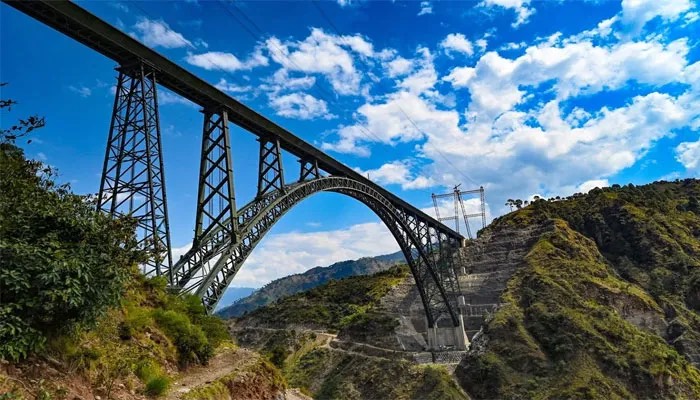
Railway Minister Ashwini Vaishnaw posted a video of a train trial run between Sangaldan and Reasi on June 16. This route, known as the Chenab Bridge, features the tallest Railway Bridge ever built and will soon be operational. In February of this year, Prime Minister Narendra Modi officially opened the bridge. The Chenab Bridge is the tallest single-arch railway bridge ever built, standing taller than the Eiffel Tower in Paris. The bridge is the largest civil engineering problem encountered in the history of any Indian railway project.
The bridge’s contract was granted in 2008 after it was approved in 2003. The engineers needed almost 20 years to find solutions to all of their problems, including ensuring the bridge’s stability and safety. The arch bridge connects Bakkal and Kauri in Jammu and Kashmir’s Reasi district. It will create a vital connection between Karta and Banihal. Remarkably, the bridge was supposed to be built by 2009, but there were several obstacles along the way. Its construction was put on hold in 2008 while the project was reassessed and changed. Only in 2009 did the railway authorities ultimately approve the new design; building could not begin until 2012. Although Northern Railway is responsible for the new railway line, Konkan Railway Corporation Ltd. served as the bridge’s executive agency and design consultant due to its track record of building railroads in difficult-to-access areas. Afcons Infrastructure, VSL India, and Ultra Construction & Engineering Company of South Korea formed a joint venture (JV) to construct the bridge, known as M/s Chenab Bridge Project Undertaking.
With a total height of 1,178 feet above the riverbed, the bridge is around 35 metres higher than Paris’s iconic Eiffel Tower. The Chenab Bridge became a reality because of the round-the-clock efforts of over 1,300 workers and 300 civil engineers. The bridge’s superstructure was finished in August 2022, after the base supports were finished in 2017.
The Rs 35,000 crore Udhampur-Srinagar-Baramulla Railway Link project includes the Chenab Bridge. The goal of this initiative is to improve connection throughout Jammu and Kashmir, including during inclement weather. The cost of the bridge alone is Rs 14,000 crore. The bridge only spans 1.3 km. It is an essential connection in the 111-kilometer route that runs from Katra to Banihal.
The steel arch design serves as one of the bridge’s primary structural components. The primary curvilinear arch is 17 spans long and 460 metres linear. To make sure the bridge stays safe and sturdy, the engineers conducted a variety of experiments, such as ones in extremely cold or hot conditions, earthquake-prone environments, and the effects of rising water levels. The bridge is anticipated to last for about 120 years. It is said to be able to resist gusts of up to 260 km/h.
The bridge can withstand earthquakes, and the construction of the arch alone took about three years. To build the arch, two cable cranes were erected on the Kauri and Bakkal ends of the Chenab River.
In addition to increasing traveller numbers, the bridge will facilitate Indian Army operations in the area. The Vande Bharat Metro train will cross this bridge between Jammu and Srinagar when the Udhampur-Srinagar-Baramulla Rail Link Project is completely operational.