


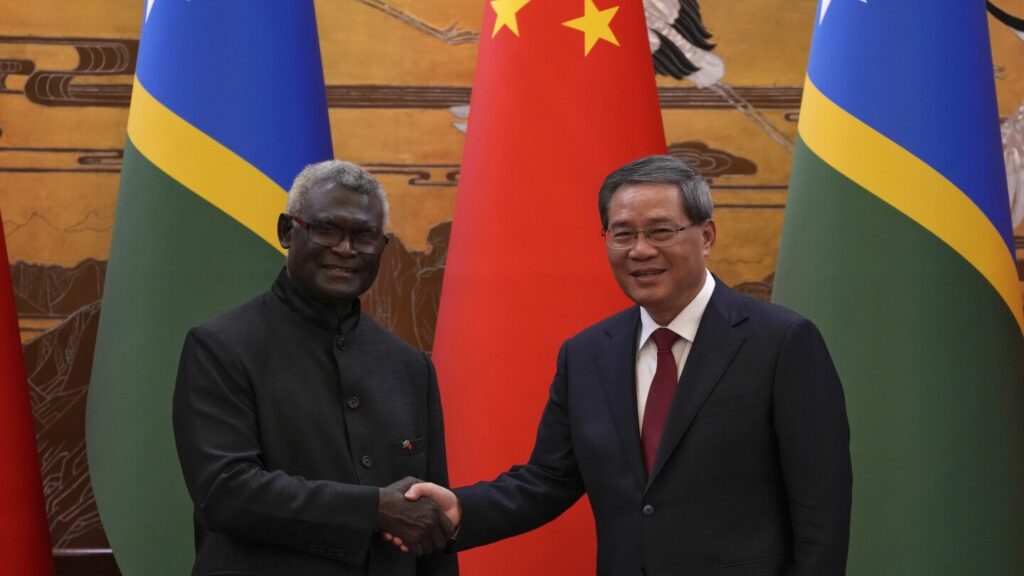
In a move that is certain to cause anxiety among the South Pacific island nation’s longtime allies, including Australia, New Zealand, and the United States, the Solomon Islands has signed an agreement to increase collaboration with China on “law enforcement and security matters.”
The agreement, the specifics of which were withheld for the time being, was included in a joint statement made public on Tuesday after a meeting between Chinese Premier Li Qiang and Prime Minister Manasseh Sogavare of the Solomon Islands on Monday in Beijing.
The parties decided to: “Intensify cooperation on law enforcement and security issues” as part of their attempts to forge a “comprehensive strategic partnership.” As required, the Chinese side will continue to support and assist the Solomon Islands in enhancing their capability for law enforcement.
The Solomon Islands, which are 1,200 miles (2,000 km) northeast of Australia, have been China’s largest achievement in an effort to increase its influence in the South Pacific. In 2019, Sogavare’s administration officially transferred its allegiance from Taiwan, the self-governing island democracy that China claims as part of its territory, to Beijing.
A covert security pact that the Solomon Islands made with Beijing in 2022 may have permitted Chinese military presence in the South Pacific. Sogavare, though, denied claims that his administration may provide Beijing a military footing in the area.
Kiribati, an island country nearby, shifted its diplomatic ties to Beijing in 2019.
China has previously sent replica firearms, riot control tools including water cannon trucks, and police training to the Solomon Islands. The Solomon Islands, a nation of 700,000 people made up of six large and around 900 smaller islands, have had times of racial unrest, and Australia, New Zealand, and other Pacific island governments have sent soldiers to assist put things right.
The US has promised to restore an embassy in Honiara, the country’s capital, as a result of Sogavare’s improving ties with Beijing. Additionally, the US and its allies have strengthened its involvement with the area as a whole.
In order to announce a plan that encompassed collaboration on climate change, marine security, and avoiding overfishing, Biden called a meeting of Pacific Island leaders in September. Additionally, over the next ten years, his government has committed to provide $810 million in additional assistance to Pacific Island countries, including $130 million to combat the impacts of climate change.
In a joint statement following their Monday meeting, Sogavare and Xi Jinping, the president and leader of the ruling Communist Party, mentioned their “high-quality” cooperation on Xi’s “Belt and Road” initiative, which aims to construct ports, highways, power plants, and other infrastructure using Chinese loans.
For nations without access to alternative sources of funding, the infrastructure initiative has delivered measurable but not necessarily useful effects, but it has also left many beneficiaries heavily indebted to China with little hope of repayment.
Exim Bank of China has already agreed to lend the Solomon Islands $66 million so that they may install 161 mobile towers that will be managed and built by Huawei, a major Chinese telecom company. A contract for an undersea communications cable network, partially financed by Australia, was given to Huawei by the Solomon Islands in 2018. In order for the islands to host the Pacific Island Games in 2023, China is also constructing infrastructure.
In what his detractors have dubbed a power grab, Sogavare has often signed such agreements in the face of fierce internal opposition and has maintained his position by postponing elections.
The Solomon Islands said in the joint statement that it was against Taiwanese independence and that it backed China’s stances on Tibet, Xinjiang, Hong Kong, and other locations where China is condemned for alleged human rights abuses. Additionally, the statement advised nations to “handle matters like the discharge of nuclear-contaminated water and cooperation on nuclear submarine” with caution.
That was a reference to both the Biden administration’s agreement with Australia and Britain, known by the acronym AUKUS, to provide the first with nuclear-powered submarines in response to China’s quick military buildup, as well as Japan’s plan to discharge treated but still marginally radioactive wastewater into the sea, which China has strongly criticised.