


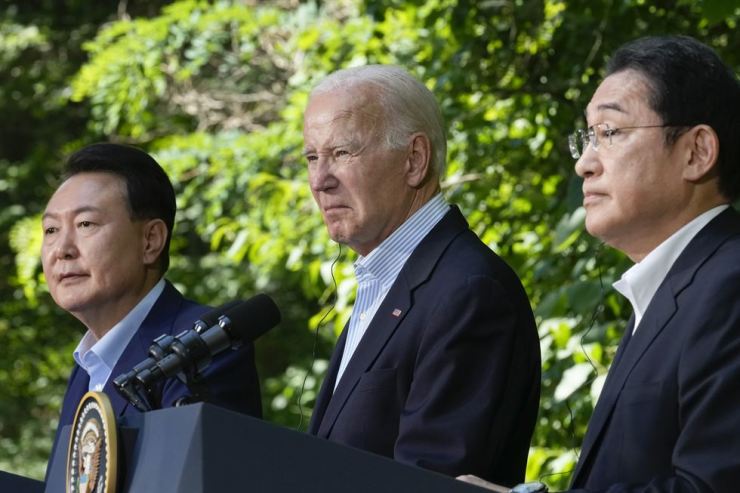
P, in a joint statement released on Friday, denounced China’s “dangerous and aggressive behavior” and voiced serious opposition to any efforts to alter the Indo-Pacific situation.
A joint statement titled “The Spirit of Camp David” was made during the first-ever trilateral summit between the three nations, which was held in the US, and it expressed support for their shared partnership.
The statement stated, “We believe our trilateral partnership advances the security and prosperity of all of our people, the region, and the world. Japan, the Republic of Korea, and the United States are determined to align our collective efforts.”
The three countries committed to deepening their bilateral ties and boosting their common goals for the Indo-Pacific region and beyond to new heights.
“We will support the free and open international order based on the rule of law, improve regional and global peace and security, notably as current and incoming members of the United Nations Security Council (UNSC), and offer resilience and prosperity. We shall improve the way we work together to advance democracy and defend human rights. Additionally, we will strengthen the US-Japan and US-ROK allies’ strategic coordination and advance our trilateral security cooperation, according to the joint declaration.
The US, Japan, and South Korea also expressed their concerns about China’s support for illegitimate maritime claims in the South China Sea in a joint statement, as well as their vehement opposition to Beijing’s unilateral actions that would alter the current situation in the Indo-Pacific waters.
“We are both concerned about acts that threaten regional peace and development and violate the rules-based international order. We strongly oppose any unilateral attempts to change the status quo in the waters of the Indo-Pacific, recalling the positions that each of our nations have previously made public regarding the risky and aggressive behavior that the People’s Republic of China (PRC) has recently displayed in support of unlawful maritime claims in the South China Sea.
They also voiced opposition to coercive actions, the militarization of reclaimed features, and the risky deployment of coast guard and marine militia boats. They also raised worry about unreported and uncontrolled fishing that is unlawful and unreported.
The three nations reaffirmed their commitment to maintaining peace and stability in the Taiwan Strait, reiterating that their fundamental stances on Taiwan have not changed, and they urged for peaceful solutions to any issues that may arise across the Strait.
“We affirm our steadfast adherence to international law, which includes the freedom of overflight and navigation as reflected in the UN Convention on the Law of the Sea (UNCLOS).” The legal framework for the amicable settlement of maritime disputes between the parties to that arbitration is laid out in the South China Sea arbitration ruling from July 2016. We reiterate the critical role that stability and peace across the Taiwan Strait play in ensuring global security and prosperity. Our fundamental stances on Taiwan have not changed, and we continue to push for a peaceful settlement of any cross-Strait disputes, according to the joint statement.
They also announced the first trilateral meeting of the finance ministers and the beginning of a new track for the ministers of trade and industry, which would meet once a year. In order to coordinate the application of Indo-Pacific strategies and to continuously discover new areas for mutual action, a trilateral Indo-Pacific dialogue will be established on an annual basis.
The three nations reaffirmed their commitment to collaborating closely with ASEAN partners to ensure the strong implementation and mainstreaming of the ASEAN Outlook on the Indo-Pacific and expressed support for the ASEAN-led regional architecture.
In line with pertinent UNSC resolutions, the US, Japan, and South Korea also reiterated their support for North Korea’s commitment to “complete denuclearization” and encouraged Pyongyang to give up its nuclear and ballistic missile programs.
“Furthermore, we reaffirm our commitment to the Democratic People’s Republic of Korea’s (DPRK) complete denuclearization in accordance with pertinent UNSC resolutions and implore the DPRK to give up its nuclear and ballistic missile programs,” the statement said. We demand that all UN members fully carry out all pertinent UNSC decisions. We vehemently condemn the DPRK’s record-breaking number of ballistic missile launches, including several intercontinental ballistic missile (ICBM) launches, as well as its conventional military activities, which constitute a serious danger to peace and security on the Korean Peninsula and beyond, according to the statement.
The three nations stated that in addition to their security relationship, they will continue to concentrate on establishing strong partnerships in the areas of technology and economic security.
“We are steadfastly dedicated to removing obstacles to economic participation and establishing varied, open, and inclusive economies where all of our citizens, especially women and excluded groups, may prosper. The joint statement said, “We will seek to further develop our people-to-people relations, particularly among our young people and students.
The three nations leave Camp David with a “shared resolve and optimism for the future,” they said, adding the trilateral summit ushers in a “new chapter” in their ties.
“We proclaim that our trilateral partnership has entered a new chapter today. The statement continued, “We are unified in our vision, unflinching in the face of the biggest problems of our time, and, most importantly, united in our conviction that Japan, the Republic of Korea, and the unified States can address those difficulties together, now and in the future.