


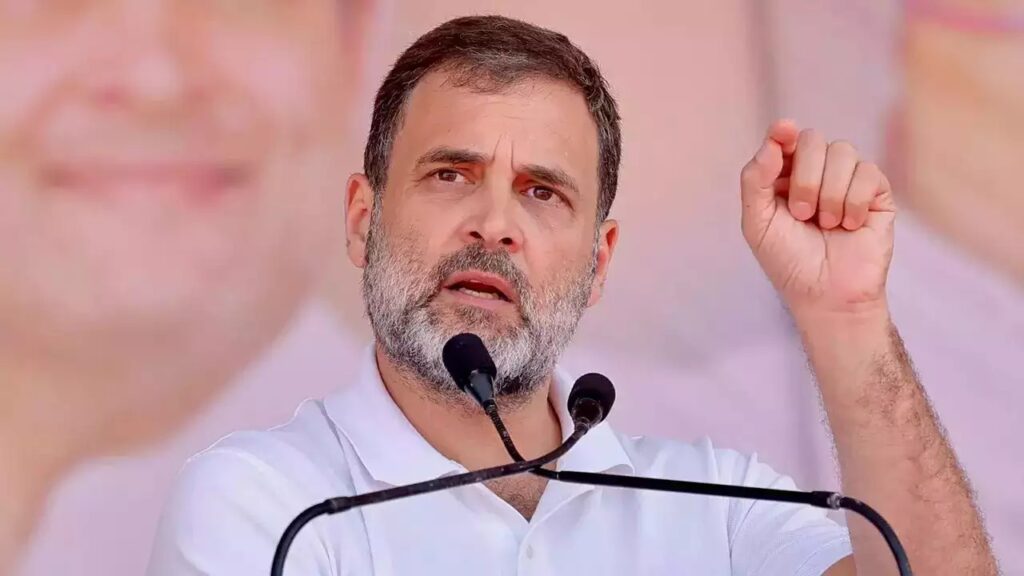
New Delhi: The Election Commission of India has been ordered by the Delhi High Court to take legal action against Congress MP Rahul Gandhi for referring to Prime Minister Narendra Modi, Home Minister Amit Shah, and billionaire Gautam Adani as “pickpockets.” The court granted the constitutional body eight weeks to take appropriate measures, noting that the utterances were not in good taste.
“Even if the remarks are offensive, the court would prefer not to delay the case while the ECI handles it. The court said in the ruling that “the same is disposed of.”
After learning that Gandhi had not responded to a notification from ECI dated November 23, which said that action would be taken against him if he did not react by November 26, the court ordered action against him.
However, the court did not say what the election panel had to do to punish Gandhi.
What was the notice that the Election Commission had sent to Rahul Gandhi?
Regarding Gandhi’s “penalty and pickpocket” remarks directed against Prime Minister Modi, the Election Commission sent him a show-cause notice on November 23 of last month. Additionally, it had requested that he reply by November 26.
The use of such words by a “very senior leader” was deemed “unbecoming” by the BJP.
Gandhi was reminded by the EC in its notice that leaders were not permitted to level unsubstantiated accusations against their opponents in accordance with the Model Code of Conduct.
The BJP said that Gandhi’s claim that its administration gave businessmen ₹14,00,000 crore in waivers was not “borne out of facts” in its case to the Election Commission.
According to the Election Commission’s notification, the term “panauti” ex-facie is covered by the Representation of the People Act’s section 123, which prohibits corrupt activities.
Gandhi was reminded in the notice that anyone who attempts to or actually does induce a candidate or elector to believe that he or anyone in whom he has an interest will become the object of divine displeasure or spiritual censure, will be deemed to be interfering with that candidate’s or elector’s freedom to exercise their right to vote. This is stated in clause 2, subsection (ii) of section 123.
The Election Commission had cited in its notification the Supreme Court’s ruling that the right to reputation was deemed an essential component of the Article 21-protected right to life.
As a result, the commission is requesting that you respond to the complaint made and explain why appropriate action has not been taken in response to the alleged breach of the Model Code of Conduct and applicable criminal laws. Your response, if any, will be received by November 25 at 6:00 p.m. The notification also said that the commission would take appropriate measures if no response is received by that date.