


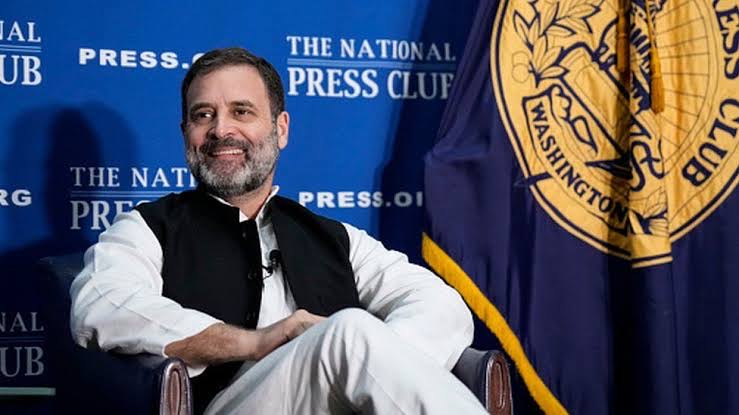
Rahul Gandhi is visiting three American cities during a 10-day tour. He addressed the Indian diaspora in New York during the final stage of his tour, making several absurd claims. Rahul Gandhi made false statements about India’s history, democracy, and leaders, continuing the theme of his tours overseas. He also disparaged India and the Indian government. One of the first things he tried to say in his speech was that the RSS and BJP (a euphemism for all Hindus who refuse to vote for the Congress party) follow the ideals of Nathuram Godse, the assassin of MK Gandhi, while the Congress party upholds the principles of Mahatma Gandhi.
According to Rahul Gandhi, the ideological conflict in India is between Nathuram Godse, who represents the BJP and RSS, and Mahatma Gandhi, who represents the Congress. The ‘Father of the Nation, Mahatma Gandhi’, he continued, shared the same values and ideologies with the Congress. “The philosophy we adhere to is that of Mahatma Gandhi, an NRI who was benevolent and unassuming and who spent his life seeking the truth. The ideology of Nathuram Godse, a violent and irate guy unable to face the truth of his existence, is what the BJP and RSS adhere to, Rahul asserted.
Rahul Gandhi referred to MK Gandhi as an NRI and claimed that the reason MK Gandhi was shot was that the shooter was unable to deal with his own life and needed to vent his rage on someone else. He decided to vent his rage on the man who personified India as a whole. Gandhi was a forward-thinking, contemporary, and tolerant figure, while Godse exclusively discussed the past and never discussed the future. He was enraged and hostile. He was terrified. He was a coward at his core and was unable to manage his life. On the other hand, Gandhi ji confronted a superpower, the strongest force on earth, and he did it because he was humble.
You are all carrying on the traditions of Sardar Patel, Ambedkar, Gandhi, and Nehru. ‘Jai Bhim’ was the way he closed this brief rant. Interestingly, Rahul Gandhi represents what someone without common sense or an honest understanding of history would say. Rahul Gandhi forgets BR Ambedkar’s critique of MK Gandhi when concluding with “Jai Bhim.” BR Ambedkar stated in one of his works that “theft and dishonesty are the weapons of the weak. Gandhi has consistently employed these tools. He said, “He went to the Moslems and informed them that if they, in turn, opposed the demands made by the representatives of the Depressed Classes, he would support their 14 demands. Even a scoundrel wouldn’t have carried out this deed. This is just one example of Gandhi’s deceit.
Additionally, Dr Ambedkar stated in the same essay that Gandhiji’s dishonest actions were to blame for the animosity between Hindus and Muslims. I was incredibly hurt by this. ‘God’s name on the lips and a dagger under the armpit,’ goes an old proverb that is appropriate for the situation (Bagal mein chhurri Munh mein Ram). By all means, refer to Gandhi as a Mahatma if such a person qualifies. The politics of Savarkar and Tilak were founded on honesty and truth, he said. It wasn’t raucous and hollow. Gandhi’s politics, however, are bombastic and hollow. It is the most dishonest political campaign in Indian political history. Gandhi was the torchbearer of removing morality from politics and replacing it with capitalism in Indian politics. Politics no longer possess any virtue.
Fascinatingly, Ambedkar compared Veer Savarkar to Tilak, a towering Congress leader who led the party before MK Gandhi and Jawaharlal Nehru took control, calling Savarkar’s politics honest and truthful while Congress and Rahul Gandhi have repeatedly disparaged Veer Savarkar. Unfortunately for Rahul Gandhi, political statements by the uninformed can rarely capture the complexity of history. While it is undeniable that each person, including M.K. Gandhi, played a part in helping India gain its freedom, turning this into a conflict of ideologies between Gandhi and Godse ignores the nuances of history that policymakers should pay attention to prevent future generations from making the same mistakes.
In this essay and numerous of his previous writings, BR Ambedkar explicitly blamed MK Gandhi for the animosity between Hindus and Muslims. In his book “Pakistan or Partition of India,” BR Ambedkar went into great detail about how MK Gandhi’s misguided beliefs caused the genocidal slaughter of Hindus and the enduring hostility between the two communities. In his book, Ambedkar stated, “The (Khilafat) movement was begun by the Mohammedans. It eventually resulted in the extermination of Hindus. Gandhi took it up with perseverance and faith, which may have shocked many Mohammedans. Gandhi was discouraged from participating in the movement since so many people questioned the movement’s moral foundation and its ethical viability. Pages 146–147 of Pakistan or the Partition of India. The statement by Ambedkar continued, “On the contrary, his misguided zeal for Swaraj and his obsession with Hindu-Muslim unity, as the only means of achieving it, led him to support the project.” Pages 144–145 of Pakistan or the Partition of India.
Various passages from BR Ambedkar’s book attacked Gandhi for sacrificing Hindu lives in the name of his fanciful goals. He stated, about the 1921 massacre of Hindus in Malabar, “Mr Gandhi has never spoken against such crimes. In addition to the fact that Muslims have not condemned these atrocities, even Mr Gandhi has never urged prominent Muslims to do so. Over them, he has remained mute. Such a mindset can only be explained by the fact that Mr Gandhi was keen to maintain Hindu-Muslim unity and did not care if a few Hindus were killed if it meant sacrificing their lives. Page 147 of Pakistan or the Partition of India. He continued that Malabar has taught us what current Islamic control entails, and we do not want to see another example of the Khilafat Raj in India. The defences offered for the Moplas by their fellow believers and by Mr Gandhi himself, who claimed that they had acted as they believed their religion had taught them to, have demonstrated how much compassion for the Moplas is felt by Muslims outside of Malabar.
We should fear that is true, but there is no place in a civilised country for people who think their religion forbids them from killing, robbing, raping, setting on fire, or expelling those who refuse to abandon their ancestors’ faiths, save in its schools, under strict watch, or in its objectives. Ambedkar added that the Malabar slaughter was a too-high a price to pay for unity. A wave of horror had spread among Hindus of all stripes throughout Southern India, which was heightened when some Khilafat leaders made the foolish decision to pass resolutions congratulating the Moplahs on their valiant fight for religious freedom. Anyone may have claimed that the cost would have prevented Hindu and Muslim harmony. However, Mr Gandhi was so preoccupied with the need to forge Hindu-Muslim unity that he was willing to downplay the actions of the Moplahs and the Khilafats who were praising them. The Moplahs, in his words, are the “brave God-fearing Moplahs who were fighting for what they consider to be religion and in a manner which they consider to be religious.” Pages 147 and 148 of Pakistan or the Partition of India.
One may write a thesis on what BR Ambedkar genuinely thought about MK Gandhi and how he believed Gandhi had condemned India for all time by caving to the Muslim population, which at the time was perpetrating serious crimes against Hindus. Therefore, if one were to honestly assess history, one would see that, despite the divergent pathways, BR Ambedkar’s views on Hindu-Muslim unity, the plight of Hindus, and MK Gandhi’s involvement in that plight were more in line with Nathuram Godse’s than with MK Gandhi’s purported objectives. Of course, it is important to emphasise that no one with a rational mind could support Godse’s actions or the murder of MK Gandhi. However, it is rhetorical and a serious historical mistake to claim that Godse murdered Gandhi because he was unable to confront his mortality.
In his testimony in court after killing Gandhi, Nathuram Godse went into great detail about his motivations. He discussed Gandhi’s nonviolent principles of extremism, his role in the extermination of Hindus, and other topics. To assume that the majority of mankind is or can ever become capable of rigorous adherence to these lofty values in its everyday life from day to day is a mere dream, according to Godse in his speech in paragraph 56. “I could never imagine that an armed resistance to the aggressor is unjust,” he continues. I shall view it as my religious and moral obligation to oppose and, if at all possible, subdue such an adversary through force. In his plea, Godse quotes Gandhi as saying that Hindus should accept their fate at the hands of Muslims who were slaughtering them openly. Gandhi was expressly quoted by Godse as saying that Hindus should never be upset with Muslims, even if those Muslims decide to end even their existence. Gandhiji stated after the partition, about the persecution of Hindus in Pakistan, “I asked them why they all came here (to Delhi).” Why did they not perish there? If we are killed, let us do it fearlessly and with the name of God on our lips. Ironically, Gandhiji’s God frequently commanded him to battle whenever the standard of righteousness fell.
Additionally, he implied that Hindus had benefited from the murder of Hindus in Pakistan since “the killers were none other than our Muslim brothers.” Similar remarks were made to the West Punjabi Hindu refugees, who were urged to return home even if it meant their deaths. Gandhi’s nonviolence is therefore not only misguided, extreme, and out of step with Hindu traditions, but it is also unfairly limited to situations in which Hindus are the targets of communal violence. Godse essentially believed that MK Gandhi’s non-violent principles were a farce that ultimately led to Hindus dying at the hands of Muslims, that he had watched as Hindus were killed and done nothing, begging Hindus to die at the hands of Muslims for the sake of unity, and that India was a distressed, bloody land as a result of Gandhi’s decisions. Since nobody in their right mind would support the political assassination in 2023, it may be impossible to comprehend the scope of the bloodbath that prompted Godse to kill Gandhi.
However, if one compares and contrasts Godse’s and BR Ambedkar’s criticisms of Gandhi, they have a lot more in common than not. Having said that, it would be negligent to ignore how Godse’s acts doomed Hindus for all time. Rahul Gandhi and others have indeed used the bullet-riddled body of Gandhi to demonise anyone who advocates for Hindu rights. By discussing Godse, Gandhi’s killing, and the factors that contributed to it, even an honest assessment of his legacy has become taboo. If Godse hadn’t killed Gandhi, the world would have seen Gandhi’s flaws and the validity of the opinions of many other leaders, including BR Ambedkar and other Hindu leaders.
Rahul Gandhi’s celebration of BR Ambedkar and denunciation of the “ideology” of Godse, however, is a reduction of history that only serves political goals. Godse condemned Hindus and polluted the possibility of an honest interpretation of history. In essence, Rahul Gandhi may argue that, within that narrow spectrum, the conflict is between the ideals of BR Ambedkar and Gandhi, but that would not fit with his “Jai Bhim” politics. Instead, he should stick to quoting Godse and Gandhi. Additionally, despite Rahul Gandhi’s assertion that Nathuram Godse only considered the past, the real cause for his assassination of Gandhi was the hardship of Hindus in the present, motives that were comparable to BR Ambedkar’s criticism of Gandhi. India needs an honest assessment of historical errors. Rahul Gandhi’s speech severely undermines these efforts and needs to be exposed for what it is: a perversion of India, her past, and her future objectives.