


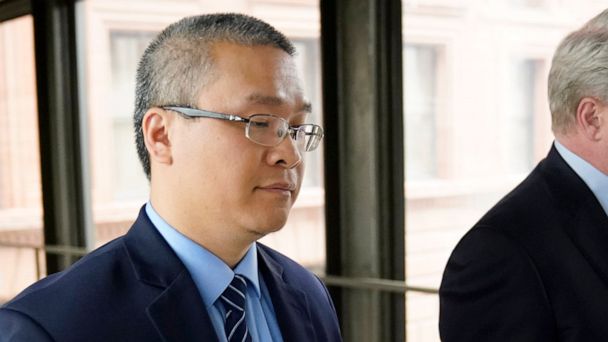
A former Minneapolis police officer was found guilty of aiding and abetting homicide after he kept onlookers at bay as his colleagues detained a dying George Floyd.
The last of four former policemen standing trial in state court for Floyd’s murder was Tou Thao, who had previously been found guilty in federal court of violating Floyd’s civil rights. He turned down a plea deal and, rather of having a trial, he allowed Hennepin County Judge Peter Cahill make the decision based on the arguments made in written files by the parties and the evidence provided in earlier trials.
“There is proof beyond a reasonable doubt that Thao’s actions were objectively unreasonable from the perspective of a reasonable police officer, when viewed under the totality of the circumstances,” Cahill wrote in a 177-page decision that was submitted Monday evening and made public Tuesday.
Floyd, a Black man, passed away on May 25, 2020, after officer Derek Chauvin, a white man, pushed him to the ground for 9 1/2 minutes as Floyd cried out for breath. The murder, which was caught on bystander video, sparked demonstrations throughout the globe and forced a national confrontation with racism and police violence.
In April 2021, Chauvin, the senior cop on the scene, was found guilty of murder and manslaughter. He subsequently entered a guilty plea in the federal case. Together with Thao, two additional officers, J. Alexander Kueng and Thomas Lane, were found guilty in their federal case after entering guilty pleas to state charges of encouraging manslaughter.
Keith Ellison, the attorney general of Minnesota who oversaw the case, urged Congress to establish a comprehensive police reform program in Floyd’s honor, saying Thao’s conviction “brings one more measure of accountability in the tragic death of George Floyd.”
“While the prosecution of Floyd’s murder has now come to an end, it is not over,” said the prosecutor. Ellison remarked. “There is much more that prosecutors, law-enforcement leaders, rank-and-file officers, elected officials, and community members can do to bring about true justice in law enforcement and true trust and safety in all communities.”
Robert Paule, the defense attorney, did not immediately respond to messages seeking comment.
The judgment was described by the Floyd family’s attorneys as “another measure of accountability for his death.”
“Nearly three years after George’s death, the family and the Minneapolis neighborhood are still recovering as the criminal justice system is successful. Police brutality is an unlawful and criminal behavior, as shown by each of these measures of justice, civil rights lawyer Ben Crump and his team stated in a statement.
Sentence was scheduled for Aug. 7 by the court. According to Minnesota rules, Thao should get a manslaughter sentence of four years, which he would serve along with his 3 1/2-year federal term.
Thao said he did nothing illegal, in contrast to the other three former cops. In a state court hearing last August, he rejected a plea agreement, saying “it would be lying” to admit guilt.
Cahill based his judgment on the evidence and transcripts from Thao, Kueng, and Lane’s federal civil rights trial as well as the murder trial of Chauvin, which he presided over. The particular charges against Thao at the time were depriving Floyd of his right to medical attention and failing to act to stop Chauvin. According to Cahill’s account, he concentrated on the evidence that related to Thao and ignored the other officers, their confessions, and convictions.
Lane is white, Kueng is black, and Thao is an American Hmong.
When Floyd attempted to pass a fake $20 bill outside a convenience store in Minneapolis, Thao testified that he was relying on the other officers to take care of Floyd’s medical needs while he acted as “a human traffic cone” to control a crowd of about 15 onlookers and traffic.
According to Thao, Floyd was being fought by the other police when he and Chauvin arrived. As the other officers attempted to put Floyd into a squad car, he claimed it was obvious to him “that he was under the influence of some type of drugs.”
In a clip from his body camera, he is heard telling spectators, “This is why you don’t do drugs, kids.” He ordered the off-duty, out-of-uniform Minneapolis fireman who inquired about whether authorities had checked Floyd’s pulse to “back off!”
Thao said he could hear people become increasingly concerned about Floyd’s health and Floyd yelling, “I can’t breathe.” However, Thao claimed that even as an ambulance was taking him away, he was unaware of any serious medical issues.
The majority of Thao’s testimony and his explanations for his conduct, according to Cahill, were “not credible.”
According to Minneapolis Police Department policies, the judge wrote, “it was objectively unreasonable to (among other things) encourage fellow officers to engage in a dangerous prone restraint for 9 minutes and 24 seconds; encourage those officers not to use a hobble; actively assist their restraint by acting as a “human traffic cone”; and prevent bystanders from rendering medical assistance.”
The court said, “Thao’s actions were even more unreasonable in light of the duty he had to intervene to stop the other officers’ excessive use of force and the fact that he was trained to provide medical aid.”
A more severe offense of aiding and abetting second-degree murder was dropped by Cahill with a presumed sentence of 12 1/2 years in accordance with an agreement between the prosecution and defense.
The George Floyd Justice in Policing Act stagnated in the Senate amid Republican opposition in 2020 and 2021. This year, Vice President Kamala Harris and others have urged for its revival. The Act seeks to end malfeasance, racial discrimination, and overuse of force in all forms of police throughout the country. Among other things, it would outlaw the use of chokeholds and remove the “qualified immunity” that shields cops from legal action.