


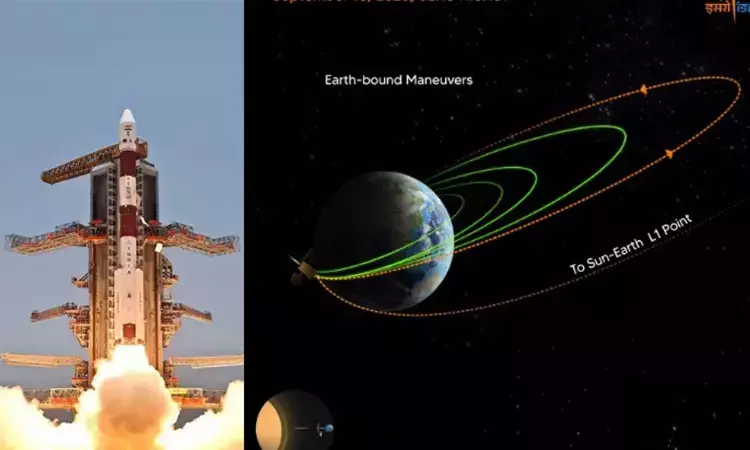
Early on Friday morning, the Aditya L1 spacecraft, India’s first space-based mission to study the Sun, successfully completed its fourth earth-bound maneuver, according to ISRO.
“The fourth Earth-bound maneuver (EBN#4) is successfully carried out. While a portable terminal currently stationed in the Fiji islands for Aditya-L1 will support post-burn operations, ISRO’s ground stations at Mauritius, Bengaluru, SDSC-SHAR, and Port Blair tracked the satellite during this operation, the space agency said in a post on X, a platform formerly known as Twitter.
It stated: “The next manoeuvre Trans-Lagragean Point 1 Insertion (TL1I) — a send-off from the Earth — is scheduled for September 19, around 02:00 Hrs. IST.” The new orbit achieved is 256 km x 121973 km.
The first Indian space observatory, Aditya-L1, is orbiting the Sun in a halo around the first Sun-Earth Lagrangian point (L1), which is around 1.5 million kilometers from the planet.
On September 3, 5, and 10, the first, second, and third earth-bound manoeuvres, respectively, were completed successfully.
The maneuvers are being carried out throughout the spacecraft’s 16-day orbit of the Earth, during which time it will pick up speed in preparation for its subsequent trip to L1.
Aditya-L1 will perform a Trans-Lagrangian1 insertion maneuver after completing four earthbound orbital manoeuvres. This will start the spacecraft’s almost 110-day route to the location near the L1 Lagrange point.
Once reaching the L1 point, another maneuver locks Aditya L1 into an orbit about L1, the point of equilibrium between the Earth and the Sun’s gravitational pull.
The satellite spends the whole of its mission life in an erratic orbit around L1 in a plane that is nearly perpendicular to the line connecting the Earth and the Sun.
On September 2, the Aditya-L1 spacecraft was successfully launched by ISRO’s Polar Satellite Launch Vehicle (PSLV-C57) from the Satish Dhawan Space Centre (SDSC), Sriharikota.
The Aditya-L1 spacecraft was successfully injected into an elliptical orbit of 23519500 km around the Earth after a mission length of 63 minutes and 20 seconds that day.
A spacecraft positioned in a halo orbit around the L1 point, according to ISRO, has the significant benefit of continually seeing the Sun without any occultation or eclipses.
As a result, it will be easier to monitor solar activity and how it affects space weather in real time.
Aditya-L1 is equipped with seven scientific payloads that were produced domestically by ISRO and national research organizations, including as the Inter-University Centre for Astronomy and Astrophysics (IUCAA) in Pune and the Indian Institute of Astrophysics (IIA) in Bengaluru.
The payloads’ electromagnetic particle and magnetic field detectors will be used to examine the photosphere, chromosphere, and the Sun’s outermost layers (the corona).
Four payloads use the unique vantage point L1 to see the Sun directly, while the other three payloads conduct in-situ particle and field investigations at the Lagrange point L1. This allows for significant scientific research on the propagation of solar dynamics in the interplanetary medium.
The most important data to comprehend the issue of coronal heating, coronal mass ejection, pre-flare and flare activities and their features, dynamics of space weather, and propagation of particles and fields is anticipated to be provided by the Aditya L1 payloads.
A tiny object prefers to remain at one of five Lagrangian points (or parking zones) between the Earth and the Sun, according to experts. The Italian-French mathematician Joseph-Louis Lagrange is honored by having his prize-winning article, “Essai sur le Problem des Trois Corps, 1772,” be the inspiration for the naming of the Lagrange Points. Spacecraft may utilize these locations in space to stay there for longer periods of time while using less fuel.
The gravitational attraction of the Sun and the Earth, which are at a Lagrange point, equals the centripetal force needed for a tiny object to move with them.