


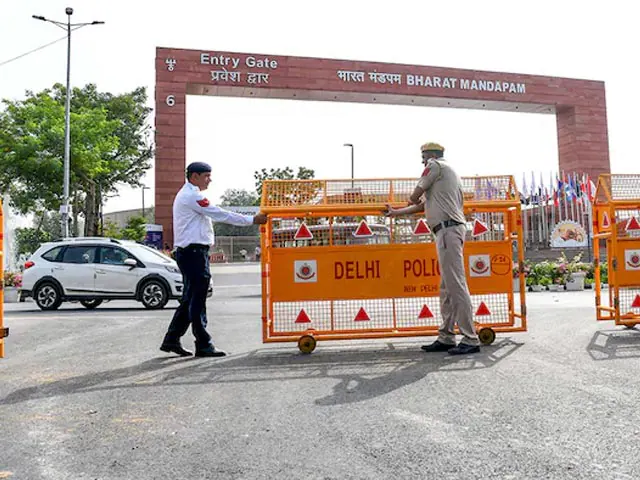
On Friday morning, stringent traffic restrictions were implemented in the New Delhi district, and internet delivery services—aside from prescription drugs—have been prohibited in the region where the G20 summit site and delegate hotels are situated, according to authorities.
Due to the summit, the New Delhi district will be a Controlled Zone-I from Friday at 5 am to Sunday at 11:59 pm. The police have warned individuals from picnicking, biking, or walking along Kartavya Path and India Gate.
The movement of cars is restricted in the New Delhi district, but police said ambulances, residents, and visitors residing there would be allowed to drive with correct identification.
In response to a request from Delhi Police Commissioner Sanjay Arora, the Delhi Metro has decided to begin its services on September 8, 9, and 10 at 4 am from terminal stations on all of the network’s lines.
According to officials, over 50,000 people have been deployed, along with dog squads and mounted police, to maintain a hawk-eye surveillance during the meeting.
The Delhi Traffic Police stated limits on the movement of buses, taxis, auto-rickshaws, and freight vehicles in a notice they issued on August 25. Due to the controlled traffic flow, it has recommended citizens to use metro services as much as possible.
To navigate the city until the limitations are in place, police have suggested using the “Mapmyindia” GPS app.
In light of India Gate and Kartavya Path being in the “controlled zone,” Special Commissioner of Police (Traffic) S S Yadav said that the Delhi Police is pleading with people not to visit the area for “walking, cycling, or picnicking” during the G20 Summit.
All of Delhi would be open to essential services including postal and medical services, as well as sample collection by pathological laboratories, he added.
The whole section of Mahatma Gandhi Marg within the Ring Road has been declared as a “regulated zone”.
Accordingly, only legitimate inhabitants, authorized cars, emergency vehicles, as well as those going to the airport, Old Delhi, and New Delhi Railway Stations, would be permitted to use the road network that extends beyond Ring Road into New Delhi district.
After verification, vehicles used by hotels, hospitals, and other significant facilities in the New Delhi district for housekeeping, catering, and garbage management will also be permitted.
Up until Sunday at 2 p.m., almost 16 intersections and roads will be considered “Controlled Zone II” locations. These include, among others, Delhi Gate, W-Point, A-Point, DDU Marg, Vikas Marg (up till Noida Link Road-Pusta Road), and Bahadur Shah Zafar Marg.
The “regulated” and “controlled zones” should not be visited by police, according to the request. If travel is necessary, it has alternate routes mentioned.
The Supreme Court, Patel Chowk, and RK Ashram Marg metro stations’ parking lots will be blocked starting at 4 a.m. on September 8 till noon on September 11, according to the Delhi Metro Rail Corporation (DMRC).
Except for Supreme Court station, where boarding and deboarding will not be allowed from 5 am on September 9 to 11 pm on September 10, all stations will continue to provide metro service, according to the police.
From September 8 at midnight until September 10, at 11:59 p.m., all kinds of commercial vehicles, interstate buses, and buses operated by the Delhi Transport Corporation and the Delhi Integrated Multi-Modal Transit System will not be permitted to operate on the Mathura Road (beyond Ashram Chowk), Bhairon Road, Purana Quila Road, or inside the Pragati Maidan Tunnel.
In contrast, interstate buses leaving from the Apsara, Chilla, Badarpur, Tikei, and Singhu borders will arrive at ISBT Kashmere Gate, ISBT Sarai Kale Khan, Ashram Chowk, Peeragarhi Chowk, and Mukarba Chowk, respectively.
The G-20 Virtual Help Desk provides real-time traffic data, which the Delhi Police recommends travelers use to plan their routes to and from the airport, train stations, and bus terminals.
September 9–10 will see the G20 Leaders’ Summit. More than 30 heads of state and other senior government officials from the European Union, invited guest nations, 14 presidents of international organizations, and more are expected to attend the summit.