


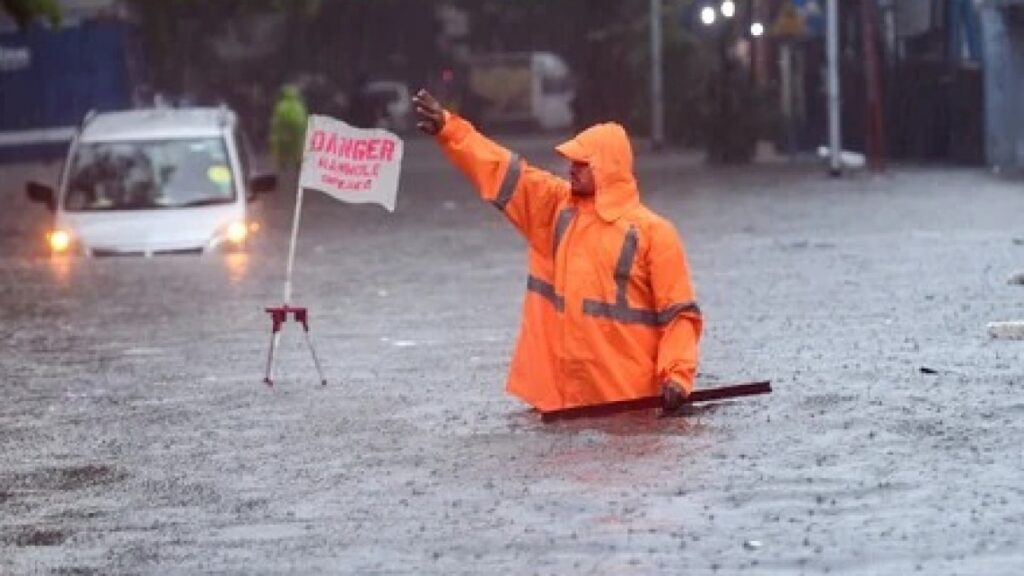
The India Meteorological Department (IMD) has issued a “yellow” advisory for Mumbai due to the expected heavy rainfall in remote areas on Friday.
All primary, intermediate, and upper secondary schools in Palghar and Thane, Maharashtra, will be closed on Friday due to the meteorological bureau’s ‘orange’ advisory, which predicts moderate to extremely heavy precipitation in remote areas, according to an official.
Top things to understand
1. According to statistics from the Mumbai Brihanmumbai Municipal Corporation, the island city (the regions in the southern section till the causeway in Mahim) saw more rain in the early half of Thursday while the suburbs experienced heavier rain since late in the day. A number of regions experienced water logging as a consequence of the heavy rain, which also caused gridlock on several arterial roads and delays for both Western and Central Railways’ suburban train services.
At 3:30 p.m., according to civic authorities, water was over half a foot deep in much of Matunga, DN Nagar, Byculla, Trombay, Azad Maidan, Kandivali, Kalbadevi, Oshiwara, Dahisar, and Magathane.
2. On Thursday, the Mumbai office of the India Meteorological Department (IMD) issued a red notice for Mumbai and the nearby Raigad district, stating that “heavy to very heavy rainfall at a few places and extremely heavy rainfall at isolated places” will occur.
3. Western Railway suburban train services are also affected by the rains and had delays of 10-15 minutes throughout the day, with waterlogging at the stations of Marine Lines and Borivali in the south and north of the network, respectively, as the main causes.
According to authorities, Central Railway’s suburban trains have been running 10 to 15 minutes late since the morning, with operations becoming worse in the evening because to water logging on the tracks at the north end of Kalyan.
4. While out fishing after heavy downpours in Kalwa town, Thane district, a 32-year-old man was washed away in an overflowing nullah beside a stream.
5. According to authorities, the Tansa dam began to overflow as a consequence of the catchment area’s constant rains, and 15 of its gates were opened, releasing 1,65,000 cusecs of water.
6. The Dhamani Dam was releasing 8,400 cusecs of water and the Kawadas Dam was releasing 21,100 cusecs of water into the neighboring Palghar district.