


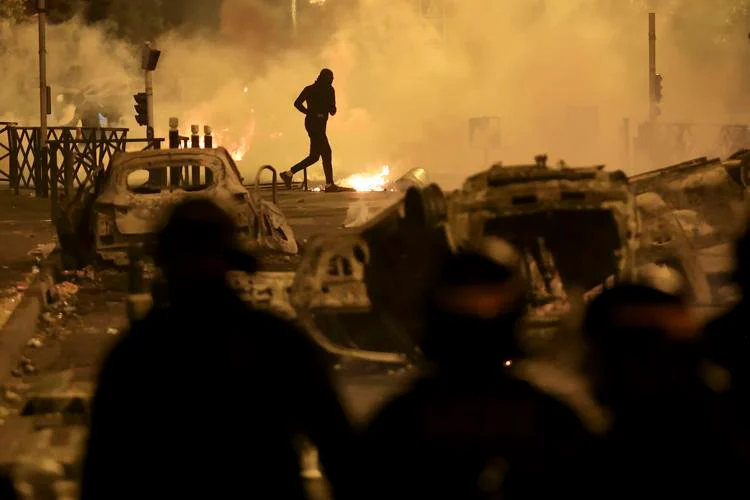
As riots escalated throughout France over the deadly police shooting of a 17-year-old motorist that has so far led to 875 arrests, French President Emmanuel Macron encouraged parents to keep youngsters at home and suggested social media limitations. Following a second crisis conference with top ministers, Macron was certain that social media sites like TikTok and Snapchat had a “considerable role” to play in encouraging copycat violence this week. Macron said that his administration will collaborate with internet firms to create protocols for “the removal of the most sensitive content.” He did not provide any details on the material he was thinking about, just that “I expect a spirit of responsibility from these platforms.”
According to the president, French police also want to ask for the names of anyone who “use these social networks to call for disorder or exacerbate the violence” when it is “useful.” Macron said that “it’s the parents’ responsibility” to keep their children at home and that “young people, sometimes very young,” made up a third of those who were detained on Thursday night. He stated of the rioting, “We sometimes get the impression that some of them are experiencing in the streets the computer games that have inebriated them. The French president’s comments came after a third night of turmoil in France after a police officer killed the kid on Tuesday in the Nanterre area of northwest Paris. Police reacted to the barricades, flames and pyrotechnics fired by the rioters by using tear gas, water cannons and shock grenades. At least 200 police officers have been hurt, according to the authorities.
40,000 police have been sent out by Macron’s administration to restore order and make arrests for actions he called “unacceptable and unjustifiable.” He refrained from declaring a state of emergency, a move that a previous French administration used in 2005 to put an end to riots after the unintentional deaths of two boys as they eluded police. Just over a year before the summer Olympic Games, which are expected to draw millions of tourists and 10,500 Olympians, rioting has broken out in Paris and other violent French towns. The Paris 2024 organising committee said that the issue was being constantly watched and that the Olympics were still being prepared for. In Nanterre, burned-out wrecks of automobiles that had been tipped over and set fire were rammed by armoured police vehicles. The 17-year-old’s family is of Algerian ancestry, according to a relative who only gave his first name, Nahel.
The nation has to “push for changes” in underprivileged neighbourhoods, according to Nanterre Mayor Patrick Jarry, who has booked his funeral for this coming Saturday.Many locals feel as if they have been treated unfairly, whether it is in relation to housing, access to culture, employment opportunities, or other aspects of daily life, according to Jarry. I think we’ve reached the point where we have to acknowledge the urgency of the problem. Pascal Prache, the prosecutor in Nanterre, said that since Nahel seemed to be so young and was travelling in a bus lane in a Mercedes with Polish licence plates, cops attempted to pull him over. To escape being caught, he reportedly ran a red light, which caused him to get stranded in traffic. After saying that his preliminary inquiry led him to the conclusion that the officer’s use of his firearm wasn’t legally justifiable, Prache stated the police officer who is suspected of firing the gun was given a preliminary charge of voluntarily murder. Investigating magistrates who have filed preliminary charges have a high suspicion of misconduct but need to look into the matter further before trying the case.
According to the prosecution, the officer said he was concerned that the automobile that Nahel was attempting to depart in would harm him, his partner, or someone else. Nearly half of the 875 persons who have been held, according to France’s national police agency, are from the Paris area. Rioting also occurred in dozens more French towns and cities. A dozen individuals were arrested and numerous fires were put out in Brussels, the capital of Belgium, where the turmoil had reached. Individuals and groups have thrown firecrackers at security personnel in a number of Parisian neighbourhoods. While several stores were stolen on Rivoli street, close to the Louvre museum, and in the Forum des Halles, the biggest shopping centre in downtown Paris, the police station in the city’s 12th district was assaulted. Police in Marseille, a port city on the Mediterranean, reportedly tried to disperse violent gangs in the heart of the city.
On Friday, Gerald Darmanin, France’s interior minister, condemned what he termed a night of “rare violence.” According to his office, the many arrests were made as part of a larger government initiative to deal with rioters in a “extremely firm” manner. The shooting, which was seen on camera, stunned France and heightened long-simmering tensions between the police and young people living in housing projects and other underprivileged areas. Speaking on French television network BFMTV, the lawyer for the arrested police officer said that the officer was regretful and “devastated.” According to lawyer Laurent-Franck Lienard, the police officer acted as he saw fit at the time. According to French custom in criminal proceedings, the officer’s identity has not been made public. “He doesn’t get up in the morning to kill people,” Lienard said of the officer. He really had no desire to murder.
Mounia M., the mother of Nahel, told France 5 television that although she was upset with the officer who murdered her only kid, she was not upset with the police in general. She claimed, “He saw a little, Arab-looking kid, he wanted to take his life,” adding that punishment should be “very firm.” She argued that a police officer couldn’t just point his pistol at our kids and kill them. Unnamed grandma of Nahel revealed that her family had Algerian ancestry to Algerian television station Ennahar TV. In a statement released on Thursday, the foreign affairs ministry of Algeria said that the family’s sorrow was felt extensively across the nation of North Africa. Following Nahel’s murder, French anti-racism groups complained once again about police conduct in general. In France, which is formally devoted to the philosophy of colorblind universalism, discussing race was prohibited for many years. However, some increasingly loud organisations contend that this agreement hides systemic prejudice and discrimination.
Compared to the US, France uses weapons less often, yet last year, French police fatally shot 13 individuals who refused to cooperate with traffic stops. Three other individuals, including Nahel, perished in identical situations this year. Following the Minnesota police shooting murder of George Floyd, there have been calls for more accountability in France. There have also been demonstrations against racial inequality there. The death of the boy and the accompanying violence disturbed the U.N. human rights office in Geneva, which sought a prompt investigation into claims that police used excessive force to put an end to the turmoil. According to spokesman Ravina Shamdasani, “this is a moment for the country to seriously address the deep issues of racism and racial discrimination in law enforcement.”
Shamdasani reported that in December, the U.N. Committee on the Elimination of Racial Discrimination expressed concern about “the frequent use of identity checks, discriminatory stops, and the application of criminal fixed fines imposed by the police or law enforcement agencies, which they said disproportionately targets members of certain minority groups.” The three weeks of rioting that followed the murders of 15-year-old Bouna Traoré and 17-year-old Zyed Benna, who were electrocuted while fleeing the police at a power substation in Clichy-sous-Bois, in 2005, were reminiscent of this week’s demonstrations.