


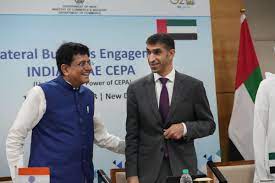
According to Piyush Goyal, India’s minister of commerce and industry, non-oil bilateral trade between India and the UAE is expected to more than quadruple to USD 100 billion by 2030.
The bilateral non-oil trade is now valued at USD 48 billion.
The Joint Committee of the Comprehensive Economic Partnership Agreement (CEPA) between India and the UAE reached an agreement on the new goal at its first meeting. The agreement went into effect on May 1 of the previous year.
After the meeting, Goyal told reporters, “We have mutually decided that let’s now become more ambitious and instead of our earlier target of an overall USD 100 billion bilateral trade by 2030… we shall now look at non-petroleum bilateral trade of USD 100 billion by 2030, which means doubling our non-petroleum trade from USD 48 billion today to USD 100 billion in the next seven years.
India receives a significant amount of crude oil from the UAE. A significant portion of the bilateral commerce between the nations is made up of oil exports.
The flawless implementation of the CEPA, he said, would contribute in encouraging enterprises on both sides to increase their trade.
It was also decided during the meeting to establish a number of committees, subcommittees, and technical councils to oversee the implementation of the trade agreement’s various provisions, including those relating to goods trade, customs facilitation, rules of origin, sanitary and phytosanitary issues, technical trade barriers, trade remedies, investment facilitation, and economic cooperation.
It was resolved to establish a new subcommittee to handle issues relating to trade in services, and it was also decided to share services trade data, including preferential and MFN (most-favorable-nation) trade statistics, on a quarterly basis.
The establishment of an India-UAE CEPA Council, which would act as a platform for both governments and the export-oriented private sector to support CEPA implementation by raising awareness, forming alliances, and hosting business events in both nations, was also agreed upon, Goyal added.
He continued by saying that this council will concentrate on issues like MSMEs, startups, female entrepreneurs, and players in the services industry.
Goyal stated that in addition to asking firms to increase their trade in the petroleum industry, the two presidents pushed for more bilateral trade.
According to him, the UAE is India’s main supplier of petroleum products, and the UAE also consumes a lot of refined petroleum products.
They also engage in substantial trading of refined goods that exceeds their capabilities. Therefore, I asked the UAE to urge its businesses to consider getting refined goods from India more often, he said.
Regarding investments, Goyal said that the majority of the problems have been handled, and that Abu Dhabi Investment Authority (ADIA) would soon be established in the GIFT city.
The UAE investors are eager to invest in industries including energy, new technologies, skills and education, food, healthcare, defence, and startups. It will also increase foreign direct investment into India.
According to Thani bin Ahmed Al Zeyoudi, Minister of State for Foreign Trade, the UAE would always remain India’s reliable source for oil.
Increasing shipments of iron and steel, aluminium, and polymers are being made by UAE exporters, he said, while Indian exports in the areas of textiles, footwear, vehicles, and gems and jewellery are benefiting from the trade deal.
Anindya Ghosh, Partner, IndusLaw, commented on the arrangement and said that Indian firms are increasingly selecting the UAE to develop because of the country’s accommodating taxation policies, large customer base with a high rate of consumer uptake, and advantageous position for international expansion.
According to Rudra Kumar Pandey, Partner at Shardul Amarchand Mangaldas & Co, the UAE is looking at investment prospects in India in the areas of infrastructure, manufacturing, and renewable energy.