


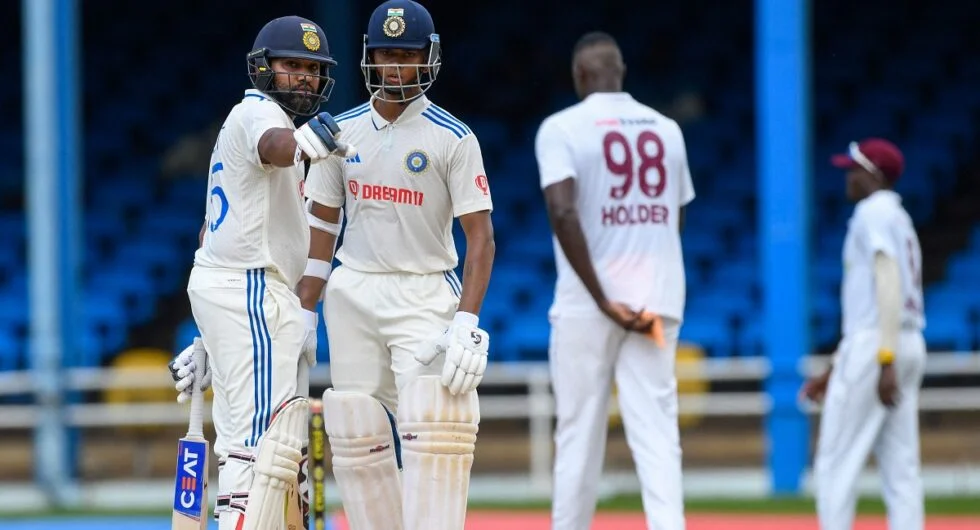
The Indian squad showed signs of ‘Jam-ball’ as they set a historic world record in Test cricket to achieve a significant milestone, but England’s bazball has transformed Test cricket like no other team in recent memory. In their second innings in the second Test at Trinidad, Team India broke the three-figure milestone against the West Indies, becoming the team to do it in the quickest 100 runs in Test cricket history.
As they sought to amuse those watching Test cricket, Ben Stokes and Brandon McCullum created the phrase “Bazball,” which has changed the dynamics of red-ball cricket across the world.
With Bazball, England produced some outstanding successes at the conclusion of the previous World Test Championship (WTC) cycle, and they maintained their mindset when the Ashes 2023 began as well as the WTC 2023-25 cycle.
When England captain Ben Stokes declared England’s first innings at 393 for 8 in the first Ashes Test, which Australia would go on to win by two wickets, Edgbaston saw the pinnacle of Bazball. As Australia went on to win the fourth Test, Day 5 was rained off, and the England skipper received some harsh criticism.
While Rohit Sharma and company engraved their names in the history books by being the side to achieve the quickest 100 in Test cricket’s storied history, India devised their own type of “Jam-ball,” a twist on Bazball as proposed by former opener Aakash Chopra.
After a sluggish defensive effort by the hosts that seemed to be an attempt to draw the second Test, India limited West Indies to 255 in their first innings. Indian openers Rohit Sharma and Yashasvi Jaiswal came out all guns blazing on Day 4 hoping to force a result.
Even though Rohit scored 57 runs, the Indian skipper went out for the day two runs shy of the 100-run threshold. Rain caused the proceedings to be delayed, but Shubman Gill joined Yashasvi soon after Rohit was fired.
India came out after lunch determined to keep the scoreboard moving and made history by surpassing the three-figure mark faster than any other side in Test cricket history (12.2 overs).