


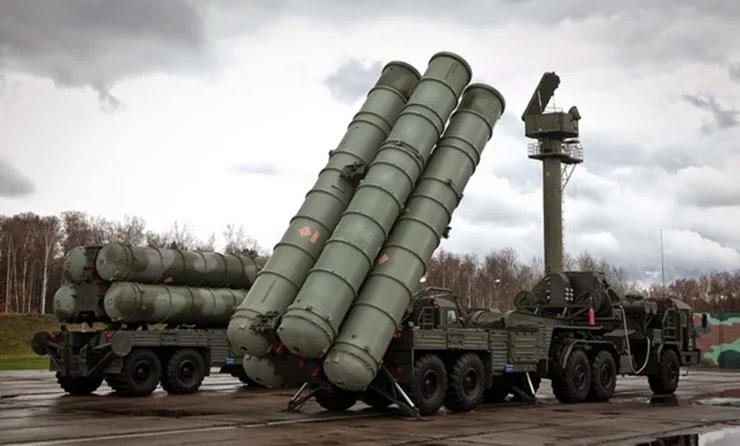
In order to improve India’s long-range defensive capabilities, top defence ministry officials will meet with their Russian counterparts this week to discuss the possibility of either jointly manufacturing or purchasing five additional S-400 air defence systems from Moscow.
Before Russian President Vladimir Putin travels to India on December 5 for his yearly summit with Prime Minister Narendra Modi, the agreement is anticipated to be approved.
While two of the five S-400 systems included in the October 5, 2018, $5.43 billion deal will be delivered by the end of 2026, India and Russia are discussing the purchase of five more systems to close the air defence gap in the northern command area and defend against any attack along the nation’s more than 7000 km of coastline.
The cost of the extra five systems, with yearly increases from the 2018 price, has already been agreed upon by the parties, HT has learnt. The details are still being worked out, but it is being discussed that three of the five systems will be bought outright, with the remaining ones being developed by Indian private sector businesses through a technology transfer process.
According to individuals familiar with the situation who spoke on condition of anonymity, the agreement will be government-to-government and include maintenance, repair, and overhaul facilities established in partnership with the Indian private sector. They went on to say that allegations that India had purchased the S-500 system were untrue because Russia was still developing such a system.
Since Pakistan is using a Chinese-built PL-15 air-to-air missile with a 200-kilometre range and used it against India during Operation Sindoor, India is also seeking a Russian-made RVV-BD, a missile with a range of more than 200 kilometres, to strengthen its Su-30 MKI fleet. It will be necessary to upgrade the Su-30 MKI’s onboard radar to integrate the Russian R-37 missile, also known as the RVV-BD.
The government has yet to express any opinion regarding the Su-57 Russian fifth-generation fighter or the US F-35 fighter, despite IAF Air Chief Marshal Amar Preet Singh’s remarks regarding his force’s consideration of the prospect of obtaining it.
During Operation Sindoor, Pakistan used Chinese long-range weaponry to repeatedly target the Russian S-400 Triumf system at Adampur and Bhuj air bases, demonstrating both the system’s ability to attack and its resilience. The S-400 system was so feared during the initial attack on May 7 that Pakistan was forced to relocate all of its aviation assets more than 300 kilometres from the Indian border, with only a small number of aircraft taking to the skies on May 10. The S-400 long-range missiles destroyed a Pakistani ELINT aircraft in Punjab, Pakistan, 314 kilometres away. Up north, they also destroyed Pakistani F-16 and JF-17 jets. In addition to being an effective standoff weapon, the S-400 was a major deterrent to Pakistan’s airborne attack.