


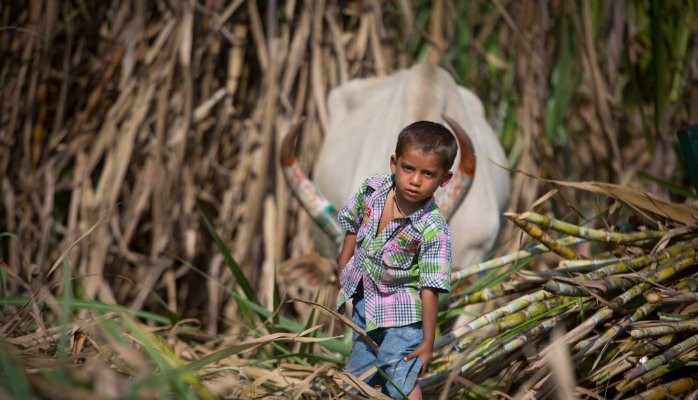
In Maharashtra, a state famous for the women’s education movement established by Savitribai and Jyotirao Phule, child marriage has grown into a significant problem. Authorities have prevented over 160 child weddings in the Beed district alone over the last eight months, and since January, police have filed 21 FIRs against parents and other family members.
Farmworkers refer to Beed as the “sugarcane belt,” and while cutting sugarcane, a pair is almost always favored and paid well. As a result, when compared to other districts in Maharashtra, the district has the highest rate of child marriages.
News18 went to the hamlet of Jarud, which is about 30 kilometers from Beed, where one of these girls was saved from child marriage two months ago by the authorities with the aid of an NGO. She is 18 years old, and according to the legislation, males must be 21 years old to be married while girls must be 18 years old.
The youngster now lives with her aunt and uncle since her mother got remarried after her father passed away. Her aunt and uncle relocate to Kolhapur district for seven to eight months each year to work in the fields as employees at a sugarcane plantation. They were ignorant and lacked a complete grasp of the law, but they believed that a man and woman may be married as soon as they reach 18 and 21, respectively. When they were married 19 years ago, the pair were both minors.
“I didn’t finish my basic education because I wasn’t interested,” the girl said. We are poor, so even though my uncle and aunt are taking care of me, I don’t want to be a burden on them, which is why I chose to get married.
When the cops showed up at the girl’s wedding on June 26, she was astonished. “On June 26, the day of my wedding, police arrived at the location and informed me that the marriage could not take place. My uncle and aunt were informed that I had not yet turned 18 years old. This was confusing to me, and it was humiliating for my whole family and myself. The NGO representatives who arrived with the police met with us and explained the legislation and the reasons the wedding was called off. Even though my uncle had paid Rs. 2 lakh on the wedding, we lost the whole sum.
The child, who was subsequently referred for counseling, is now interested in studying to become a nurse. Her uncle and aunt are also assisting with her academic progress.
BEED DISTRICT HAS MAHARASHTRA’S HIGHEST PERCENTAGE OF CHILD WEDDINGS
Nandkumar Thakur, the superintendent of police for Beed, told News18: “It’s a societal problem; often, we have incidents where even educated people do this for familial or financial reasons. We were able to prevent 160 child weddings in the district this year until the end of August, and we also filed 21 FIRs against family members, relatives, and guests at the wedding. Even in the metropolis, we have detected child marriages.
“With the aid of NGOs and local officials, we are putting up a comprehensive awareness campaign and even providing parenting advice. Especially from where we obtain our information on such weddings in the area, our local network has increased, and we are starting to see effects,” Thakur said.
When police learn of child weddings, they enlist NGOs’ assistance in putting an end to it. Field police arrive at the scene and attempt to step in at the first stage. Although some cases are recorded from the town area as well, cases are mostly reported from rural areas.
Girls are still seen as a “burden” by many people, according to social experts in this sector, thus there is a need to alter that perception. Numerous girls are prevented from finishing their education because of underage marriage. They said that in certain cases, they had even faced threats for trying to end underage weddings.
Sugarcane farmers do get substantial compensation if husband and wife labor together in the fields, according to Tatvashil Kamble, who has been fighting child marriage for 12 years. As a result, many parents support child marriage so they may encourage the girl to work alongside their son and increase the family’s income. Nobody is aware that if a girl marries young and has a child in a remote location, there is a risk to both the girl’s and the child’s lives. We have seen several instances in the past when babies delivered to malnourished mothers subsequently develop serious health problems.
In India, information from the National Crime Records Bureau (NCRB) reveals that between 2017 and 2021, more than 3,000 instances were reported under the Prohibition of Child Marriage Act, 2006. 2017 saw a total of 395 instances reported; 2018 saw 501; 2019 saw 523; 2020 saw 785; and 2021 saw 1,050.
However, the rise in instances does not always correspond to an increase in child marriages. This might be as a result of growing awareness that such incidents are being reported more often.
However, based on the fact that 21 FIRs have been filed in a single district in Maharashtra in only eight months, child marriage is still a problem. The state administration has to be reminded of this situation since it is impossible to envisage it happening over the whole state.