


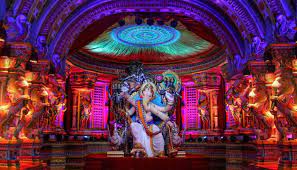
On Tuesday, the annual return of Lord Ganesh to Mumbai was celebrated with pomp and ceremony, signaling the start of the 10-day celebration.
Idols of the elephant-headed God were installed in a number of homes and pandals (temporary stages erected by community organizations at street corners and open spaces), which were decorated elaborately with a variety of themes, from the Chandrayaan-3 launch to Ayodhya’s Ram Mandir.
Amidst chanting of “Ganpati Bappa Morya” and the banging of drums, families—including young children and elderly individuals—left their houses early in the morning to carry their cherished “bappa” home. In autorickshaws, vehicles, and other forms of transportation, several individuals could be seen transporting Ganesh idols.
Every year, a number of Bollywood actors and politicians place idols of the god of learning and knowledge in their houses. While many famous Lord Ganesh idols, including the most well-known Lalbaugcha Raja, were installed in pandals in Mumbai early in the morning, many other idols were transported from workshops to the pandals in vibrant processions.
The municipal administrative council said on Monday that 2,729 “sarvajanik Ganeshotsav mandals” had been given permission to host public Ganesh celebrations by building “pandals.” More than 13,750 police officers, including employees from the traffic department, have been deployed to ensure security and order during the well-known event, which attracts thousands of visitors to pandals, an official said.
He said on Monday that they were made up of 15, deputy commissioners, 2,024 officers with ranks ranging from sub-inspector to assistant commissioner, and 11,726 constables. The traffic police announced many actions, including a restriction on heavy trucks on certain days, to ensure a smooth flow of traffic in the city.
The officer said that on immersion day (September 28), there would be more police on the scene and that personnel plans have been made. Mumbai is the city that celebrates Ganesh the most, with Lord Ganesh idols being placed in pandals and residences.
Mumbai residents flocked to the city’s busiest shopping areas, such as Dadar, Crawford Market, and Lohar Chawl, to purchase festival-related products including decorations, flowers, and puja supplies. This year, the city’s Ganesh mandals have created unique themed decorations for their pandals, so visitors are in for a visual treat.
Big mandals or pandals in the city are showcasing themes related to the launch of Chandrayaan-3, the Ayodhya Ram Temple, and the 350th anniversary of the coronation of warrior-king Chhatrapati Shivaji Maharaj. Many devotees are anticipated to go to Lalbaug in downtown Mumbai to see Lalbaugcha Raja, one of the most revered Ganeshas there, before moving on to Matunga to see the GSB Seva Mandal’s Ganpati, which is said to be the wealthiest and most magnificent.
The “Mahaganpati” of the GSB Seva Mandal is decked with valuable objects totaling more than 295 kg of silver and 66.5 kg of gold. Other well-known Ganesh mandals can be seen at Tejukaya, Ganesh Gully, and Chinchpokli.
In addition to this, the Khetwadi neighborhood of Girgaum is home to the 45-foot tallest Ganesha in the whole city. According to a police officer, there were no unpleasant incidents recorded in the city throughout the day, and the movement of trucks transporting Lord Ganesh idols was generally trouble-free.
The Lord Ganesh statues are immersed on several festival days beginning on the second day (Wednesday, September 20). According to the source, security has been stepped up at key immersion locations, including those in Versova, Khar Danda, Juhu Chowpatty, and Shivaji Park Chowpatty.
The Brihanmumbai Municipal Corporation (BMC) has constructed man-made ponds for the immersion of idols, mostly those that worshippers keep in their houses. Along with Mumbai, other regions of Maharashtra also saw a fervorous religious start to the celebration.
Lord Ganesh made his yearly pilgrimage to Earth at Nashik, around 200 kilometers from Mumbai, where he was welcomed into houses and pandals with songs of “Ganpati Bappa Morya” and “Mangalmurti Morya.” From early in the morning, people could be seen eagerly anticipating the arrival of the God of wisdom and wealth. People were buying Ganesh idols, puja supplies, ornamental items, and sweets, which resulted in congested markets, businesses, and streets. Devotees clad in traditional garb welcomed Lord Ganesh inside their houses and pandals in Latur, central Maharashtra, to the sound of drums and trumpets.
To welcome Lord Ganesh, prominent mandals (community organizations) staged a number of large processions while singing mantras and religious songs.