


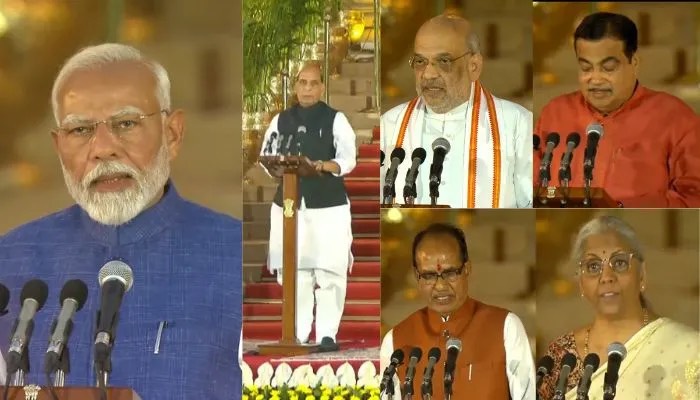
In an extraordinary ceremony held at Rashtrapati Bhavan on Sunday, June 9, Prime Minister-designate Narendra Modi took the oath of office for his third consecutive term as Prime Minister of India. Leaders from India’s neighbouring regions and the Indian Ocean region were in attendance. Other members of his team of ministers followed President Droupadi Murmu in administering the oath of office to Narendra Modi. Thirty leaders have been named united Cabinet Ministers, and the united government will have thirty-six Ministers of State and five Ministers of State with independence charge.
61 of the 72 ministers in the new ministry, which also includes Prime Minister Modi, are from the BJP, with the remaining 11 coming from allies. TDP and JD (U) have two ministries each, one for the cabinet and one for the ministry of state, among the alliance partners’ ministers. Each of the remaining seven parties has been given a minister. Among them were Shiv Sena, RPI, RLD, and Apna Dal, who received MoS slots, and HD Kumaraswamy of JDS, Chirag Paswan of LJP-Ramvilas, and Jitan Ram Manjhi of HAM, who took an oath as cabinet members.
Notably, Praful Patel was not included in the ministry because the NCP rejected his request for a cabinet ministry in exchange for the MoS Independent position.
There are 10 SCs, 5 STs, and 27 OBCs among all of the ministers. There isn’t a single Muslim minister, despite there being five ministers representing minority groups.
Below is a list of the ministers who were sworn in at Rashtrapati Bhavan. The party names of the NDA coalition partners’ ministers are listed in brackets next to their names.
Union Cabinet Ministers’ List
- Rajnath Singh
- Amit Anil Chandra Shah
- Nitin Gadkari
- Jagat Prakash Nadda
- Shivraj Singh Chauhan
- Nirmala Sitharaman
- Subrahmanyam Jaishankar
- Manohar Lal Khattar
- Haradanahalli Devegowda Kumaraswamy (JDS)
- Piyush Vedprakash Goyal
- Dharmendra Pradhan
- Jitan Ram Manjhi (HAM)
- Rajiv Ranjan Singh alias Lalan Singh (JDU)
- Sarbananda Sonowal
- Dr. Virendra Kumar
- Kinjarapi Ram Mohan Naidu (TDP)
- Pralhad Joshi
- Jual Oram
- Giriraj Singh
- Ashwini Vaishnaw
- Jyotiraditya Madhavrao Scindia
- Bhupender Yadav
- Gajendra Singh Shekhawat
- Annapurna Devi
- Kiren Rijiju
- Hardeep Singh Puri
- Dr. Mansukh Mandaviya
- Gangapuram Kishan Reddy
- Chirag Paswan (LJP-Ramvilas)
- CR Patil
List of Independent Charge Ministers of State
- Rao Inderjit Singh
- Dr. Jitendra Singh
- Arjun Ram Meghwal
- PratapRao GanpathRao Jadhav (Shiv Sena)
- Jayant Chaudhary (RLD)
Minister of State
- Jitin Prasada
- Shripad Yasho Naik
- Pankaj Chaudhary
- Krishan Pal {Gurjar}
- Ramdas Athawale (RPI-A)
- Ram Nath Thakur (JDU)
- Nityanand Rai
- Anupriya Patel (Apna Dal-Soneylal)
- V Somanna
- Dr. Chandrashekhar Pemmasani (TDP)
- Professor SP Singh Baghel
- Shobha Karandlaje
- Kirti Vardhan Singh
- BL Verma
- Shantanu Thakur
- Suresh Gopi
- L Murugan
- Ajay Tamta
- Bandi Sanjay Kumar
- Kamlesh Paswan
- Bhagirath Choudhary
- Satish Chandra Dubey
- Sanjay Seth
- Ravneet Singh Bittu
- Durga Das Uikey
- Raksha Nikhil Khadse
- Sukanta Majumdar
- Savitri Thakur
- Tokhan Sahu
- Dr Raj Bhushan Choudhry
- Bupathiraju Srinivasa Varma
- Harsh Malhotra
- Nimuben {Jayantibhai} Bambhaniya
- Murlidhar Mohol
- George Kurian
- Pabitra Margherita
In the Modi government, seven women, including two cabinet members, have been appointed as ministers. Despite losing to Amethi, Smriti Irani has not been admitted into the ministry.
George Kurien is a Christian, two Sikhs, Hardeep Singh Puri and Ravneet Singh Bittu, two Buddhists, Kiren Rijiju and Ramdas Athwale, and one Christian are among the five ministers from minority groups.
Prime Minister Modi led the BJP-led NDA to a third consecutive victory in the Lok Sabha elections. In the 2014 and 2019 Lok Sabha elections, the BJP secured an absolute majority on its own, gaining 282 and 303 seats, respectively. With 292 MPs in Parliament, PM Modi leads the NDA coalition, which is focused on advancing India’s goal of becoming a developed country by 2047.