


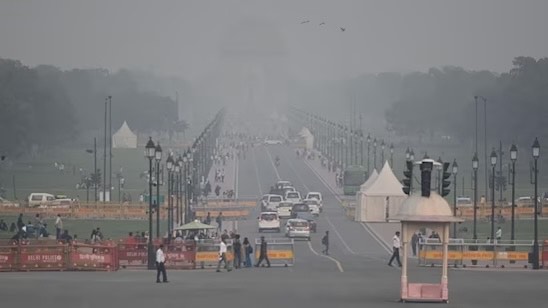
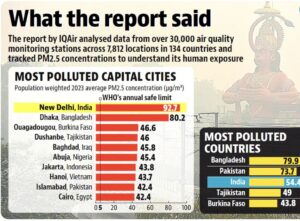
Data from Swiss company IQAir, which also ranked India as the third most polluted nation in the world, revealed on Tuesday that New Delhi earned the infamous distinction of being named the most polluted capital city in the world in 2023 due to residents breathing air that is nearly 20 times the international safe standard.
As the world’s most polluted national capital, New Delhi defeated Dhaka (80.2 µg/m3) with an annual population-weighted PM2.5 of 92.7 µg/m3. The capital of Burkina Faso, Ouagadougou, came in a distant third place on the list with a population-weighted PM2.5 of 46.6 µg/m3.
Of the 50 most polluted cities worldwide, 42 were in India, up from 39 in 2022. The most polluted city is Begusarai in Bihar, with 118.9µg/m3, and Guwahati in Uttar Pradesh, with 105.4µg/m3.
Delhi, the bigger Union territory, was the third most polluted city in the world in 2023, with an average PM2.5 concentration of 102.1 µg/m3. New Delhi, a smaller capital, was ranked sixth in the world.
Greater Noida (88.6µg/m3), ranked 11th among the world’s most polluted cities, was the most polluted city in the National Capital Region (NCR) after Delhi. Gurgaon (84µg/m3) came in at number 17. In 2022, Ghaziabad experienced the greatest effect (88.6), following Delhi.
The results were published in the World Air Quality Report 2023 and coincide with the yearly threat of air pollution that blankets the National Capital Region in the days leading up to Diwali and continues far into the winter. Even in the dead of winter, citizens of the capital of India are now not exempt from the assault of pollution.
New Delhi was the world’s second-most polluted capital in the 2022 study edition, after N’Djamena, Chad (89.7µg/m3). It was again the world’s most polluted capital city in 2021, with an average yearly pollution level of 85µg/m3, surpassing Dhaka’s 78.1µg/m3.
According to the paper, there was a 10% increase in PM2.5 levels in Delhi, the National Capital Territory, in 2023. The levels peaked in November, with an average monthly concentration of 255 µg/m3.
Indeed, a few areas—Chad among them—were removed from the list because there wasn’t enough information available.
The first half of November, the second part of December, and mid-January are the three fortnights that Delhi often experiences when the AQI is consistently in the severe zone. Punjabi stubble fire smoke is a major source of toxicity during the early phase. However, the second and third phases are mostly caused by local pollution sources such as industrial and traffic emissions, which are exacerbated by colder temperatures and almost constant winds.
According to IQAir’s research, car emissions are responsible for 40% of PM2.5 emissions in the city.
The report examined data from over 30,000 air quality monitoring stations spread across 7,812 locations in 134 countries, territories, and regions to understand the exposure to the local population and determine a population-weighted exposure level. PM2.5 concentrations are fine particulate aerosol particles that measure up to 2.5 micrograms per cubic metre.
The federal and state governments have implemented policies to help reduce pollution over the past ten years.
The Centre approved the Graded Response Action Plan (Grap) for Delhi-NCR in 2016. It is a set of emergency-level protocols implemented each winter, contingent on the state of the air. The NCR Commission for Air Quality Management (CAQM) was established in 2021 with the goal of enforcing regulations and reducing pollution in Delhi.

Air pollution with PM2.5 can aggravate a wide range of medical disorders, such as lung disease, cancer, asthma, and stroke. It may also cause complications from pre-existing conditions like diabetes and impede a child’s cognitive development.
According to the paper, crop burning, car emissions, coal burning, garbage burning, and burning biomass for cooking and heat all contribute to the haze that plagues Delhi and northern India.
“Annual crop burning in neighbouring Pakistan and northern India frequently causes emergency-level air quality days in Delhi,” the statement stated.
Punjab’s Mullanpur (100.4µg/m3) and Pakistan’s Lahore (99.5µg/m3) were placed fourth and fifth, respectively.
According to the research, India’s yearly PM 2.5 was 54.4µg/m3, which was lower than that of Bangladesh (79.9µg/m3) and Pakistan (73.7µg/m3).
India’s annual PM 2.5 average was 53.3µg/m3 in 2022 when the nation was rated eighth among the most polluted nations.
In 2022, Chad (89.7 µg/m3) was the most polluted nation, with Iraq (80.1 µg/m3) and Pakistan (70.9 µg/m3) following closely behind. The other nations ahead of India were Kuwait, Burkina Faso, Bangladesh, and Bahrain.
The most recent report shows improvements in Iraq, Bahrain, Burkina Faso, and Kuwait but leaves out Chad due to insufficient data on air quality.
The list of the top 50 most polluting cities included nine new additions due to data becoming available for the first time in 2023.
Goshaingaon in Assam (ranked 9), Samastipur in Bihar (15), Hanumangarh in Rajasthan (23), Bandhwari in Haryana (32), Baghpat in Uttar Pradesh (33), Mushalpur in Assam (45), Dhaulpur in Rajasthan (49), and Ganganagar in Rajasthan (50) were among these eight Indian cities.
According to experts, the large number of Indian cities on the list of the most polluted cities suggested that the nation had significant pollution levels.
This indicates that although there aren’t enough ambient air quality stations dispersed yet, there may be excessive levels of pollution across the entire nation. In addition to being the most polluted city in the world, Begusarai is home to several fossil fuel-related businesses. This demonstrates the potential influence that these sectors may have on the atmosphere, according to Greenpeace India campaigner Avinash Chanchal.
The only southern Indian city to make the list was Vayushaktinagar, Hyderabad, which came in at number 60 on the list of the most polluted cities in India.
The world’s most polluted cities in 2022 were Lahore, Pakistan (97.4), Hotan, China (94.3), and Bhiwadi, Rajasthan (92.7), with Delhi coming in fourth overall (92.6). Bhiwadi drops to 31st overall in the 2023 rankings, with an average concentration of 77.1.
Only seven of the 134 nations examined—Australia, Estonia, Finland, Grenada, Iceland, Mauritius, and New Zealand—could satisfy the yearly PM 2.5 average of 5µg/m3 or less set by the World Health Organisation (WHO).
IQAir’s yearly report demonstrates the ongoing air pollution crisis’s global scope and unfair effects. According to Aidan Farrow, senior air quality scientist at Greenpeace International, “local, national, and international effort is urgently needed to monitor air quality in under-resourced places, manage the causes of transboundary haze, and cut our reliance on combustion as an energy source.”
“Air pollution continued to be a major global health crisis in 2023. He continued, “IQAir’s worldwide data collection serves as an essential reminder of the ensuing injustices and the necessity of putting the numerous solutions to this issue into practice.
Nearly 1.36 billion people in India are at danger of health problems because the country’s total PM 2.5 concentration is 10 times greater than the WHO’s allowable limit, according to the research. The research stated, “Furthermore, PM2.5 levels exceed seven times the WHO annual PM2.5 guideline for 1.33 billion people, or 96% of the population.”
According to Anumita Roychowdhury, executive director of research and advocacy at the Centre for Science and Environment (CSE), the latest rankings show how difficult it is to maintain good air quality in India’s fast motorizing and urbanising towns.
“To address this, the National Clean Air Programme requires transformative multisector action in all regions to achieve a time-bound decrease in pollution levels. While PM2.5 concentrations determine most global rankings, our NCAP programme only considers PM10, which directs resources and attention away from dust control and onto the evaluation of city performance. The speaker noted that this further demonstrates the necessity for more effective control measures for the more dangerous finer percentage of PM2.5, mostly produced by combustion sources.