


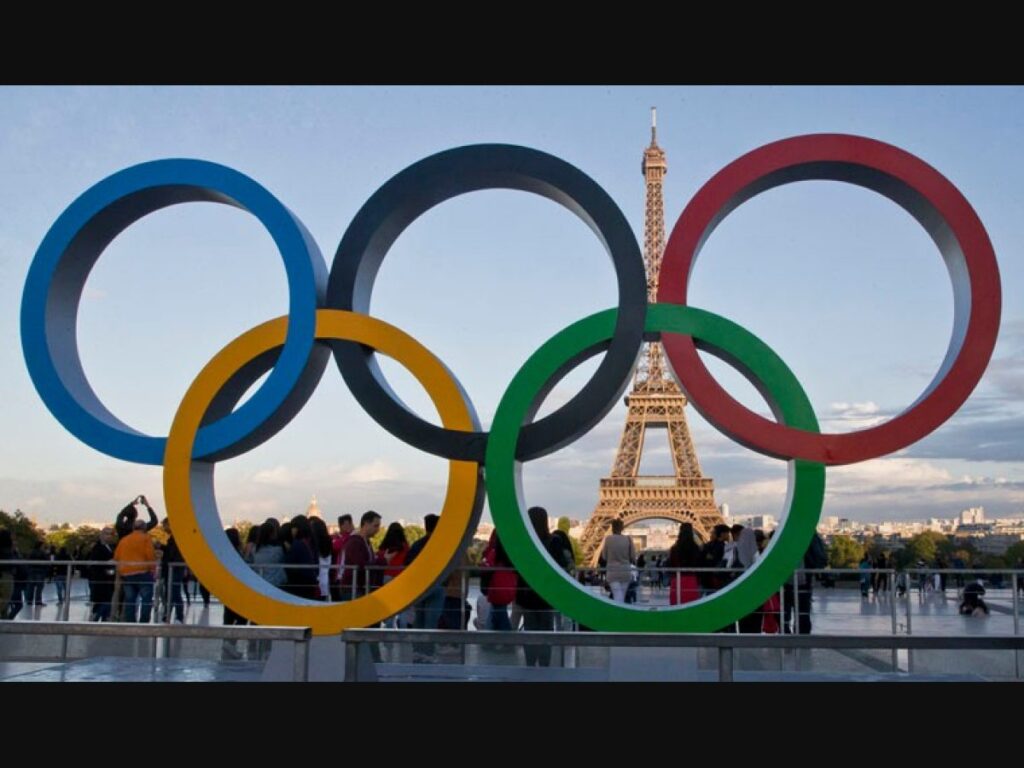
Infrastructure for next year’s Paris Olympics faced the danger of being destroyed by the unrest earlier this month when riots raged around France, adding to the organizers’ already overwhelming list of security concerns.
The under-construction Olympic athletes’ village, media center, and swimming complex—all of which are located in the impoverished Seine-Saint-Denis neighborhood of northeast Paris, one of the rioting’s hotspots—were subject to intensified surveillance.
In the end, a structure that would house a training pool sustained minor facade damage as a result of the nearby bus depot catching fire and two vigilant security personnel foiling an attempted arson assault on the media center.
“We were very close to having a major problem,” Nicolas Ferrand, the leader of the Solideo organization in charge of the Olympics building work, stated after the incident.
The wild street scenes served as an uncomfortable reminder of the Champions League final from the previous year in Paris, which took place at the Olympic sports venue in Seine-Saint-Denis.
At the 2022 conclusion of the European football season, teenage gangs preyed on football fans, and many of them were robbed and attacked as they exited the stadium.
This week, Thomas Bach, the president of the International Olympic Committee, tried to reassure those who were going to Paris.
“We are very confident that the Games can and will happen in a peaceful environment,” he told the press.
– FEARS FOR THE OPENING CEREMONY
According to former national police head Frederic Pechenard, managing street violence around the Olympic sites is a task that French security services are used to facing.
Delinquency, possibly violent riots, and strikes are organizers’ primary concerns, he said.
“If I were in charge of security, which I am thankfully not, a terror attack is what I would be most concerned about.”
Securing what seems to be the most extravagant opening ceremony in Olympic history is the greatest challenge.
Approximately 100 boats carrying sports delegations are scheduled to cruise through the heart of the City of Light on the river Seine instead of the customary parade at the athletics stadium.
Tickets for the open-air event, which will include the flotilla traveling over a six-kilometer (3.7-mile) course passed by tens of thousands of structures, are expected to sell for up to half a million people.
Pechenard, who held the job of national police chief from 2007 to 2012 before becoming a lawmaker for the opposition Republicans party, said security agencies were understandably concerned.
“Everyone knows that it won’t be easy to secure,” he said. “Alone acting and choosing to cause an incident is the biggest risk,”
Interior Minister Gerald Darmanin said in December 2017 that large terror schemes involving several individuals are considered as being simpler to discover and disrupt by intelligence agencies, who had stopped 39 assaults in France over the previous five years.
In general, Pechenard said he was “optimistic” due to the robust team in charge of security, which included the interior ministry and the organizing committee, and that “100 percent safety” was impossible at any significant public event.
Tony Estanguet, the head of the organizing committee for Paris 2024 and a three-time Olympic gold medalist in canoeing, told reporters on Tuesday that “unprecedented security arrangements” will be put in place. “I believe it will be the safest place on earth, where you can be in complete security,” the speaker said.
IS THE ARMY NEEDED?
Security personnel are relying on the assistance of contentious crowd-monitoring equipment and private-sector troops because to the vast area that has to be protected surrounding the opening ceremony as well as the venues.
The use of cameras connected to AI-assisted software will enable police to identify possible threats and suspicious activity before they become evident to officers on the ground.
While domestic opponents fear that the system might be implemented indefinitely, several left-wing EU politicians have cautioned that it “creates a surveillance precedent never before seen in Europe”.
Efforts to hire up to 22,000 private security agents have also encountered difficulties; thus yet, only around 25% of the available posts have been filled, and industry insiders have complained that the pay is too low.
In a strategy reminiscent of Britain’s for the 2012 London Olympics, Interior Minister Darmanin has already suggested that the military may be called in to cover any gaps.
President Emmanuel Macron has put enormous pressure on him to make sure that the Games go off without a hitch in front of the anticipated over a billion television viewers.
“The president wants everything to go smoothly for the international image of the country,” a ministry told AFP this week on the condition of anonymity. Things that go wrong are never forgotten.