


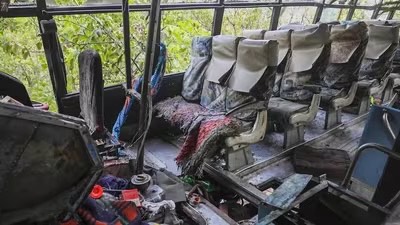
Prime Minister Narendra Modi disregarded former Pakistani Prime Minister Nawaz Sharif’s advice to replace “hate with hope” in his congratulatory message and made it clear that the security and well-being of the Indian people are the top priorities of Modi 3.0, one day after three jihadists from the Pakistan-based Lashkar-e-Toiba (LeT) sprayed bullets on Hindu pilgrims on a bus returning from Shiv Khouri to Katra on the Reasi-Katra road, killing ten innocent people. (Jammu)
The very following day, S. Jaishankar, the minister of external affairs, addressed the crucial problem of cross-border terrorism between Pakistan and India with greater candour, emphasising that terrorism could never be the conduct of a neighbourly friend.
There have been numerous terror incidents in the Jammu and Kashmir region since Prime Minister Modi took the oath of office on June 9 at Rashtrapati Bhawan. In addition to the 10 people killed and 33 injured in the bus explosion, six soldiers were hurt in terrorist firing at Chattergala in Bhaderwah on the intervening night of June 11–12. Before the Doda event, security forces in Kathua also shot and killed two terrorists from Pakistan.
In the wee hours of June 12, another CRPF constable lost his life when terrorists opened fire on him in the Kathua district’s Hiranagar sector.
What is Pakistan up to, and why has the number of terror occurrences south of Pir Panjal suddenly increased?
First, the LeT handlers in Sialkot, Sajid Jutt, also known as Saifullah, Mohammed Qasim, also known as Gujjar, and Abu Qatal, also known as Qatal Sindhi, are the terror offenders behind the Reasi bus attack and other heinous acts.
The three have planned the enlistment and deployment of LeT terrorists from Pakistan to attack security officers and other innocent bystanders, as well as Hindu pilgrims. Jutt is a senior LeT leader, while Qasim Gujjar is the commanders’ right-hand man in Lahore.
Along with other terrorists, Bi Qatal arrived in India in 2002–2003 and has since been operating in the Poonch–Rajouri region. At least thirty to thirty-five foreign terrorists or Pakistanis have infiltrated into the Jammu and Kashmir sector in the last year. The Samba-Kathua sector is currently the hotspot of infiltration, and the cross-border tunnel is a possibility. There is more mayhem and carnage in the Jammu and Kashmir region now that the number of Pakistani jihadists surpasses that of local radicals.
Since 2021, Pakistani terrorists have been targeting the Rajouri-Poonch-Samba-Kathua axis because of the Sajid-Jutt and Qasim Gujjar module. As a result, at least 38 soldiers and 21 civilians have died in the Jammu sector.
According to top intelligence sources, since 2021, at least four groups of three terrorists have been active in the Rajouri-Poonch region. All of these groups have either Russian-origin AK-47 weapons or American M-4 or M-16 assault rifles.
Although Pakistani Prime Minister Shehbaz Sharif has wished Prime Minister Modi well, the deep state in Pakistan is responsible for the recent spike in terror-related murders, giving the go-ahead to jihadists. In actuality, the GHQ in Rawalpindi tightened down on cross-border terrorism during the Indian general elections, fearing that it would either polarise Indian voters in favour of the BJP or provoke an Indian attack on Pakistan akin to Balakot in the event of a terror strike similar to the one that occurred in Pulwana.
Only 20 days before the pilgrimage to Amarnath, the Reasi bus attack was planned to strike hard at India, had Providence not forced the unfortunate bus into a deep gorge.
The Islamists would have slaughtered all 53 innocent people on board if the bus had crashed on the road. This would have been a reenactment of the terrorist attack in June 2013 in Hyderpora, on the outskirts of Srinagar, when they opened fire on a bus carrying security officers. Sajid Jutt signed both assaults, while Muridke-based LeT emir Hafiz Saeed, acting at the behest of Rawalpindi GHQ, devised the evil scheme.
Massive voter turnout—58.6% in the parliamentary constituencies of Srinagar, Baramulla, Anantnag-Rajouri, Udhampur, and Jammu—during the 2024 general elections is the main cause of the spike in terror attacks in the Jammu sector. The three Kashmir Valley parliamentary constituencies saw an exceptional 30 point increase in voter turnout from the previous general elections in 2019, when it was 19.16 percent, to 50.86 percent.
With the largest voter participation in the last 30 years and after the repeal of Article 370, the parliamentary constituencies of Srinagar, Baramulla, and Anantnag-Rajouri registered tremendous turnouts of 38.49 percent, 59.1 percent, and 58.84 percent, respectively.
The fact that Kashmiri Muslims, including separatists and Jamaat-e-Islami employees, were shown excitedly displaying their ink-stained fingers in front of the media following the 2024 poll was what infuriated both the government of Pakistan and jihadists.
The unexpected upsurge in terror attacks is meant to serve as a warning to the people of J&K that they will face severe reprisals should they choose to engage in the democratic process in India in the future. The attacks serve as a reminder that the Islamic jihad in the UT is still ongoing, even though pro-Pak and Western media’s forecasts that Kashmiris would abstain from the polls were completely incorrect.
The Indian security forces confront a difficult challenge in neutralising the Pakistani asymmetric onslaught from across the border, even if national security planners do not rule out further terror operations in the Jammu region. The task is challenging since the Jammu and Kashmir region has both steep and densely forested terrain, making it more difficult to locate and neutralise militants.
Because of the difficult terrain and the inability to immediately deploy soldiers, as in the valley, intelligence on these terrorists requires a lead time of 18 to 20 hours. As a result, the Indian security services must employ previously untested strategies to find terrorists hiding in the high mountains and forested areas. Since these terrorists are native to the region and make their home there, the Indian security services also require access to relevant intelligence from across the border. Drones are unable to penetrate the dense jungle, so actionable HUMINT and TECHINT are needed.
It is the responsibility of the recently appointed Chief of the Indian Army, Gen. Upendra Dwivedi, and his Northern Army Commander, Lt Gen M V Suchindra Kiumar, to confront the enemy head-on. Dwivedi is familiar with the terrain and the tactical challenges of counterterrorism operations in the Jammu sector. Stopping infiltration is essential, then eliminating the FTs by rewarding the overground members of jihadist groups.
To stem the terror attack, the Indian security forces must coordinate with the Jammu and Kashmir police and intelligence services since the jihadists are currently on the rampage.
The Prime Minister, Narendra Modi, has made it plain to the Army that he will not stand by while Pakistanis slaughter Indian citizens without cause. The Modi administration, in particular, is more than willing to offer any assistance. The Jammu and Kashmir region is experiencing a high level of terror activity, and Bharat will respond to the Pakistan-sponsored jihad with equal vigour. Prime Minister Modi does not tolerate fear.