


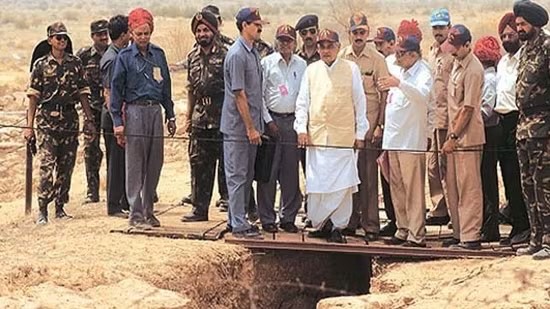
The Shakti series of nuclear tests, carried out by India under NDA Prime Minister Atal Bihari Vajpayee on May 5 and May 11 at Pokhran, marked a turning point in the country’s nuclear capabilities about both clean energy and national security 26 years ago.
India has advanced significantly in the interim since announcing its nuclear weapon state status by detonating a variety of explosives, including thermonuclear and tactical bombs. It now possesses a fully operational nuclear triad and a strong second-strike capability thanks to nuclear-powered ballistic missile-firing submarines. Currently, India possesses a 3000 km range K-4 submarine-based ballistic missile and a 5000 km range land-based Agni ballistic missile, which are capable of protecting India from threats from China, Pakistan, and other countries.
The primary factor in Vajpayee’s decision to test was that, for the first time, India publicly acknowledged China as the primary driver behind Bharat’s nuclear programme, even if nuclear deterrence has allowed India to resist the military and diplomatic pressure of major world powers. “We have an overt nuclear weapon state on our borders, a state that committed armed aggression against India in 1962… to add to the distrust that country has materially helped another neighbour of ours to become a covert nuclear weapon state,” Vajpayee wrote in a letter to then-US President Bill Clinton on May 13, 1998. That day exposed China’s threat to India, since up until then, neither the Indian government nor the media had mentioned China by name. The Buddha grinned that day, and the Communist state was Voldemort in India.
Even after 20 years, the threat from China and the Communist dictatorship has not lessened; on the contrary, it has grown as a result of concerns that the pro-Beijing Muizzu regime in the Maldives may soon lease an island to the PLA so that it can establish a base. The Maldives has received clear communication from India that this is unacceptable and will have dire consequences. China has expanded the number of intermediate-range ballistic missiles in its arsenal, while Pakistan is working to develop MIRV technology in response to India’s asymmetric conventional threat. Another issue is that China is utilising Pakistan as a springboard for jihad against the Indian hinterland.
Following the Shakti series of tests, PM Vajpayee faced criticism from the opposition, especially from left-wing parties and leftist media. The government also had to resist US pressure to sign the CTBT through media that supported West Indian states. However, under Vajpayee, India was able to withstand pressure and sanctions, and four years later, on July 28, 2002, Secretary of State Colin Powell offered National Security Advisor Brajesh Mishra the civilian nuclear deal. This was despite the world declaring India to be a nuclear pariah, except for France in the P-5.
By carrying out surgical strikes and Operation Bandar in Balakot, Pakistan, in response to terror attacks for which Rawalpindi GHQ refused to respond, Prime Minister Narendra Modi disproved the nuclear flashpoint theory, which India’s enemies in the west were using to put pressure on India over Kashmir on behalf of Pakistan. To ensure that Bharat is included in the response to climate change, the same Indian capability is being used today to develop sustainable energy. It was May 11, 1998, that marked India’s global debut.