


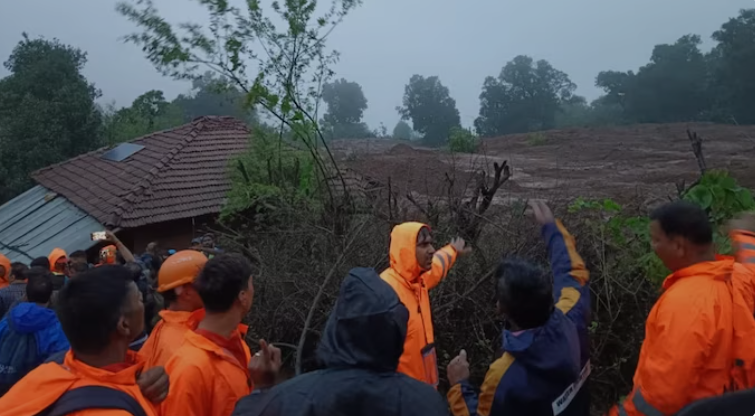
The effects of the devastating landslide that destroyed an entire hamlet in Maharashtra’s Raigad region on that fateful July 19 night are still clearly visible in the memories of those who survived. The threat of climate change has arrived at the doorstep of the people of Irshalwadi, who now live in temporary container houses just a short distance from where they formerly lived. According to scientists, extreme weather occurrences have made the slopes more unstable, posing a danger to their very survival.
While rainfall amounts have stayed mostly consistent, Prakash Gajbhiye, head of the Geological Survey of India (GSI) in Pune, notes that the temporal dynamics have changed. Now as the rains come in shorter, more frequent spurts, they are more strong, sopping up the rocks and dirt and causing abrupt landslides. These dangers are made worse by man-made activities including deforestation, slope cutting connected to development, and changes to natural drainage patterns, according to PTI.
The citizens of Raigad struggle with an uncertain present and an even more uncertain future as scientists examine larger climate patterns. They struggle with the decision of whether to stay in the houses that have been handed down through the generations or to face reality and move to safer locations.
Manisha Yashwant Dore lives in one such resident’s makeshift container house close to the Irshadgad fort. Even while it provides more modern conveniences than in the past, it will never be able to match the straightforward yet content existence they formerly had in Irshalwadi. Her daughter’s calls for aid during the landslide, a tragedy that lost seven family members, always haunt her.
Similar tales of ambiguity and imminent peril resound across the adjacent communities. Residents of Changewadi are always in danger of landslides because a huge rock nearby is on the verge of collapsing. Their request is straightforward: get rid of the boulder, and we’ll remain. Many of these people are members of the Thakar tribe, which has long coexisted peacefully with the forest. As such, they are hesitant to leave their ancestral lands.
In other communities, like Tadwadi and Beedkhurd, where sinking earth and fissures have raised fears, this sorrowful story is repeated. Tragically, Irshalwadi is not the only hamlet to have met with such a demise. Similar landslide disaster struck the Raigad hamlet of Tailye in 2021, killing 87 people.
The Raigad district collectorate said that between 2005 and 2021, almost 350 lives were lost as a result of harsh weather occurrences. The Konkan division’s deputy collector, Vivek Gaikwad, has identified 109 villages that are very susceptible to landslides, with 11 being categorized as “moderately vulnerable” and nine as “most vulnerable.” The permanent evacuation of six Raigad villages has been suggested by the Indian Geological Survey.
Ulka Mahajan, a social activist who often interacts with indigenous people, thinks more villages need renovation. Being close to these natural resources is essential to any relocation endeavor since these tribes’ existence is inextricably connected to the woods.
Extreme weather conditions in the area are a result of the Arabian Sea warming, according to climate expert M Rajeevan. Raigad is more prone to landslides than other locations because to the Deccan plateau’s distinctive basalt rock formations and its geological makeup.