


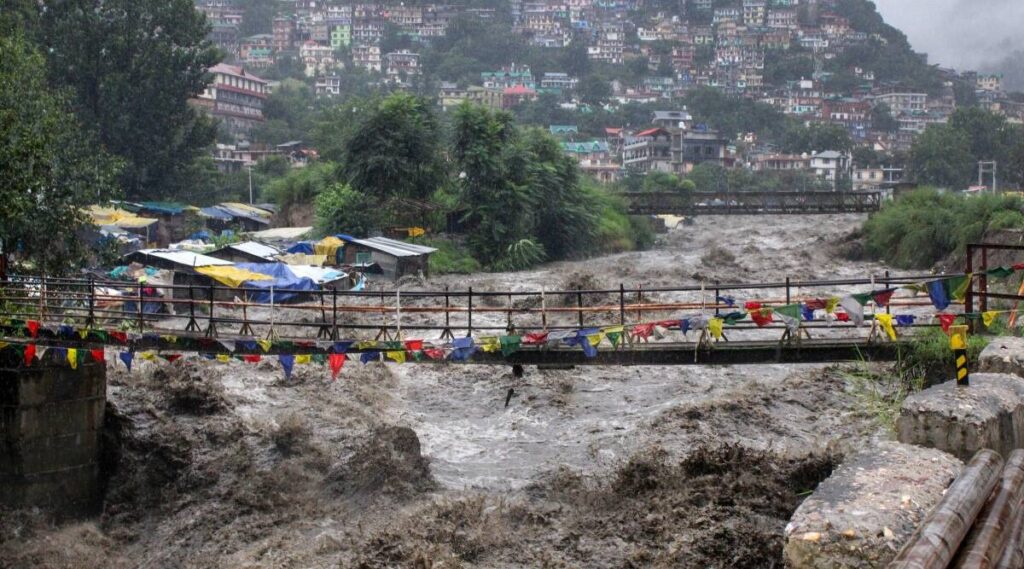
Over the course of three days, torrential rains in different regions of India have claimed the lives of at least 42 people. Landslides have severed several cities’ and villages’ sole connections, and rampaging floods have destroyed bridges, homes, and automobiles.
The most devastated areas were Himachal Pradesh, Punjab, and Chandigarh, with Himachal alone responsible for 20 fatalities. As heavy rain was predicted for many days in Uttarakhand, weather authorities issued a red warning for the state on Tuesday, raising concerns of a repeat of the pandemonium that the neighbouring Himalayan state has been experiencing since the weekend.
Sukhvinder Singh Sukhu, the chief minister of Himachal Pradesh, expressed “deep sorrow” over the fatalities and said the administration was “making all-out efforts” to address the issue despite the forecast for additional rain.
The state has already lost around 3,000 crore in this monsoon season, he said, adding such “widespread heavy rains” have not happened in 50 years.
Authorities had sent helicopters to rescue nearly 300 people, including tourists, who were stuck in Lahaul-Spiti and Kullu in Himachal Pradesh but were waiting for the downpour to stop before doing so.
When water from the Ghaggar and Sutlej rivers flooded urban areas on Monday, it broke bridges, breached roads, flooded homes and hospitals, and caused serious waterlogging in Chandigarh, Panchkula, and Mohali, three planned towns in north India.
The government halted traffic on the Delhi-Amritsar highway, which is the busiest road in India, at the Shambu toll plaza, which is close to the Ambala-Patiala border because the Ghaggar River’s embankment broke, flooding the roadway.
There isn’t an other path accessible, according to Ambala District Collector Dr. Shaleen (who goes by one name only). The Army has been requested to seal the opening and clear the path so that traffic may resume on the roadway, the DC said.
According to a government official, Prime Minister Narendra Modi discussed the status of their respective states with the chief ministers of Himachal Pradesh and Uttarakhand, Sukhu and Pushkar Singh Dhami, respectively. He said that the Indian government will provide every assistance and support.
A unusual and powerful combination of monsoon winds with a western disturbance has caused heavy rain periods to spread from Punjab and Rajasthan in the west and northwest to the Himalayas in the north. Late last week, the storm moving in from the west, over Pakistan, coupled with the monsoon winds that had been bringing moisture in from the south, creating a powerful rain-bearing system.
The highest alert or red warning was issued by the India Meteorological Department on Monday for very heavy rain in the districts of Kangra, Kullu, Mandi, Shimla, Sirmour, Una, Bilaspur, Hamirpur, and Solan. “Solan, which received 135mm of rain on Monday, broke a 50-year-old record of 105mm of rain in a day in 1971, while Una received the highest rainfall after 1993,” said Surender Paul, director of the IMD regional office, which has its headquarters in Shimla.
The monsoon trough is over the Indo-Gangetic Plains region, thus we may anticipate heavy to very heavy rainfall over Himachal Pradesh for one more day and over Uttarakhand for the next two to three days. Additionally, there is cyclonic circulation across sections of South Haryana that border northwest Rajasthan. Therefore, Mahesh Palawat, vice president of climate and meteorology at Skymet Weather, predicted that rain would continue to pour across northern India.
The third consecutive day saw a disruption in Shimla-Kalka railway service, while section of the Manali-Leh route was washed away, causing traffic to stop. Numerous sections of the Shimla-Chandigarh motorway were blocked.
A three-story hotel structure fell into the raging Beas river in the alpine town of Manali.
The Public Works Department’s most recent data indicates that as of Monday, 171 roads, including 16 state highways, were blocked in Uttarakhand. Schools have been closed in the areas most severely impacted, including Almora, until July 12.
IMD’s Dehradun centre has issued an orange alert that is in effect till July 12. Due to landslides and rockfall at several spots, the current Char Dham Yatra has also been impacted by the recent severe rains.
The Amarnath Yatra in Jammu and Kashmir was put on hold for a third day in a row, despite increased attempts by the National route Authority of India to reopen the Jammu-Srinagar route (NH44), which is closed near Ramban because of heavy rain. A senior official said, “The yatra remains suspended from Jammu due to the poor condition of the highway.”
In numerous areas of eastern and central Rajasthan, life came to a complete halt due to the heavy rain. In the state capital’s various regions were reeling from waterlogging, a seven-year-old kid was carried away in the surging floods of an overflowing sewer.