


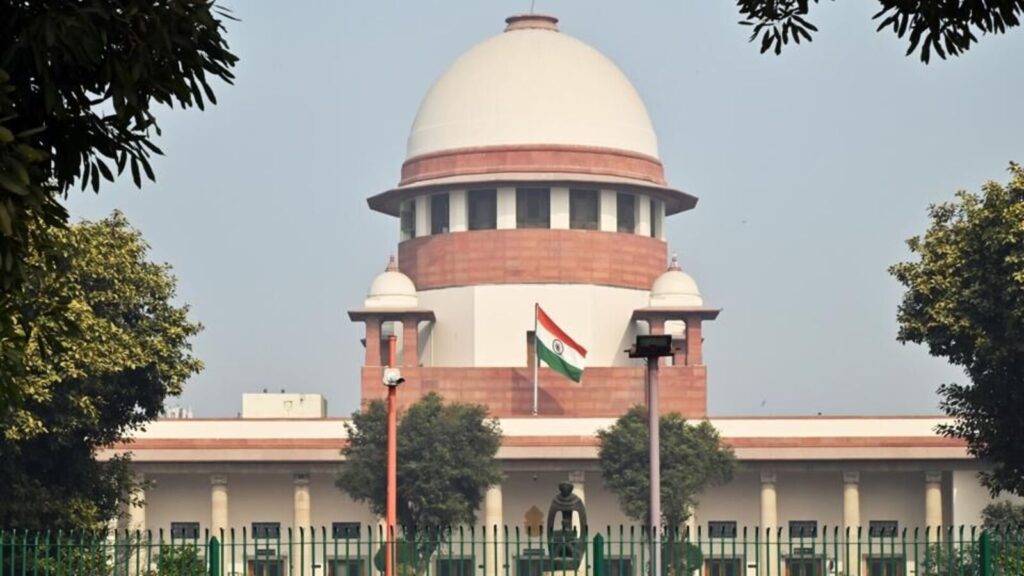
A number of petitions asking the Supreme Court to reconsider its decision maintaining the 10% economic weaker section (EWS) quota imposed in 2019 for educational institutions and government employment that excluded the poor within the SC/ST/OBC categories have been rejected.
A five-judge panel led by Chief Justice D Y Chandrachud ruled that there was no justification for the judgement to be overturned.
Additionally, it denied the request to schedule an open court hearing for the applications.
The order was issued by the Supreme Court on May 9, and a copy of it was posted online on Tuesday.
“After reading the review petitions, I can say that the record seems to be error-free. No case to be reviewed… The panel, which also included Justices Dinesh Maheshwari (now retired), S. Ravindra Bhat, Bela M. Trivedi, and J. B. Pardiwala, ruled that the review petitions were therefore rejected.
The Supreme Court’s decision was made in response to a number of appeals, including those brought by Congresswoman Jaya Thakur and the Society for the Rights of Backward Communities (SRBC) to have the Supreme Court’s November 7, 2022 ruling reviewed.
The fundamental structural theory cannot be used as a “sword” to “stultify” the State’s efforts to provide economic justice, a five-judge Constitution court said in a historic decision.
It had rendered a 3:2 majority ruling in favor of the 103rd Amendment to the Constitution. The Supreme Court had ruled that the 10% reservation for EWS, which was implemented in 2019 and removed the poor from the SC, ST, and OBC categories, is neither discriminatory nor in violation of any fundamental principle of the Constitution.
The court had said that treating the EWS as a distinct group is a legitimate categorization and that the Mandal judgment’s 50% cap on the overall reservation is “not inflexible” when they rejected the petitions contesting the legality of the statute.
On 40 petitions challenging the amendment that was made after the Narendra Modi administration chose to offer quota to the economically vulnerable sections ahead of the 2019 Lok Sabha elections, the bench presided over by then Chief Justice U U Lalit had issued four verdicts.
The EWS quota has been affirmed by Justices Dinesh Maheshwari, Bela M Trivedi, and J. B. Pardiwala.
When they rejected it, the then-CJI and Justice S. Ravindra Bhat were in a minority and said that the amendment “practises constitutionally prohibited forms of discrimination” since it excluded the impoverished from classifications like SCs, STs, and OBCs.
In order to promote an inclusive march toward the objectives of an equitable society while combating disparities, the supreme court has ruled that reservations are a tool of affirmative action by the State.
The present 50% reservation to Scheduled Castes (SCs), Scheduled Tribes (STs), and Other Backward Classes (OBCs) is in addition to the EWS quota.