


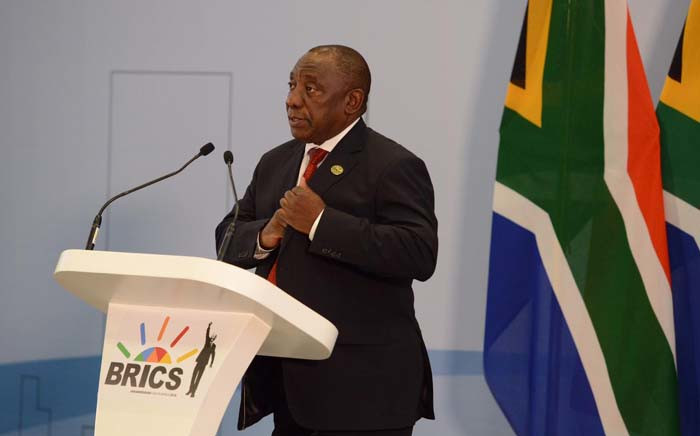
President Cyril Ramaphosa of South Africa said as he started the 15th BRICS Summit on Tuesday that the current wave of protectionism and the consequent effect of unilateral actions that are incompatible with WTO standards damage global economic growth and development.
On stage, Ramaphosa spoke with Chinese Commerce Minister Wang Wentao, who spoke on behalf of Chinese President Xi Jinping, Brazilian President Lula Da Silva, and Indian Prime Minister Narendra Modi. Putin, the president of Russia, spoke virtually after the leaders had gathered for the Leaders Dialogue of the BRICS Business Forum.
The structure of the global economy has significantly changed as a result of the developments that have occurred in the BRICS economies during the last ten years. The latest surge of protectionism, together with the effects of unilateral actions that are outside WTO regulations, jeopardizes international economic progress, according to Ramaphosa.
The President said that BRICS needs to reiterate its stance that inclusivity and transparency must serve as the cornerstones of economic progress. It has to work with a multilateral trade system that promotes development. The New Development Bank (NDB), founded by the BRICS nations in 2015, was cited by Ramaphosa as setting the bar in this respect. “We require a fundamental reform of the global financial institutions so that they can be more agile and responsive to the challenges facing developing economies,” he added.
Since its founding, the NDB has shown its capacity to mobilize funds for infrastructure and sustainable development in developing countries, he said.
According to Ramaphosa, the BRICS nations’ economies have become potent drivers of world expansion. “However, the quickening economic, technical, and social transformations pose fresh threats to poverty, equality, and employment in many BRICS nations. We thus urge the business community to work with us to find answers to these and other issues impacting our national economies, he said in his address to the Summit’s audience of several hundred business leaders.
The president also emphasized the chances for the BRICS nations to join in and contribute to Africa’s economic narrative. Increased collaboration in industries including infrastructure, agriculture, manufacturing, new energy, and the digital economy, according to Ramaphosa, can help accomplish this goal.
BRICS investors, according to Da Silva, would be interested in Brazil’s vastly increased prospects for infrastructure development. Putin criticized certain nations for taking advantage of markets, but he did not directly identify any.
“It is crucial that this forum concentrate on such urgent issues as increasing volatility in the stock, currency, energy, and food markets, as well as strong inflationary pressures resulting, among other things, from the irresponsible large-scale money emission by a number of countries seeking to mitigate the effects of the pandemic, which has led to the accumulation of private and public debt,” Putin said.
Despite the uncertainty in the global market, Modi predicted that India will soon reach a five trillion dollar GDP. Without a shadow of a doubt, India will be the global development engine in the years to come, according to Modi. “The reason for this is that India has turned crises into opportunities for growth and development,” he said.
According to Wentao, the globe has evolved into a community with a common future. “A new Cold War or a narrow exclusive bloc are absolutely not what people in the different nations want for. They aspire to a free, welcoming, spotless, and lovely society where everyone may enjoy social security and shared wealth. This is the benefit of historical logic and the current fashion, according to Wentao.
On Wednesday, the BRICS Summit will continue, and on Thursday, it will come to an end with a focus on Africa.