


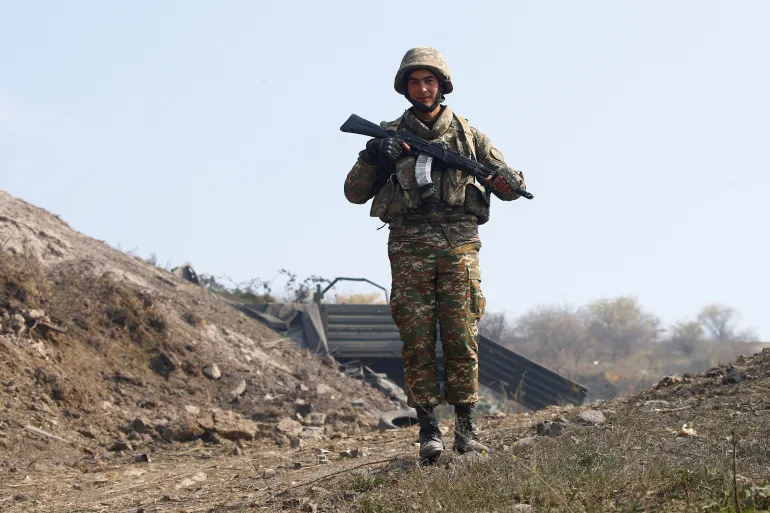
The hilly territory of Nagorno-Karabakh has been the source of two wars between the former Soviet republics of Armenia and Azerbaijan in the last century.
A TIMELINE OF THE PROBLEMS APPEARS BELOW:
independent Soviet region in 1923
Nagorno-Karabakh, a region with a majority of Armenians that is recognized by the international world as being a part of Azerbaijan, a country with a Muslim majority, has had several handovers throughout its history.
It joined the Russian empire in 1813 and was given the status of an autonomous district in the Soviet republic of Azerbaijan in 1923.
Ethnic Armenians in Karabakh started to demand that their territory be governed by Armenia as the Soviet Union started to fall apart in the late 1980s, but both Azerbaijan and Moscow rejected their request.
First war in 1992
After Armenia and Azerbaijan left the Soviet Union in 1991, a large majority of Karabakh’s citizens voted in favor of independence.
The two sides engaged in conflict when Azerbaijan rejected the election, which was not accepted by the international world.
The Armenians of Karabakh won the battle in 1992-1993.
They seized control of the area as well as a portion of the nearby Azerbaijani land that connected it to Armenia.
About 30,000 individuals died in the battle, and thousands more were driven from their homes.
While ethnic Armenians left Azerbaijan, ethnic Azeris fled Karabakh and Armenia.
1994: a truce
In 1994, a cease-fire mediated by Moscow placed control of Karabakh and the surrounding area in Armenian hands.
However, fatal skirmishes continued to occur frequently along the Azerbaijani-Karabakh border.
Second conflict in 2020
Azerbaijan, aided by Turkey, reclaimed a large portion of the area it had previously lost in a six-week conflict in 2020.
The conflict claimed the lives of almost 6,500 soldiers, with the Armenians suffering the greatest casualties.
A cease-fire mediated by Russia brought it to a conclusion.
Large portions of the area that Armenia had long held were given up as part of the agreement.
Around 2,000 Russian peacekeepers were sent from Moscow to monitor the cease-fire.
The major government building in Yerevan, the capital of Armenia, was overrun by protesting Armenians who saw the accord as a disgrace.
Blockade in 2022
Fighting came out once again in September 2022, this time with both sides blaming the other for starting the week-long battles that resulted in more than 210 fatalities.
After Baku restricted cargo deliveries on the only route between Armenia and Karabakh, leading to a lack of food, Armenia accused Azerbaijan of escalating a humanitarian crisis in December.
New Azeri offensive in 2023
On September 19, Azerbaijan accused Armenian rebels in Karabakh of carrying out fatal mine strikes and began what it called “anti-terrorist measures” against them.
In Stepanakert, the capital of Karabakh, explosions were audible.
The separatists said that so far, the attack has resulted in five fatalities and 80 injuries.
As a prerequisite for peace, Azerbaijan demands the complete departure of Armenian troops from Karabakh.