


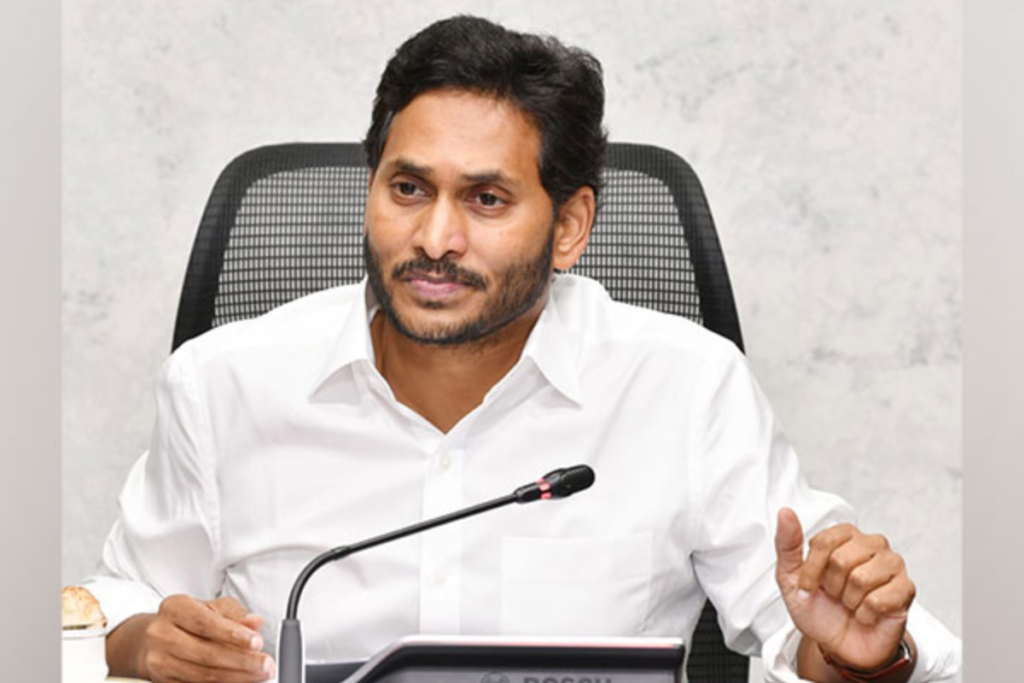
In spite of rainfall deficits, the Andhra Pradesh government, led by Chief Minister YS Jagan Mohan Reddy, has successfully managed water distribution to help farmers in tail-end areas. However, a few media outlets have been disparaging the government by disseminating misleading information, according to a statement from the chief minister’s office.
Under the Prakasam Barrage, there are more than 13.08 lakh acres of Ayakattu (land that relies on canal irrigation). For the Kharif 2023–2024, water was provided on July 7. 9.91 lakh acres of paddy have been planted, it continued.
Ayakattu has received 85.81 TMC of water from the Prakasam Barrage so far. Water is being withdrawn from the Pattiseema lifting system and Pulichintala project due to the Krishna River’s lack of flow, the announcement said.
The Water Resources Department states that “inflows to the Krishna River from Munneru, Paleru, Keesara, etc. supply the remaining 20 TMC water, with 35.93 TMC coming from the Pulichintala project and 29.88 TMC from the Pattiseema scheme.” This year’s bad weather has resulted in little rainfall in the Krishna River basin. Consequently, the reservoirs at Srisailam and Nagarjuna Sagar hold insufficient water to discharge for the Krishna delta area. The Chief Minister has periodically discussed the matter with the department’s top personnel and created a backup plan.
According to the statement, the government has taken the required precautions to safeguard the crops that the farmers have sown, and as a result, the water in the Pattiseema and Pulichintala projects has been utilized very cautiously and sensibly.
It said that at the start of this season, the Pulichintala project had 38 TMC of water storage, according to statistics from the Water Resources Department.
The farmers received water for their crops, and around 18 TMCs of water were released for the crops in the Krishna Delta up to Godavari. The Pattiseema pumps were turned on, and starting on July 21, water was sent to the Krishna delta via the Prakasam barrage since Pulichintala’s water supplies were running low.
The department said that the government, led by Chief Minister Jagan, had executed a visionary strategy that allowed them to store 19 TMCs of water in Pulichinthala via the Musi River during Telangana’s rainy season. “The inflow of water from the Musi River would have created a flood-like situation if the water from the Pulichintala project had not previously been harnessed.”
This year has had very little rainfall in both the Ayakattu area and the Krishna basin. It is unusual that there was less rainfall in August and October. The government has implemented the Warbandi system (on and off) and other essential steps to prevent the crop from drying up, especially in this severe circumstances when nature is not cooperating. These actions are intended to safeguard the interests of the farmers.
According to the statement, given the monsoon circumstances, the Warbandi technique is also being used to prevent the crops from drying out. “There won’t be any drain flow in the locations that are specified for a week due to the system. Farmers use oil engines in these circumstances, particularly near the canal’s terminus, to clear the standing water and preserve the crops. The Water Resources Department is working tirelessly to provide water to the areas who need it most in the back end.
The agency said that 5,30,136 acres of the 7,36,953 acres of registered land in the Krishna Eastern Delta are under cultivation. The Prakasam Barrage has delivered 52.69 TMC of water so far. According to the statement, Ayakattu is receiving water supplies via the Warabandi system.
It also said that the Eluru Canal was formerly supplied with 800–1200 cusecs of water, and that at present, 1000 cusecs of water are being delivered. In Ayakattu, crop drying is not a need. Every acre of Ayakattu is to get water, and this is being done with every effort.
A weekday strategy is being implemented to prevent crops from drying up, and frequent evaluations are being carried out in front of public representatives and officials from the water resources department.