


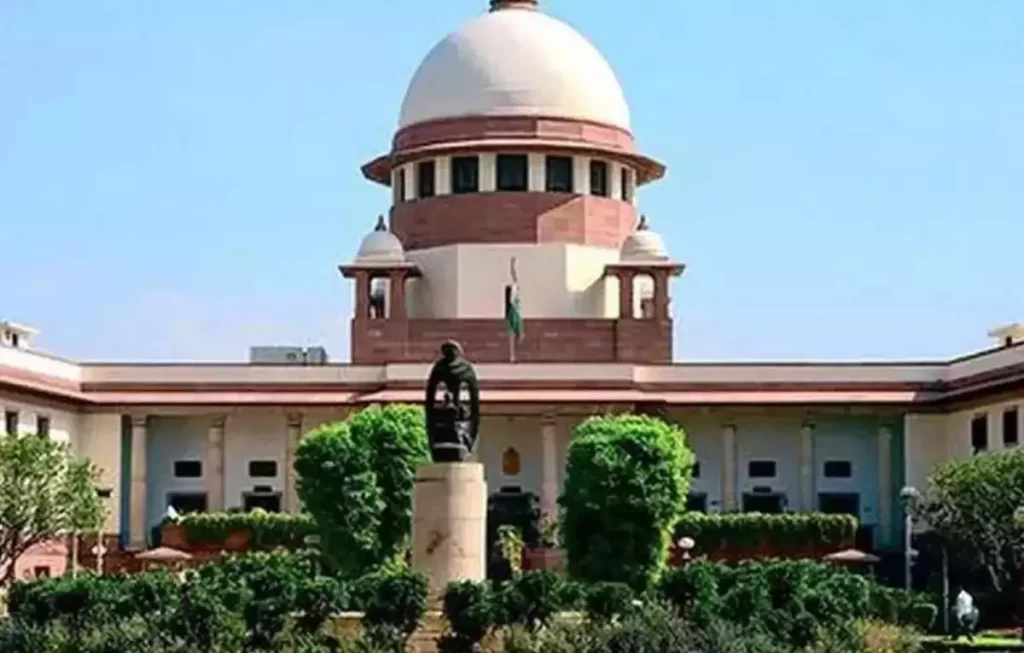
The Supreme Court maintained the legality of two national laws and the accompanying regulations on Tuesday, stating that the directors of the CBI and Enforcement Directorate may hold office for a maximum of five years.
The contention of the petitioners, including some leaders of the Congress and TMC, that the Act amendments will be used as “carrot and stick” by the government of the day to ensure that the chiefs of the two central probe agencies work according to its wishes was rejected by a bench of Justices BR Gavai, Vikram Nath, and Sanjay Karol.
“The challenge to Central Vigilance Commission (Amendment) Act, 2021 and the Delhi Special Police Establishment (Amendment) Act, 2021 as well as to the Fundamental (Amendment) Rules, 2021 is rejected and the writ petitions are dismissed to that extent,” the court said.
In explaining its decision, the bench noted that the highest court had specifically ordered that the CBI director have a minimum term of two years in its judgement in the Vineet Narain v. Union of India case from 1997.
The supreme court established criteria to guarantee the independence and autonomy of the CBI in its ruling in the case, which is also known as the Jain Hawala case, and ordered that it be put under the supervision of the federal Vigilance Commission (CVC) rather than the federal government.
The two-year term for which the original appointment has been made may, in the public interest, be extended for up to one year at a time, according to Justice Gavai, who wrote the 103-page ruling on behalf of the bench.
“However, this can only be done based on the Committee’s recommendation, which is why it was formed for their nominations. The second caveat additionally stated that no such extension would be allowed until a total of five years, including the original appointment term, had passed.
“The impugned Amendments empower the Government to extend the tenure of the incumbent in the said office by a period of one year at a time subject to a maximum period of five years including the period mentioned in the initial appointment,” the statement said.
The court ruled that such extensions may only be approved by the government if the committees established to advocate their appointment suggest them in the public interest and document their justifications in writing.
Thus, it is evident that the extensions that may be given to the current Director of CBI/Director of Enforcement employees are not at the goodwill of the Government. The Government may only give such an extension on the basis of the committees’ recommendations, and even then only where it is determined to be in the public interest and when the grounds are documented in writing, the bench said.
The court said that the two-year timeframe for CBI/ED directors, as stipulated in the 1997 ruling and subsequent judgments, has not been changed by the challenged changes.
“The contested Amendments do not alter the aforementioned timeframe. The bench said that all that had been done was to provide them the ability to have their terms extended for periods of one year at a time, with a maximum of three such extensions. In addition, the bench added that this had to be done with the approval of the panels established for their appointment.
“We are, therefore, unable to accept the arguments that the impugned Amendments grant arbitrary power to the Government to extend the tenure of the Director of ED/CBI and has the effect of wiping out the insulation of these offices from extraneous pressures,” stated the court.
The bench said that it had “failed” to convince itself that the two core laws and the associated norms are genuine.
The bench took note of the petitioners’ argument that the amendments will undermine the Supreme Court’s directive to have a fixed tenure for the CBI and ED directors and allow the executive to adopt a “carrot and stick” policy that would undermine the very goal of shielding these high positions from unrelated pressures.
A committee comprised of the Central Vigilance Commissioner (Chairman), Vigilance Commissioners (Members), Secretaries of the Union Government in charge of the Ministries of Personnel, Home Affairs, and Secretary to the Government of India in charge of the Department of Revenue, Ministry of Finance, was noted to have the sole authority to recommend the appointment of the ED director.
The appointment requirements were implemented in accordance with the instructions provided by this Court in the Vineet Narain case. We see no reason why such committees cannot be trusted to examine whether the extension is necessary to be provided in the public interest or not if they can be trusted to propose their original appointment.
The judgment said, “At the risk of repetition, such Committee is likewise compelled to record reasons in writing for such recommendations.