


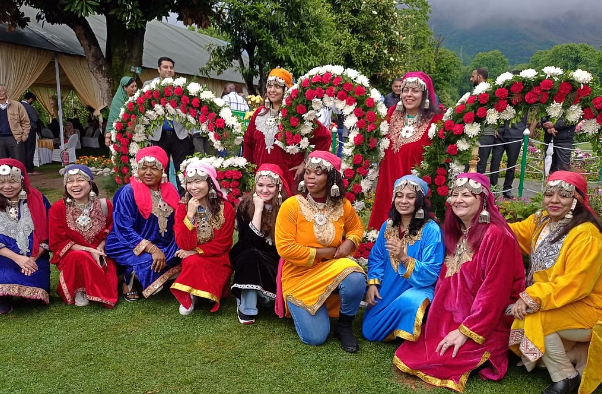
The G20 tourism working group conference ended on Thursday, and senior officials have already sent words of congratulations for its “success” in the Kashmir Valley.
The administration had made extensive preparations for the first international gathering in Srinagar after the repeal of Article 370 and downgrading of Jammu and Kashmir from a state to Union Territories of J&K and Ladakh.
Several neighborhood schools were closed, and the entrance to the venue, the Sher-i-Kashmir Convention Center on the Dal Lake’s shore, was blocked off. To foil any extremist assault, the elite marine commandos of the CRPF and the special naval commandos were stationed at the Dal Lake.
According to the Jammu and Kashmir Police, Kashmir Police Chief Vijay Kumar commended the officers and staff of the Jammu and Kashmir Police, the Centre Reserve Police Force, the Army, the Border Security Force, the SSB, NSG, MARCOS, NDRF, and intelligence agencies for holding a smooth and incident-free G20 Summit.
On the way to the event, the authorities took the concertina wires out of the security bunkers. In addition, the roads were updated, the bunkers were remodeled, and they were painted blue and shrunk in size. The administration also converted the Polo View and Residency Road markets in Srinagar’s city center into pedestrian-friendly marketplaces and invited several delegations to see it.
Although the event was intended to promote travel and film tourism in Jammu and Kashmir, Srinagar’s significance as the venue gained greater weight as a result of Pakistan’s objections and China’s announcement that it would not attend. Along with China, the ceremony was also missed by G20 members Saudi Arabia, Turkey, Oman, and G20 guest nation Egypt.
In explaining the significance of the venue to the attendees, Union Minister of State (Independent Charge) Science & Technology; MoS PMO, Personnel, Dr. Jitendra Singh said, “Earlier, if you had an event like this over here, a hartal call would be made from Islamabad and shops would be shut at Residency Road, Srinagar.” He said that things are different right now. He said that because people are no longer had to pay for the demands for strikes made by Pakistan or by certain Srinagar residents, people’s attitudes have changed.
“A regular person has advanced. If you do a quiet poll, you’ll discover that the average Srinagari guy wants to go, he remarked. In a later interview with media outside the G20 summit, he said that the manner the summit was organized in Srinagar communicated to the outside world that the people of Kashmir had turned their attention to the growth and advancement of India and Jammu and Kashmir.
Without addressing the repeal of Article 370, Lieutenant Governor Manoj Sinha said during a media interview: “Policies and programs have been revised over the past four years to ensure that the fruits of development are distributed to the public and nurture nature. After the second wave of the COVID epidemic, there was an extraordinary rise in tourist foot traffic, and we were pleased to welcome over 18 million visitors in 2017.
“An environment of terror promoted by our neighbor has virtually been destroyed by using a complete government strategy. Jammu and Kashmir of today is not a place of stone throwers or hartals. A responsive and accountable government is working too hard to improve the lives of the people in this nation of peace and prosperity.
The G20 summit in Kashmir, according to a political expert in Srinagar, “is a replica of Jashn-i-Kashmir under Bakshi Ghulam Mohammad’s rule in Kashmir.” ‘All is good’ in Kashmir was Bakshi’s political stance after Sheikh Abdullah’s incarceration.
The expert said, “Even though the G20 was hosted in Srinagar under heavy security, the event had its own importance. It could ostensibly be related to tourism. But politics was the main focus. The presence of US and European delegations at the summit suggests a change in the western powers’ positions on Kashmir.
Historically, Americans were considered as being pro-Pakistan on Kashmir and were actively engaged there starting in 1948. US diplomat Robin Raphel was appointed by President Bill Clinton as the first Assistant Secretary of State for South Asia in 1995 (the position was expanded to include Central Asia). She was well-known in Srinagar because, when working at the US Embassy in Delhi from 1991 to 1993, she often visited the Valley. At a diplomatic gathering, she had called Kashmir “a dispute” and urged holding a plebiscite.
While visiting Kashmir Valley often in the 1990s to meet with separatist leaders and other civil society players, American diplomats and politicians like senator Frank Brown and ambassador Frank Wisner no longer organize any such gatherings.
On Thursday night, Lieutenant Governor Manoj Sinha went to the Jhelum riverside, which had just undergone renovations to show off Srinagar’s progress to G-23 delegations that were in town.
The third tourism working group meeting, which is now taking place in Srinagar, is reportedly hosting the largest contingent of international participants to yet. According to Sinha, it is greater than previous TWG meetings in Siliguri and Gujarat, and, with the exception of China, all G20 nations’ delegates, representatives, and other tourism sector players are in attendance.
Due to its objection to having “any kind of G20 meetings in the disputed territory,” China has already said that it will not be attending the gathering. Pakistan, a non-G20 member, expressed its “strong indignation” in April at India’s choice to conduct the talks in Kashmir, labeling it a “self-serving” action on the part of New Delhi. Pakistan’s complaints were dismissed by the minister of external affairs, S. Jaishankar, who said that Pakistan had “nothing to do with the G20, nothing to do with even Srinagar and Kashmir.” Jaishankar had declared, “Wake up and smell the coffee, as Article 370 is history.”
“There is every reason for the government to rejoice over the event as it seems necessary to create an international legitimacy of the constitutional changes it did in 2019, and this time Americans are on its side and Pakistan couldn’t do anything,” said a Kashmir-based expert who asked to remain anonymous.
“Historic three-day G20 event (May 22–24) comes to an end with delegates taking a flight back and leaving behind all good memories to be treasured by the people of Jammu and Kashmir for long,” said Director General of the Police Dilbagh Singh in a statement that also addressed Pakistan. This gathering has dispelled numerous falsehoods and false anti-Kashmir and anti-peace narratives that have been spread by our neighboring countries, opening up new vistas and raising new hopes.
“The people of Kashmir deserve particular praise for seeing through the fabrications of Pakistan’s propaganda and enthusiastically accepting and taking part in the event. The delegates praised the locals for their friendliness in addition to the beauty of Kashmir, according to the statement.
The least intrusive security measures were taken to ensure that individuals could go about their daily lives and do business as usual, he added. “The security and law enforcement arrangements were friendly to the public.”