


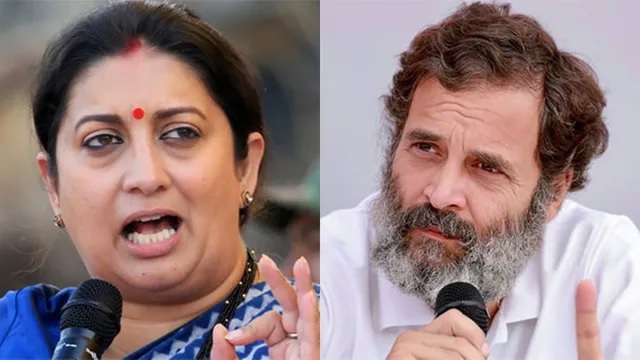
Union Minister Smriti Irani on Monday targeted Congress leader Rahul Gandhi and said that if he (Gandhi) had lived in Wayanad, it would have been in the same condition as Amethi in Uttar Pradesh. Before being convicted and sentenced to two years in prison by a Gujarat court in a criminal defamation case, Rahul Gandhi was a Member of Parliament from the Wayanad Lok Sabha constituency.
After inaugurating the state-level ‘Mahila Shramik Sammelan’ organized by the Bharatiya Mazdoor Sangh (BMS), Kerala, here, the Union minister said he had the “good fortune” to “see off” Gandhi from Amethi. Irani said, “The reason for this was that when he was the MP from Amethi, 80 per cent of the people there did not have electricity connection, there was no District Magistrate’s office, there was no fire station, there was no medical college, no Kendriya Vidyalaya or There was no Sainik school and there was no dialysis center or X-ray machine in the district hospital.
The Union Minister for Women and Child Development said, “After he (Gandhi) left, all these facilities and infrastructure became possible there, so if he stays in Wayanad, it will also meet the same fate as Amethi, so you (people) ) will have to ensure that he does not stay here.” Irani said that wherever she lives, be it in Delhi or Amethi, she is very concerned about Wayanad, so there is a need to convert 250 anganwadis into efficient ones. has decided.
Saksham Anganwadi is a centrally sponsored scheme, under which anganwadis in states and union territories provide six services – supplementary nutrition, pre-school non-formal education, nutrition and health education, immunization, health check-up and referral services to all eligible beneficiaries. On the issue of women’s safety, the minister referred to the recent murder of young doctor Vandana Das in a taluk hospital in the state and said it was surprising that such an incident took place despite the presence of a police officer there. Minister of State for External Affairs V Muraleedharan, who was present in the programme, also raised questions on the issue of women’s safety in the state.