


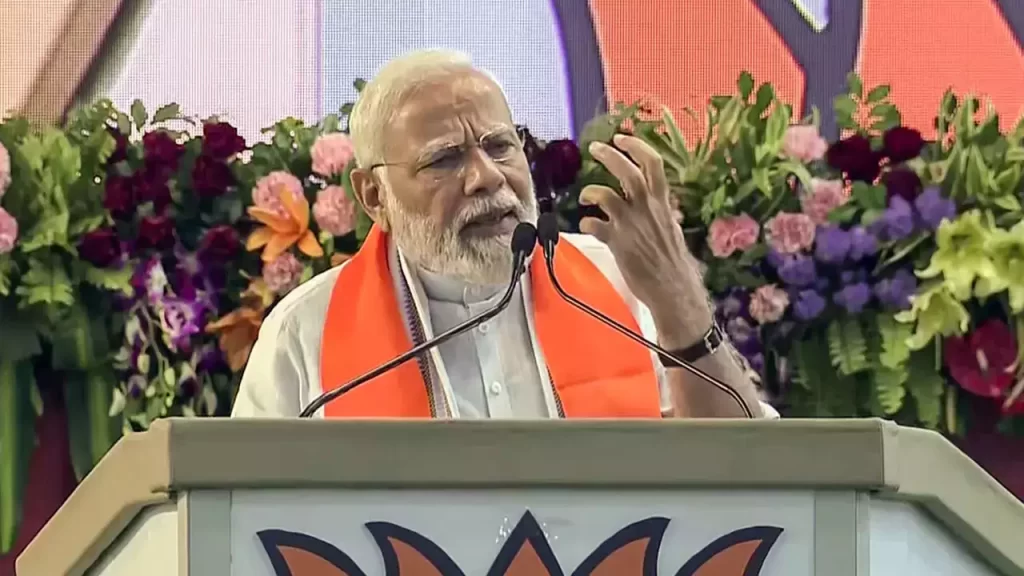
People with knowledge of the situation said that Prime Minister Narendra Modi’s strong support for the uniform civil code (UCC) on Tuesday suggested that the government might give priority to a matter that has long been on the BJP and Rashtriya Swayamsevak Sangh’s (RSS) agenda.
Both the RSS and the BJP have long advocated for a Uniform Civil Code (UCC) that would apply to all groups and religious beliefs and regulate matters like marriage, divorce, succession, adoption, and asset distribution.
In Madhya Pradesh, Modi remarked that Muslims were being mislead under the guise of UCC when speaking to BJP booth workers. “The UCC has been provoking people lately. You tell me, can that house work if there is one rule for one person and another one for another person?
The primary goals of the BJP and RSS for many years have been the implementation of UCC, the repeal of Article 370 in Jammu and Kashmir, the building of a Ram Temple in Ayodhya, and a statewide prohibition on cow slaughter. The BJP applauded itself for fulfilling two long-standing pledges once Article 370 was formally repealed in 2019 and work on the Ram Temple in Ayodhya started.
On condition of anonymity, a BJP source stated, “The roll-out of UCC is seen as the only pending ideological issue and many in the party believe it will be done before the 2024 general elections as the BJP now has a track record of fulfilling what it promises in the manifesto.”
According to the leader referenced above, the Prime Minister’s direct mention of UCC shortly after the legislation Commission requested public input on a single code is a “clear indication” of the government’s intention to implement the legislation.
In the past, when Modi spoke topics like population control and the need to outlaw triple talaq, “it was seen as an indirect reference to UCC,” the politician cited above stated.
The UCC is opposed by many opposition parties, activists, and communities because some see it as an attempt to obliterate minority practises and ceremonies. Within the greater Hindu religion, a number of tribal groupings and sects are opposed to a single code.
The administration has chosen a conciliation strategy in light of this.
There are plenty of adivasis and janjaatis who follow unique traditions and practises. Some of them have voiced worry about how this may effect their puja padhhati (form of prayers). Some of these tribes also adhere to their unique marriage and divorce customs because they fear that the wider law may engulf them. A representative of the RSS who works with the Vanvasi Kalyan Ashram, a branch of the Sangh that deals with tribespeople, stated, “We have been reaching out to them to address their problems.
A group of 30 tribal organisations in Jharkhand planned to demonstrate against the new legislation on Sunday, while a tribal council in Meghalaya signed a resolution last week opposing the implementation of UCC in regions under its control.
The BJP is courting tribal people in Madhya Pradesh, Gujarat, Rajasthan, and the Northeast because it is cognizant of the possible effects of UCC on its vote share in places where tribes predominate.
The Sangh has advocated for “building a narrative, encouraging debate and discussion, and creating consensus” rather than merely proposing legislation, the RSS functionary described above stated, refusing to be identified due to the sensitive nature of the subject.
The government’s belief in choosing a peaceful path that would benefit all facets of society is shown by the fact that some states have been requested to or have drafted their draught laws and sought opinions from the public. We are aware that a strong lobby is trying to portray UCC as a pro-minorities issue,” the BJP leader who was first cited as saying this remarked.
States including Gujarat, Madhya Pradesh, Uttar Pradesh, and Uttarakhand have formed committees to look into UCC.
According to the mentioned RSS official, a significant portion of the BJP and RSS’s outreach on the UCC centres on how some of the Constitution’s authors saw a single code positively.
The functionary said, “Article 44 says the State shall endeavour to put it in place.” The Constitution’s guiding principles for state policy include UCC.
A BJP politician filed a private member’s bill to establish UCC in the Rajya Sabha last year.
According to Ajay Gudavarthi, a professor at the Jawaharlal Nehru university, the PM’s mention of UCC is a sign that it may turn into an electoral platform for the 2024 elections.
“It is increasingly evident that the 2024 election will be decided by the mandir and UCC. His remarks must be viewed in light of the next monsoon session of Parliament and potential opposition resentment at recent US inquiry about the plight of minorities in India and the violence in Manipur, he said.