


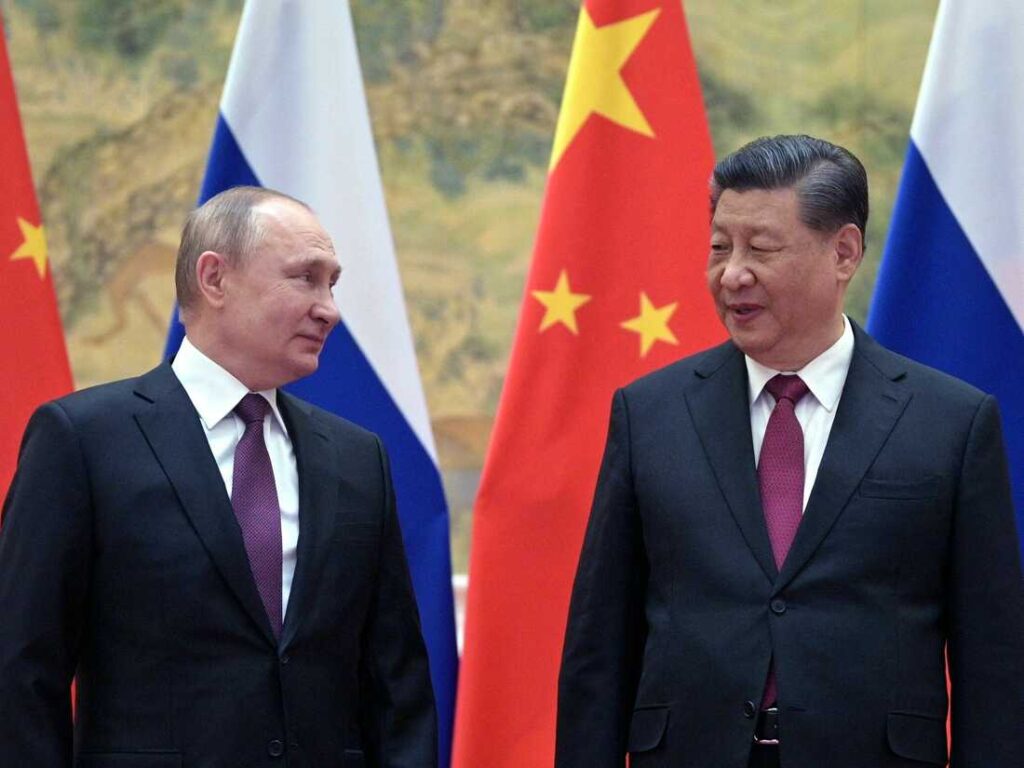
Indicating that they might jointly thwart attempts by the G7 nations in particular to bring up the Ukrainian problem at the G20, China and Russia have publicly said that they reject any attempt to force political matters on the agenda of multilateral fora.
The two leaders of China and Russia said in a joint statement released in Moscow following their meeting that they “firmly condemn the politicization of multilateral platforms and the attempts of certain countries to insert irrelevant issues on the agenda of multilateral platforms and dilute the core functions of relevant mechanisms.”
While the G20 was not specifically mentioned, the phrase does not leave much room for question, given that this was the position that Russia and China expressed during the two ministerial meetings of the grouping that took place in Mumbai last month.
The G20 is a venue for addressing financial and macroeconomic policy, as Russian Foreign Minister Sergey Lavrov had openly noted in the Raisina Dialogue, where he addressed the day following the G20 foreign ministers conference.
“The main issue at the G20 was how to handle Ukraine and include it in the statement. I questioned if the G20 ever took the situation in Iraq, Syria, or Yogoslavia into account in such announcements by asking India, Indonesia, and individuals who had previously presided over such meetings. ’ “Nobody was giving a damn about anything other than money and macro-economic policies for which G20 was founded,” Lavrov said in response.
Russia and China opposed the inclusion of the G20 Bali Declaration’s passages on Ukraine, therefore the G20’s finance and foreign ministers meetings were unable to issue a single statement.
Instead, after both ministerials, a chair’s summary and outcome document were published. The joint statement from Russia and China seemed to criticize the alliance of India, the US, Japan, and Australia while omitting any mention of the Quad.
The creation of a closed, exclusive group structure in the Asia-Pacific area, which would lead to group politics and camp conflict, is opposed by the two sides. Both parties emphasized how the US’s “Indo-Pacific Strategy” and adherence to the Cold War mindset had a detrimental effect on regional peace and stability.
To ensure regional peace, stability, and development, China and Russia are dedicated to creating an equitable, open, and inclusive security system in the Asia-Pacific.
Both nations have separately criticized the Quad and AUKUS, an alliance of Australia, the US, and the UK that aims to establish a framework for Washington and London to support Canberra in acquiring a fleet of nuclear-powered submarines to counter China. However, this is the first time they have synchronized their similar positions in a joint statement.