























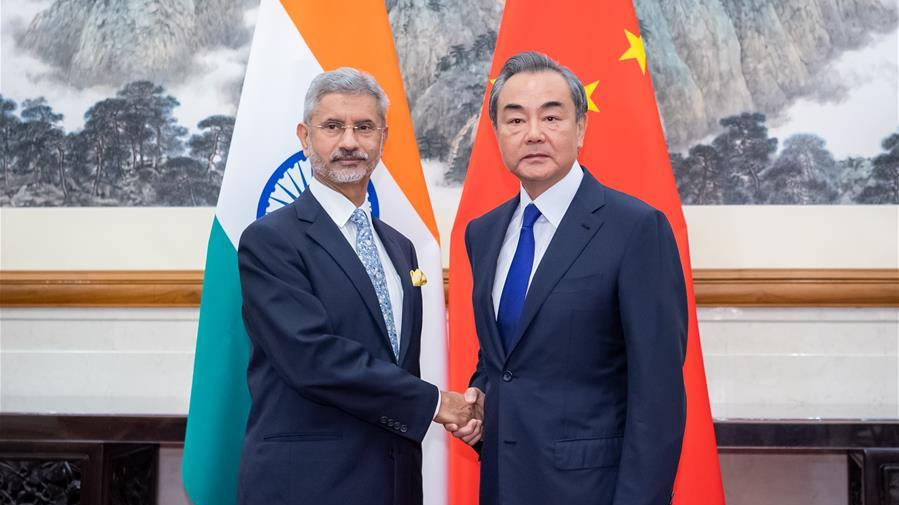
Wang Yi, a top Chinese official, told External Affairs Minister S. Jaishankar during their meeting in Jakarta that the two nations should work together to find a solution to the border issue rather than allowing “specific issues” to define their relationship as a whole.
For more than three years, India and China have been engaged in a military stalemate in eastern Ladakh. According to Jaishankar, this is the most difficult situation he has faced in his lengthy diplomatic career.
Jaishankar has also made it abundantly clear to China that the two nations’ ties cannot advance unless there is peace and tranquility in border regions.
On Friday in Jakarta, Indonesia, outside of the Ministerial Meeting of the ASEAN Regional Forum (ARF), Wang and Jaishankar had a meeting. Since Qin Gang, the current foreign minister of China, is ill, Wang, a former foreign minister of China, attended the ASEAN summit in Jakarta.
An official statement released by the Chinese Foreign Ministry here on Saturday reported Wang as stating during the meeting with Jaishankar that he hoped the Indian side would meet China halfway and find a solution to the border dispute that was acceptable to both parties.
The statement quoted Wang, Director of the ruling Communist Party of China (CPC) Central Commission for Foreign Affairs, as saying, “We should focus our energy and resources on each other’s development, improving people’s livelihoods, and accelerating revitalisation without letting specific issues define the overall relationship.”
Jaishankar said on Twitter that he and Wang addressed unresolved matters pertaining to tranquility and peace in the border regions during their meeting.
He tweeted on Friday that he and I also discussed the East Asia Summit/ARF agenda, BRICS, and the Indo-Pacific.
Wang said that Prime Minister Narendra Modi and Chinese President Xi Jinping have established a significant understanding over the need to stabilize China-India ties.
In order to achieve this, “the two sides should take actions, adhere to the correct direction of bilateral relations, grasp the general trend of world development, and promote the stabilization and improvement of China-India relations,” he added.
As the top two emerging nations in the world and longtime neighbors, China and India’s shared interests clearly exceed their disagreements, and the realization of their shared prosperity and progress is significant for the whole world, according to Wang.
In several trouble spots in eastern Ladakh, Indian and Chinese forces have been fighting for more than three years, despite the fact that both sides have finished withdrawing from a number of locations as a result of lengthy diplomatic and military negotiations.
Following the intense combat in the Galwan Valley in June 2020, which was the biggest important military confrontation between the two sides in decades, relations between the two nations took a sharp turn for the worst.