
























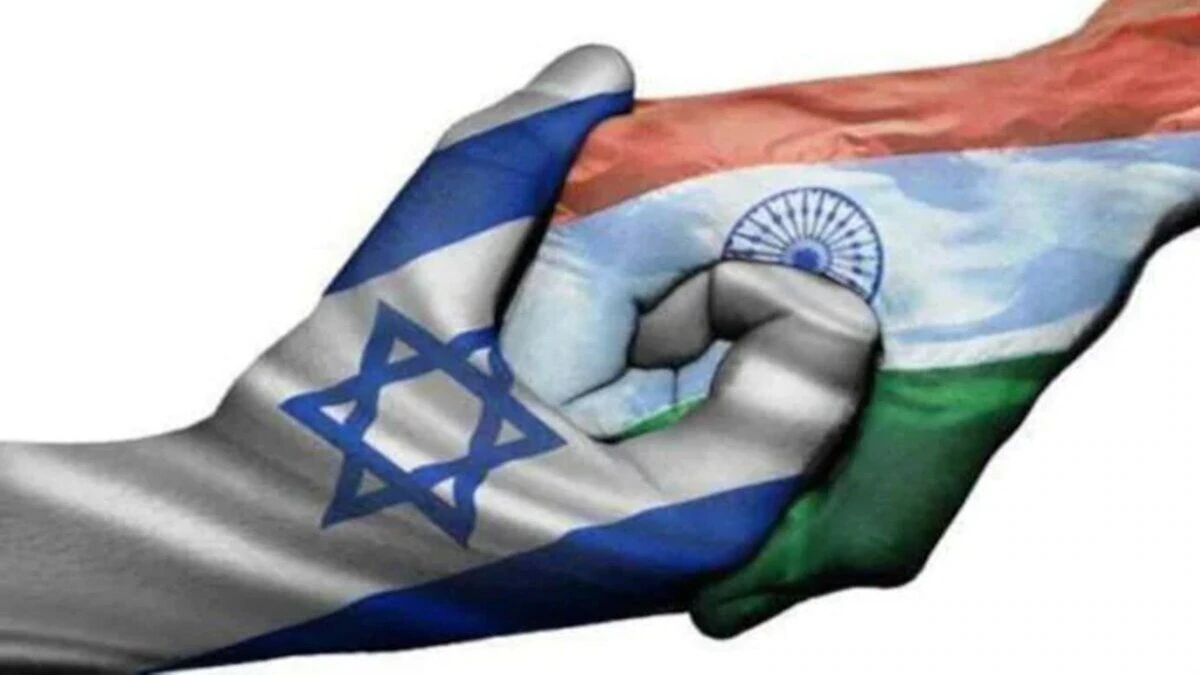
An Indian-Jewish Cultural Square, commemorating India’s 77th Independence Day, was unveiled in Israel’s Eilat city. It is intended to highlight the deep “civilizational bond” between the two nations, which is based on “centuries of shared heritage and values.” The plaza, according to Eli Lankri, mayor of Eilat, represents love, friendship, caring for one another, and a strong bond between India and Israel. He stated this after officially opening the square: “It also shows the relationship between the Indian-Jewish community and the city of Eilat.”
“India-Israel friendship is a testimony to the civilizational bond of trust and friendship between the two nations that are built on the foundation of centuries of shared heritage, values, and aspirations of their people,” read an inscription on the wall of the plaza. The letter also wished for the relationship to “inspire future generations with the indomitable spirit of the peoples of India and Israel that transcends geographic boundaries, demonstrating the potential of the collaboration in fostering a brighter future.”
On one side of the wall in the square, with the flags of India and Israel flying at the corners, are painted symbols of the “Malida” ceremony that the Bene Israel community from the Maharashtra region performs on most of their festive occasions, but especially on the Jewish festival of “Tu B’Shvat,” also known as the new year of the trees.
As a significant acknowledgement of the customs of the Indian-Jewish community, Malida is now recognized by the Hebrew Calendar as an official national holiday. According to tradition, the community’s ancestors came in India on Tu B’Shvat around 175 BCE (before the Common Era). Sadly, it is said that their ship sank off the coast of India, although seven men and as many ladies were rescued.
The project’s main driver and local Indian community leader Isaac Solomon called the location a “monument symbolising the long-standing friendship between India and Israel.”
The Sitar Association is a center that gives these families the sense of belonging to one happy family, the Sitar family, Solomon said during the event. “Eilat is a pleasant and warm home for about 120 Indian-Jewish families and many other Indian families,” Solomon added. He expressed gratitude to the city of Eilat and promised that “this wonderful act of kindness will be remembered forever.”
“The 85,000 strong Jewish community, with its achievements in diverse fields such as academics, scientific fields, business, defense, and so on keeps the flag of both India and Israel flying higher and higher,” an Indian embassy official who was present at the event told PTI.
Participants in the event conducted on Tuesday night included members of the Indian community, Deputy Mayor Stas Bilkin, and representatives of the Eilat municipality. Israel’s Red Sea coast’s southernmost city has historically shown to have close relations to India.
A plaque honoring the six Jewish victims of the 26/11 terror attacks in Mumbai was placed in November 2020 by the Jewish outreach organization Chabad in a synagogue in the city not far from the plaza that was officially opened on Tuesday. A message is inscribed on a durable plastic plate and shown on the 3A paper size plaque in the synagogue.
In honor of Rabbi Gavriel Noah and Rivka Holtsberg, who perished while carrying out their sacred duty in a terrorist assault at the Chabad home in Mumbai, India, from whence the Torah’s message was being disseminated across the region. And for the four visitors who were staying at the Chabad home at the time of the assault and were also killed: Yocheved Orpaz, Mrs. Norma Rabinovich, Rabbi Ben Zion Kurman, and Rabbi Gavriel Taitelbaum. The plaque’s Hebrew inscription reads, “May their souls be joined together in the bond of eternal life.”