

























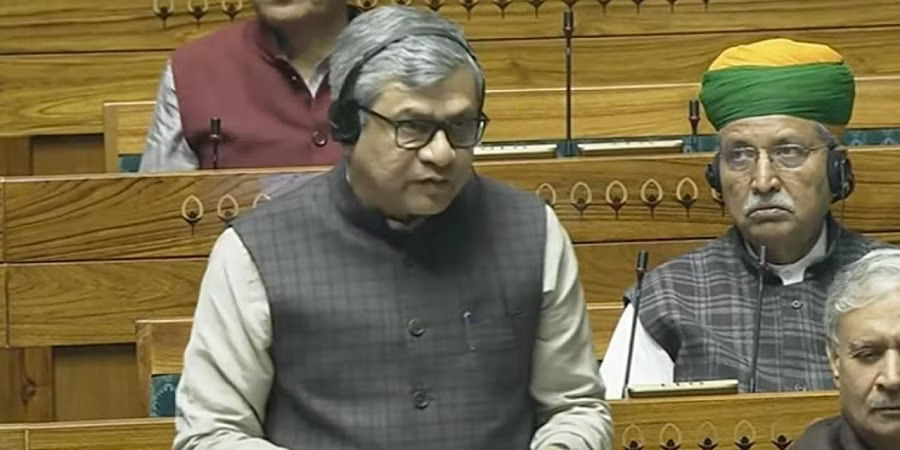
Wednesday’s voice vote in the Lok Sabha saw the Telecommunications Bill, 2023 approved after an hour-long discussion during which the majority, if not all, of the Opposition MPs were absent.
The bill solidifies user protection provisions in the legislation, permits administrative distribution of satellite spectrum, establishes a four-tiered dispute resolution process, and replaces the licensing system for communications service providers with an authorization framework.
When proposing the bill on Monday, Communications Minister Ashwini Vaishnaw said, “The bill [seeks] to amend and consolidate the law relating to development, expansion, and operation of telecommunication services and telecommunication networks; assignment of the spectrum; and for connected matters.”
The Indian Telegraph Act (1885) and the Wireless Telegraphy Act (1933) would be superseded by the law. Industry associations like the Broadband India Forum (BIF) and the Internet and Mobile Association of India (IAMAI) applauded the bill, but three main concerns were raised by privacy and technology activists and some Members of Parliament: the inclusion of “online services,” including OTT messaging ones; strict user verification requirements; and worries about increased surveillance.
Inaugurating the debate on Wednesday, Vaishnaw made reference to the criminal code reforms voted by the Lower House earlier in the day and said it was a historic day when three laws that had a “colonial mindset” were being eliminated. “The Indian Telegraph Act of 1885 is one colonial bill that is being repealed with today’s requirements, today’s economic needs, and today’s aspirations in mind,” he said.
Members of the opposition submitted queries on a few of the bill’s clauses.”Privacy of citizens should be respected but communication interception in the interest of national security is absolutely necessary,” YSRCP Lok Sabha MP Sanjeev Kumar Singari said in the chamber.
Bhartruhari Mahtab of Biju Janata Dal urged Vaishnaw to define “temporary” and “possession” in relation to the circumstances in which the government may assume “temporary possession of the telecom network.”
“In the interest of national security and in times of emergency, the law permits the government to seize control of telecom services and intercept communications. I recognize [the need for that]… Mahtab said, “Perhaps the minister could explain to us how it will be decided, at what level, and under what law it will be decided.”
“Given that the definition of “message” includes the term “data stream,” it is reasonable to assume that cloud services, email services like Gmail and Zoom, and messaging apps like Telegram and WhatsApp may be subject to telecom regulations. “Same rules, same service” may be applied if this Bill regulates similar services. The honorable minister has to clarify this, Singari said.
Shrirang Appa Barne of the Shiv Sena questioned why applications like Signal and WhatsApp weren’t included. “The door has been kept open to include online services, so we need the minister to clarify that,” he added. In response, Vaishnaw provided a broad summary of the legislation, listing its advantages in ten points.
He began by saying that the new legislation would strengthen user defenses against KYC scams. Right-of-way reforms come in second. Given the rate at which the telecom sector has been expanding and services are being embraced, we have to modify the right of way. We have achieved this by working with district and state administrations,” he said.
Third, he mentioned licenses, saying that over 100 had been replaced by a single authorization. Spectrum reforms come in fourth. Spectrum was not even mentioned in the 1885 Act. He said that the new legislation considers presidential referrals from constitutional benches as well as decisions made by the Supreme Court.
He said that the four-tiered, digitally designed conflict resolution process was the fifth highlight.”Sixth, a legal framework for cybersecurity and telecom network protection has been established,” he said. The interception provisions of the law, he said, were the seventh item, and its “checks and balances” and guiding concepts came from the 1996 PUCL case ruling.
The new law’s other major themes were related to business and India’s standing as a technology exporter; the eighth and ninth major points were the regulatory sandbox provisions for innovation and Digital Bharat Nidhi, which aims to create new goods and technologies.
The sector employs close to four million people, therefore the tenth and most crucial point is that this bill ensures there won’t be any delays, he added.
The Internet Society said, “The Bill must contain provisions for distinguishing between traditional telecom services and Internet-based services,” in a statement after the bill’s passing.
“Fundamentally altering their governance, risking regulatory overreach and overlap” is the result of the absence of difference.
The group said that end-to-end encryption is threatened by the measure. Neeraj Mittal, the telecom secretary, briefed lawmakers on the bill earlier in the day. He gave an explanation of the bill’s purpose and the operation of the spectrum. He also clarified why satellite spectrum could not be put up for sale in answer to a query.
Participant access may only be needed temporarily for tasks like research and development, as defined by the proposed regulatory sandbox. As an example, he said that it is not practical to have auctions in certain situations. Mittal explained that the interception clause was also taken from the existing legislation and that the government’s temporary takeover of telecom services and networks was not a new provision.