

























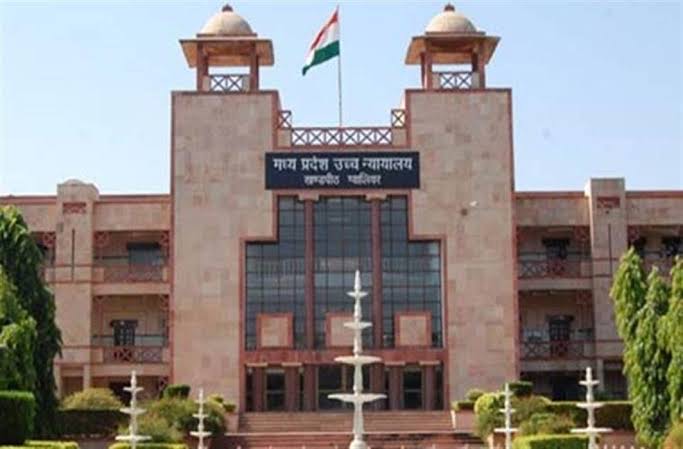
A man was found not guilty by the Madhya Pradesh High Court on January 24th, on charges of rape of his own daughter. In 2012, the daughter allegedly lodged a fictitious rape complaint against her father while under the influence of her ex-boyfriend, as per the judgement. Life in prison and a Rs 10,000 fine were imposed on the individual in February 2013. The same year, he lodged an appeal with the High Court against the ruling. After twelve years of anticipation, the court ultimately acquitted him.
In the judgement, a two-judge bench consisting of Justices Sujoy Paul and Vivek Jain stated that the daughter admitted to filing a false rape complaint after her father reprimanded her for being caught with her boyfriend. The girl subsequently approached her grandfather while under the influence of her boyfriend. Subsequently, she lodged a false rape complaint against her father. By luring her to file a lawsuit, her lover claimed that it would prevent her father from interfering in their personal lives.
Context of the case
OpIndia obtained a copy of the corresponding judgement. During the incident, the complainant was a juvenile and resided in a slum area. A formal complaint was lodged at the Chola Mandir Police Station on March 21, 2012. As per her complaint, her father sexually assaulted her on the evening of March 18, 2012, following dinner. That evening, her mother was not at home. According to her, her father issued a death threat against her if she disclosed the incident to anyone, including her mother. As per the complaint, he attempted to assault her once more on March 20, but she escaped and approached her grandfather instead.
The grandfather, upon hearing her account, escorted her to the police station, where he registered a formal complaint. Infractions of Sections 376 and 506 of the Indian Penal Code (IPC) were filed against the individual. An investigation led to the man’s detention, and on February 15, 2013, he received a life sentence following a trial. An additional penalty of Rs 10,000 was levied.
In 2013, subsequent to his conviction in the Sessions Court, the father petitioned the Madhya Pradesh High Court for an appeal. Attorney Vivek Agarwal, representing the father, noted during the hearing that the MLC dated March 21, 2012, made no mention of sexual assault. In addition, a physician who testified as a witness stated that no indications of sexual assault were present. A second doctor who appeared in the case noted that the girl fled and arrived at the police station after being asked to remove her clothing for an examination.
Amidst a courtroom inquiry, the girl forthrightly acknowledged engaging in both romantic and physical relations with a particular boy. Additionally, she disclosed that her father had issued her multiple reprimands regarding the relationship. The judgement stated, “Extensive reliance is placed on paragraph 5 of the cross-examination, in which she admitted that she and the aforementioned boy filed a police station report after her father reprimanded her.” She openly acknowledged that she and her father/appellant have not engaged in any form of physical intimacy. She specified that her only physical contact was with the aforementioned child.
Moreover, her grandfather became antagonistic throughout the proceedings and refuted the girl’s account. Another individual who testified against her was her younger sister. Advocate Agrawal noted that the family resided in a one-room dwelling, rendering the father’s sexual assault on the girl in the room where her four younger siblings were confined highly improbable.
Notably, despite the forensic report’s assertion that sperm was discovered on the girl’s undergarments, no DNA analysis was performed. Advocate Agrawal stated, “The prosecution should be held liable for the negative inference that results from the failure to conduct the DNA test.”
After thorough deliberation, the court rendered an acquittal for the appellant. The court emphasised that the prosecution neglected to present the fundamental evidence that was essential for the conviction. “In light of the preceding evaluation, the appellant is deserving of an acquittal,” the court stated. Regrettably, the appellant continued to be detained as of March 21, 2012. “The prosecution has utterly failed to establish the merits of its case.”
Withdrawing the Session Court’s ruling, the court further stated, “The appellant shall be released immediately if his presence in custody is not necessary for any other case.”