
























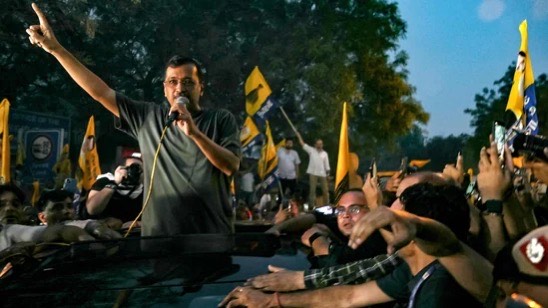
Following the 2024 Lok Sabha elections, the Supreme Court earlier today granted Delhi Chief Minister Arvind Kejriwal interim bail until June 1. Two days before the announcement of the 2024 Lok Sabha Election results, on June 2, the leader of the Aam Aadmi Party was requested to return to detention.
Arvind Kejriwal was granted temporary bail by a bench made up of justices Sanjiv Khanna and Dipankar Datta till June 1. The top court stated in its extensive ruling that Kejriwal’s bail case was unique since he was the current chief minister and had to continue his campaign for the Lok Sabha elections.
The Enforcement Directorate (ED) was represented in the matter by Solicitor General Tushar Mehta and additional Solicitor General SV Raju, who challenged the temporary bail on the grounds that all parties should receive “equitable treatment.” The bench, however, disregarded their complaints. The law officers urged the bench to place limitations on Kejriwal so that he would not talk about the excise policy while he was out on bail.
The court stressed that general elections happen only once every five years and noted that it dealt with an elected Chief Minister, not a serial offender. There are four more rounds of general elections, with polls in Delhi, the nation’s capital, scheduled for May 25, 2024.
Senior attorney Abhishek Manu Singhvi, who is defending Kejriwal at this point, asked the judge to extend the temporary bail period until June 4, which is when the results of the Lok Sabha election are expected to be announced. The bench, however, turned down the plea.
Mehta intervened and proposed that the court ruling should state that Kejriwal must turn himself in to the Tihar jail officials on June 2 and should not include a clause extending the bail term.
Justice Khanna nodded and said, “He will surrender on June 2.” The bench then adjourned, saying that Kejriwal’s appeal contesting his detention by the ED on March 21 and the ensuing remand would be considered in-depth in July, following the court’s summer recess.
The case concerns allegations of money laundering and corruption during the creation and implementation of the Delhi government’s now-cancelled excise policy for 2021–2022.
The Enforcement Directorate (ED) filed an affidavit on Thursday objecting to political personalities receiving any kind of “special treatment” during elections. It contended that allowing bail for political campaigning would create a risky precedent that would erode the values of equality before the law and the rule of law.
The agency argued that, particularly in a nation like India where elections are held often throughout the year, granting politicians bail for campaigning would open the door to never having to be arrested or detained for political purposes.
It’s important to remember that the Delhi High Court rejected Arvinder Singh Kejriwal’s motion to suppress his detention in the Delhi liquor policy case in April, citing evidence from the Enforcement Directorate that implicated the AAP chief.
The Delhi High Court expressed severe concerns about CM Kejriwal’s involvement, stating that the evidence indicates he participated in the conspiracy and actively used the proceeds of the crime.
According to the evidence acquired by the ED, Mr Arvind Kejriwal engaged in active participation and conspiracy to use and conceal the proceeds of the crime. The Delhi High Court sneeringly noted, “The ED’s case also suggests his involvement both in a personal capacity and as the convenor of AAP.”
However, earlier today, the Supreme Court gave Arvind Kejriwal a temporary release. Given the extreme differences in how the two branches of the court perceive the same issue, it is difficult for the general public to determine the judiciary’s position on any given issue.
It is noteworthy that Amritpal Singh, who is being held under the National Security Act (NSA), was able to register his nomination for the forthcoming Lok Sabha elections thanks to the Punjab AAP government’s notification to the Punjab and Haryana High Court. Will the Supreme Court apply the same standard and release Singh on bond until June 1st, when the polls are over?
If so, does the judiciary plan to issue bail to all applicants only because the Lok Sabha elections are taking place, or would this not amount to giving politicians preferred treatment over regular people? It is impossible to overestimate the necessity of judicial changes if that is the course we are taking. Though Amritpal Singh’s situation is unique, the Supreme Court pointed out, that it didn’t sit well with many legal observers.
Furthermore, granting bail sends an unspoken message to the investigating authorities that limits their independence and prevents them from acting hostilely or detaining possible suspects simply because an election is approaching, which happens far too frequently in India. Investigating authorities would not be able to conduct a fair investigation without constant disruptions and delays if politicians were granted bail due to impending elections.
However, just because elections are taking place doesn’t mean that politicians or anybody else should be denied bail. Basically, the basis for granting or denying an applicant’s bail should not be the urgency of an election but rather the seriousness of the accusations made against them, the merits of the case, and the evidence that the agencies have provided.
In an election, when political sentiment is high, the leaders and those who support them may also try to boost their chances of winning by granting bail. The current administration frequently portrays an opposition leader’s arrest and potential guilt as “vindictive” acts against investigative institutions that are considered to be “puppets” by their allies and sympathetic media.
Furthermore, receiving bail in India is frequently marketed as being “vindicated” by the local legal system or as being granted an acquittal; nevertheless, these claims are blatantly false and are made merely to win the public’s sympathy. It is anyone’s guess what Mr. Kejriwal and his cronies will do with the high court’s bail reprieve. It doesn’t take a political analyst to see how such language can unreasonably affect the results of the elections.
While it’s possible that investigative authorities will have to take action to detain opposition leaders, the granting of bail shouldn’t make up for this. Instead, the judiciary should give the government instructions to make changes to the way investigative agencies operate, ensuring their complete independence and lack of political influence.
More significantly, though, the Arvind Kejriwal bail scandal and the numerous inconsistencies and contradictions that have arisen from it point to the urgent need for a judicial overhaul. This overhaul must include several contemporary provisions in addition to expediting cases, such as the grant of bail based on merit and the prohibition of giving preference to any particular group of people over others.
Voters frequently give moralising speeches encouraging them to research their candidates before casting a ballot. Giving politicians bail in the face of severe charges like money laundering, however, conveys a mixed message to the electorate and the public at large. The judiciary, which is frequently recognised as the defender of the public good, ought to accept the responsibility.