






















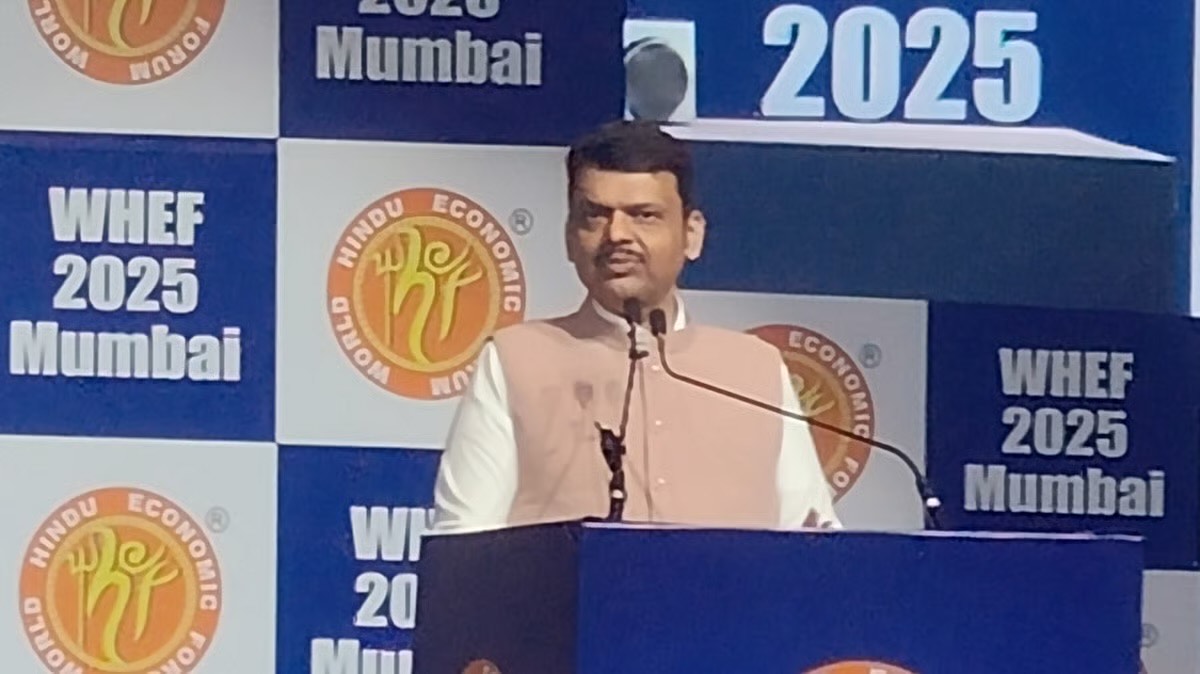
Speaking on the people of “Maharashtra—Accelerating Viksit Bharat,” Fadnavis claimed that Hinduism is a system that sustained a civilization rather than merely a collection of religious rites. “Numerous civilizations have flourished for millennia before fading away. Bharat is one of the few civilizations that has thrived continuously. Ten thousand years ago, we were a single civilization,” stated Fadnavis.
A planned Africa Center in Navi Mumbai will enhance international engagement.
The Chief Minister announced the construction of a 54-story African Center in Navi Mumbai, which will contain the representative offices of every nation on the continent on each floor. Fadnavis claimed that India has an edge in that the world trusts the nation, and that Africa will experience the next demographic boom that will raise the continent’s economic significance. Because China has taken over the economies of numerous nations, the globe does not trust it. Fadnavis described how Papua New Guinea encouraged India to take advantage of its gas fields and stated, “Countries do not fear India because they know we believe in coexistence.”
“During his recent visit to that nation, our Prime Minister Narendra Modi was informed by the leaders that Australia, which now manages their gas reserves, does not treat them fairly. China is not trusted by them. They are looking forward to India’s visit. What is the source of this confidence? Our Hindu ethos serves as the foundation for this belief. Fadnavis asserted, “We have dispersed our ideas and philosophies throughout the world, but we have never conquered any nation.”
Scholar and Sanyasi Swami Vigyananand, founder of the World Hindu Economic Forum, stated that if India’s economy is weak, the world will not pay attention to it. He enumerated the problems impeding the nation’s ability to generate prosperity. According to Vigyananand, India’s primary obstacles in its quest for wealth creation include a lack of accessible capital, a low rate of technological adoption, a paucity of skilled labor, and the flight of capital and expertise.
He asserted that popular culture, especially Bollywood, has demonized businesses. According to a study of 250 movies, over 60% of the dishonest businesspeople shown in them have Bania last names. Furthermore, 62% of the films depicted Brahmins as corrupt politicians. The same businessmen who fund these movies have disregarded this demonization of enterprise. “We must respect business: making money is not simple,” Vigyananand stated.
Sajjad Jindal, the head of the USD 23 billion JSW group, asserts that the service sector accounts for almost 60% of India’s GDP. “Manufacturing is less than 15% of our economy,” Jindal stated, adding that young people in India are driven and enterprising. “They are aware of the world. We need to focus on production.
According to Jindal, the JSW group signed Memorandums of Understanding to invest Rs 3,00,000 crores in Maharashtra during the Davos summit last year. “Converting MoUs into executed projects is important, and we can say that action has been taken on all these projects,” Jindal stated.
The managing director of Shree Cement, Hari Mohan Bangur, gave a Letter of Intent to invest Rs 10,000 crores in Maharashtra on the opening day of the two-day event.