
























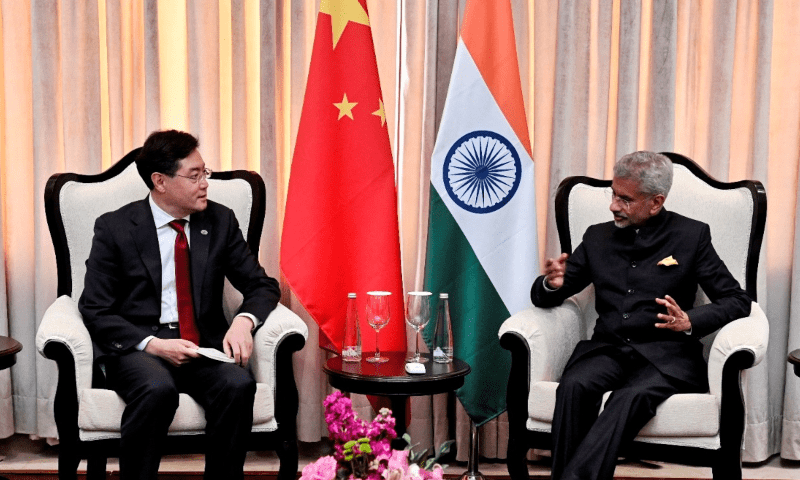
According to Chinese Foreign Minister Qin Gang, the situation along the China-India border is mostly calm, and both countries should work to further defuse and cool the situation.
On the margins of the Shanghai Cooperation Organisation (SCO) Council of Foreign Ministers meeting, Qin mentioned this to Minister of External Affairs S. Jaishankar.
The two nations should build on their current successes and rigorously adhere to the relevant accords, Qin said, while also pressing for further cooling and relaxing of the circumstances for lasting peace and tranquilly along the boundary.
Since the Chinese military’s incursion into Indian territory in early 2020, which resulted in violence, India and China have been locked in a standoff along their shared border in Eastern Ladakh. The biggest incident, which occurred in June 2020 in Galwan Valley in Eastern Ladakh and resulted in the deaths of 20 Indian troops and an undetermined number of Chinese soldiers, was a series of confrontations between Indian and Chinese military.
According to a press release on the Qin-Jaishankar talks released on Friday, Qin stated that the two sides should continue to implement the significant consensus reached by the leaders of the two countries, consolidate the existing accomplishments, strictly adhere to relevant agreements, push for further cooling and easing of the border situation, and maintain sustainable peace and tranquilly in the border areas.
After the meetings, Jaishankar said in a tweet that the emphasis remained on finding a solution to any unresolved problems and maintaining calm and peace in the border regions.
“A thorough conversation on our bilateral relationship with State Councillor and FM Qin Gang of China. Focus continues to be placed on finding solutions to unresolved problems and maintaining calm and tranquilly in border regions, according to Jaishankar.
According to Jaishankar, the SCO, G-20, and BRICS (Brazil-Russia-India-China-South Africa) concerns were also discussed.
What else did FM Qin the Chinese say?
China and India, the two most populous emerging nations in the world, are both, according to Qin, at a crucial stage of modernization.
In order to spur national renewal and promote stability and positive energy for global peace and development, Qin advised that we should learn from history, approach bilateral relations from a strategic and long-term perspective, respect, learn from, and build on each other’s achievements, and forge ahead on a new path of peaceful coexistence, peaceful development, and common rejuvenation among major neighbours.
China is prepared to collaborate with India to conduct bilateral consultations and exchanges, advance multilateral dialogue and cooperation, intensify coordination and cooperation on global and regional issues, and return China-India relations to the path of sound and stable development.
China, according to Qin Gang, supports India’s efforts to hold a successful SCO summit and believes that India would contribute positively to the summit’s success in the spirit of cooperation and unity as the rotating chair.
The press statement said that the two sides also discussed regional and global topics of mutual interest.
Chinese border violence “eroded” all of the relationships, according to India
At a meeting last week, Defence Minister Rajnath Singh informed his Chinese counterpart Li Shangfu that China’s breach of the existing border agreements had “eroded” the entire foundation of relations between the two nations and that all border-related disputes needed to be settled in accordance with the agreements already in place.
On April 27, a gathering of SCO military ministers took held concurrently with the summit in New Delhi.
The 18th round of negotiations on resolving the border dispute was conducted by the Indian and Chinese militaries days before the two defence ministers’ meeting.
The two parties agreed to keep in constant contact and find a compromise on the outstanding concerns in eastern Ladakh as soon as possible at the discussions with the Corps Commander on April 23.
However, there was little evidence that the three-year argument was any closer to being resolved.
Following the severe combat in the Galwan Valley in June 2020, which was the most important military confrontation between the two countries in decades, relations between India and China dramatically deteriorated.
The Line of Actual Control (LAC) in eastern Ladakh has been the site of a stalemate between Indian and Chinese forces for the last three years, despite their disengagement in certain areas after several military and diplomatic discussions.
According to India, the two nations’ relationship should be founded on the “three mutuals” of respect, sensitivity, and shared interests.
Following a bloody altercation at Pangong Lake on May 5, 2020, the eastern Ladakh border standoff broke out.
The two parties concluded the disengagement process in 2021 on the north and south banks of the Pangong Lake and in the Gogra region as a result of several military and diplomatic discussions.