
























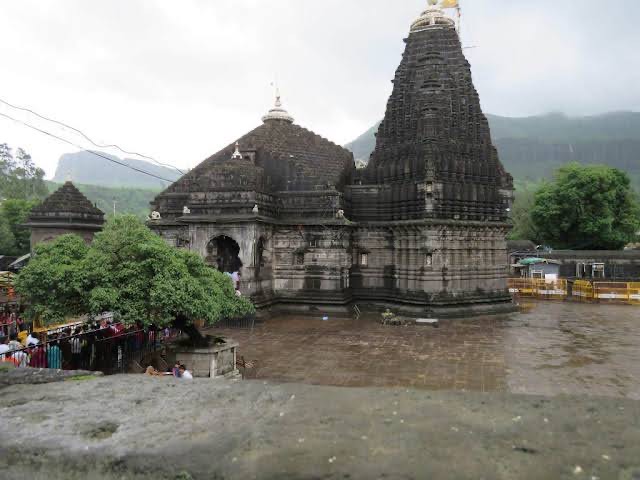
It all seems like a game of sabotage these days. properties, political parties or religions everything can be grabbed or hijacked. A group of Muslims stormed the Trimbakeshwar temple in Nashik, Maharashtra, on May 13, 2023, at about 9:15 p.m. Trimbakeshwar is one of Lord Shiva’s twelve sacred jyotirlingas and it has a great prominence n the Hindu belief. However, the Muslims who attempted to enter the temple’s courtyard did so because they allegedly wanted to forcibly drape a Chadar over the Shivling inside the sanctum sanctorum. They claimed that it is their regular ritual but there is no note of such a happening earlier. In light of this issue, it is important to understand the events leading up to this temple’s destruction, its conversion to a mosque, and Hindus subsequent recapture of the site.
The temple management committee filed a police report after security guards prevented the local Muslims from entering the sanctorum as they tried to enter the temple. Videos of the incident quickly became popular on social media. The police detained Aqeel Yusuf Sayyed, Salman Aqeel Sayyed, Matin Raju Sayyed, and Salim Bakshu Sayyed for breaking into the Trimbakeshwar temple by force. Under sections 295 and 511 of the Indian Penal Code (IPC), a case was filed against them. In addition, Devendra Fadnavis, the deputy chief minister of Maharashtra, has mandated the creation of the SIT. They allegedly attempted to offer chadar on the Shivling while trying to enter the temple grounds by joining the Sandal procession. The organiser of the sandal, Matin Sayyed, asserted that the accused only took the chadar to the temple’s steps and never attempted to place it on the Shivling.
There was no attempt to enter the temple or place any chadar inside the temple grounds, according to Avez Kokni, the former president of the Trimbakeshwar Nagar Parishad. Muslims in Trimbakeshwar have been shooting frankincense fumes from the stairs of the temple grounds during an annual gathering at a nearby dargah for generations. The local Hindu community has never objected to this practice, which has been going on for years. We are shocked that this matter has now gained attention and adopted a communal tone. How long until Hindus question whether the frankincense vapours are necessary for their gods?
It is a long-standing custom and a representation of syncretism, according to Trimbakeshwar native and former Nashik District Central Cooperative Bank chairman Parvez Kokni. This custom has existed for a very long time. The city’s Muslims, who make up a very small portion of the populace, have managed to coexist peacefully. Since our city has a calm, non-communal atmosphere, it makes sense that I was welcomed as a leader despite being a Muslim. I find it surprising that this long-standing practice is now being called into question. Will this representative of a syncretic society support the recitation of the Hanuman Chalisa in any neighbourhood dargah or mosque, let alone a significant Jama Mosque?
In terms of ceremonies, there is no known custom of bringing any Chadar to any significant Hindu temple, such as a Jyotirling which has unique significance among all temples. No Purana or Shastra scripture supports it because Sanatan Dharma precedes Islam over an unlimited amount of time. Furthermore, there are no provisions that would permit a non-Hindu to enter a temple and carry out his non-Hindu religious ceremonies there. If such a practice is present in any Hindu temple, it ought to be stopped right away.
Many individuals desire Hinduism to be more inclusive than some Abrahamic religions. Even though there may be some regional customs in various temples throughout India, a Jyotirlinga site requires some level of solitude. The appropriate Hindu Dharmik authorities must act swiftly to make the necessary changes. Muslims in Nashik blame the incident on a “syncretic” culture and subtly accuse Hindus and temple authorities of fomenting religious strife and enmity. To further the link of love and respect between the two communities, they smugly ignore, no, they conceal, the fact that this harmony thing is one-sided and that no Maha Aarti, Yagya, Havan, or Puja is permitted within any Muslim house of worship. Hindus are supposed to permit non-Hindus to enter temples to place Chadars on gods, which has been placed as a load on their shoulders. The case of Kashi Vishwanath Temple, where a Shivling is found in the Wazukhana of the so-called mosque in the Gyanvapi complex where Muslims washed their hands and feet, washed their mouths, and spit for centuries on a Shivling, shows what kind of respect a Hindu deity may receive when Muslims forcibly enter a temple. In Trimbakeshwar, adherents of the same religion are now complaining that communal peace is being hampered by the temple administration.
Aurangzeb assassinated Chhatrapati Sambhaji Maharaj in 1689. Following the murder of the Hindu king, Aurangzeb added to the Mughals’ already-existing oppression by committing even worse atrocities against Hindus. To undermine the Maratha empire’s religious reasons, he ordered the desecration of further temples in Maharashtra in 1690. He hoped to dampen the spirit of the skilled and motivated Maratha troops who were then defending the Hindu kingdom under a youthful and inexperienced Chhatrapati Rajaram Maharaj by erecting mosques on the destroyed temples.
Jadunath Sarkar quoted Kashinath Sane’s ‘Varshik Itibritta’ (literally, ‘annual newsletters’) numerous times in his work ‘History of Aurangzeb’. He says, “About 1690. K. N. Sane in Varshik Itibritta page number 133-135” gives examples of Aurangzeb’s temple demolition at Ellora, Trimbakeshwar, Narsinghpur (foiled by snakes, scorpions, and other venomous insects), Pandharpur, Jejuri (foiled by the god! ), and Yavat (Bhuleshwar). It should be emphasised that even though the attack wasn’t stopped, Trimbakeshwar’s temple was turned into a mosque if the language’s metaphors are to be taken literally. Gulshanabad was given to Kumbh Nagari Nashik, formerly known as Janasthan. More than a thousand years had passed since Aurangzeb demolished the temple.
In “New History of Marathas – Volume II,” author GS Sardesai states, “In November 1754, the Peshwa restored the shrine of Trimbakeshwar, and the Masjid was destroyed.” According to some documents, the temple was built from 1751 to 1754, a period of three years. This essentially implies that the Trimbakeshwar temple was constructed in basalt stone during the time of Chhatrapati Ramraja, led by the Marathas Balaji Bajirao Bhat aka Nanasaheb Peshwa, who also led the Karseva. The linga installed inside Trimbakeshwar’s sanctum sanctorum is in the shape of a three-faced representation of the gods Brahma, Vishnu, and Mahesh. It lies 28 km from Nashik city at the foot of Mount Brahmagiri. Hemad Panthi architecture is used to build the temple. Hemadri Pandit, a minister of the Yadava kingdom in the 13th century, served as the style’s icon.
The Trimbakeshwar temple wasn’t constructed in exactly that way. Because they had the governmental power, the Marathas were able to recapture the holy site. Numerous Hindu soldiers sacrificed their lives for four generations in a row to obtain this power. This achievement was made possible by the warriors’ assertion of their military and financial dominance, as well as by the Maratha administrators’ collection of taxes from the majority of India starting in 1715. Protecting the fields, restoring the gods in the temples, and reestablishing Dharma required a lot of work. Given that the very temple was once destroyed by a follower of the same faith in the past to assert his faith and tyranny over the Hindus, it is past time for Hindus to reconsider whether their deities, like Trimbakeshwar, actually need any of the fumes of some frankincense from some Islamic place of worship.
It all seems like a game of sabotage these days. properties, political parties or religions everything can be grabbed or hijacked. A group of Muslims stormed the Trimbakeshwar temple in Nashik, Maharashtra, on May 13, 2023, at about 9:15 p.m. Trimbakeshwar is one of Lord Shiva’s twelve sacred jyotirlingas and it has a great prominence n the Hindu belief. However, the Muslims who attempted to enter the temple’s courtyard did so because they allegedly wanted to forcibly drape a Chadar over the Shivling inside the sanctum sanctorum. They claimed that it is their regular ritual but there is no note of such a happening earlier. In light of this issue, it is important to understand the events leading up to this temple’s destruction, its conversion to a mosque, and Hindus subsequent recapture of the site.
The temple management committee filed a police report after security guards prevented the local Muslims from entering the sanctorum as they tried to enter the temple. Videos of the incident quickly became popular on social media. The police detained Aqeel Yusuf Sayyed, Salman Aqeel Sayyed, Matin Raju Sayyed, and Salim Bakshu Sayyed for breaking into the Trimbakeshwar temple by force. Under sections 295 and 511 of the Indian Penal Code (IPC), a case was filed against them. In addition, Devendra Fadnavis, the deputy chief minister of Maharashtra, has mandated the creation of the SIT. They allegedly attempted to offer chadar on the Shivling while trying to enter the temple grounds by joining the Sandal procession. The organiser of the sandal, Matin Sayyed, asserted that the accused only took the chadar to the temple’s steps and never attempted to place it on the Shivling.
There was no attempt to enter the temple or place any chadar inside the temple grounds, according to Avez Kokni, the former president of the Trimbakeshwar Nagar Parishad. Muslims in Trimbakeshwar have been shooting frankincense fumes from the stairs of the temple grounds during an annual gathering at a nearby dargah for generations. The local Hindu community has never objected to this practice, which has been going on for years. We are shocked that this matter has now gained attention and adopted a communal tone. How long until Hindus question whether the frankincense vapours are necessary for their gods?
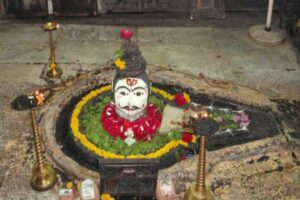
It is a long-standing custom and a representation of syncretism, according to Trimbakeshwar native and former Nashik District Central Cooperative Bank chairman Parvez Kokni. This custom has existed for a very long time. The city’s Muslims, who make up a very small portion of the populace, have managed to coexist peacefully. Since our city has a calm, non-communal atmosphere, it makes sense that I was welcomed as a leader despite being a Muslim. I find it surprising that this long-standing practice is now being called into question. Will this representative of a syncretic society support the recitation of the Hanuman Chalisa in any neighbourhood dargah or mosque, let alone a significant Jama Mosque?
In terms of ceremonies, there is no known custom of bringing any Chadar to any significant Hindu temple, such as a Jyotirling which has unique significance among all temples. No Purana or Shastra scripture supports it because Sanatan Dharma precedes Islam over an unlimited amount of time. Furthermore, there are no provisions that would permit a non-Hindu to enter a temple and carry out his non-Hindu religious ceremonies there. If such a practice is present in any Hindu temple, it ought to be stopped right away.
Many individuals desire Hinduism to be more inclusive than some Abrahamic religions. Even though there may be some regional customs in various temples throughout India, a Jyotirlinga site requires some level of solitude. The appropriate Hindu Dharmik authorities must act swiftly to make the necessary changes. Muslims in Nashik blame the incident on a “syncretic” culture and subtly accuse Hindus and temple authorities of fomenting religious strife and enmity. To further the link of love and respect between the two communities, they smugly ignore, no, they conceal, the fact that this harmony thing is one-sided and that no Maha Aarti, Yagya, Havan, or Puja is permitted within any Muslim house of worship. Hindus are supposed to permit non-Hindus to enter temples to place Chadars on gods, which has been placed as a load on their shoulders. The case of Kashi Vishwanath Temple, where a Shivling is found in the Wazukhana of the so-called mosque in the Gyanvapi complex where Muslims washed their hands and feet, washed their mouths, and spit for centuries on a Shivling, shows what kind of respect a Hindu deity may receive when Muslims forcibly enter a temple. In Trimbakeshwar, adherents of the same religion are now complaining that communal peace is being hampered by the temple administration.
Aurangzeb assassinated Chhatrapati Sambhaji Maharaj in 1689. Following the murder of the Hindu king, Aurangzeb added to the Mughals’ already-existing oppression by committing even worse atrocities against Hindus. To undermine the Maratha empire’s religious reasons, he ordered the desecration of further temples in Maharashtra in 1690. He hoped to dampen the spirit of the skilled and motivated Maratha troops who were then defending the Hindu kingdom under a youthful and inexperienced Chhatrapati Rajaram Maharaj by erecting mosques on the destroyed temples.
Jadunath Sarkar quoted Kashinath Sane’s ‘Varshik Itibritta’ (literally, ‘annual newsletters’) numerous times in his work ‘History of Aurangzeb’. He says, “About 1690. K. N. Sane in Varshik Itibritta page number 133-135” gives examples of Aurangzeb’s temple demolition at Ellora, Trimbakeshwar, Narsinghpur (foiled by snakes, scorpions, and other venomous insects), Pandharpur, Jejuri (foiled by the god! ), and Yavat (Bhuleshwar). It should be emphasised that even though the attack wasn’t stopped, Trimbakeshwar’s temple was turned into a mosque if the language’s metaphors are to be taken literally. Gulshanabad was given to Kumbh Nagari Nashik, formerly known as Janasthan. More than a thousand years had passed since Aurangzeb demolished the temple.
In “New History of Marathas – Volume II,” author GS Sardesai states, “In November 1754, the Peshwa restored the shrine of Trimbakeshwar, and the Masjid was destroyed.” According to some documents, the temple was built from 1751 to 1754, a period of three years. This essentially implies that the Trimbakeshwar temple was constructed in basalt stone during the time of Chhatrapati Ramraja, led by the Marathas Balaji Bajirao Bhat aka Nanasaheb Peshwa, who also led the Karseva. The linga installed inside Trimbakeshwar’s sanctum sanctorum is in the shape of a three-faced representation of the gods Brahma, Vishnu, and Mahesh. It lies 28 km from Nashik city at the foot of Mount Brahmagiri. Hemad Panthi architecture is used to build the temple. Hemadri Pandit, a minister of the Yadava kingdom in the 13th century, served as the style’s icon.
The Trimbakeshwar temple wasn’t constructed in exactly that way. Because they had the governmental power, the Marathas were able to recapture the holy site. Numerous Hindu soldiers sacrificed their lives for four generations in a row to obtain this power. This achievement was made possible by the warriors’ assertion of their military and financial dominance, as well as by the Maratha administrators’ collection of taxes from the majority of India starting in 1715. Protecting the fields, restoring the gods in the temples, and reestablishing Dharma required a lot of work. Given that the very temple was once destroyed by a follower of the same faith in the past to assert his faith and tyranny over the Hindus, it is past time for Hindus to reconsider whether their deities, like Trimbakeshwar, actually need any of the fumes of some frankincense from some Islamic place of worship.