























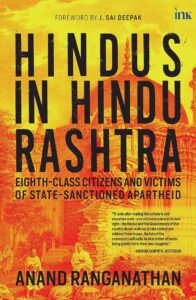
What happens when justice and truth are also skewed and partial? Or do you choose to take them in the name of “balance,” “criticism,” and “inclusivity”? Do you still speak the truth and pursue justice? Have your answers ready in your mind before you read the recently published book “Hindus in Hindu Rashtra” by Anand Ranganathan.
This write-up is neither an objective analysis of the book nor a critique of it. It is a straightforward review explaining why “Hindus in Hindu Rashtra” is a Magnum Opus and why every Hindu should read it.
“Murder of democracy” is one of the most popular placard quotes of the Left-Liberal environment in India. This Hindu-hating ecology has made a big deal out of their desire for dissent, acting as though they possess even the tiniest vestige of democratic ideals. Their character does not even remotely qualify as democratic for them to even grasp what dissent means since the ecology is so high on the Opium of Hindu hatred.
Anand Ranganathan, a Hindu who identifies with his Hindu heritage, demonstrates via his excellent writing what dissent genuinely means in the era of a purportedly pro-Hindu governmental system. The eight illnesses that the author has identified in Hindu society are broken down into eight chapters. He contends that these eight issues have reduced Hindus to the status of eighth-class citizens in their nation and made them victims of state-sanctioned apartheid.
In a bold statement, the author states in an excerpt from Chapter 4 of The RTE Act, “If there is one thing more cruel than not allowing Hindu temples to run their educational institutions without fear of State intervention and control, it is not allowing Hindus to run their educational institutions without fear of State intervention and control. And if there is anything more heinous than the fact that both of these atrocities are committed against Hindus, it is that they are committed against Hindus. belonging to a Hindu administration. Hindu Rashtra.”
Notably, the author calls himself a “Darwinian atheist,” yet he shows that this does not stop him from fighting for justice, the truth, and what is right despite his seeming atheism. The book’s no-holds-barred approach impels Hindus to introspection by outlining the laws that specifically discriminate against them and highlighting the wounds the community has sustained as a result of anti-Hindu judgements. The book then says something to and for Hindus that is hardly ever said: words of recognition for the sacrifices we have made.
“For this reason, I believe that the Hindus should be commended for petitioning the court to seek justice in the cases of Ayodhya, Kashi, or Mathura. This nation would have experienced a civil war if the holiest shrine of another religion had been destroyed and followers of other faiths had washed their muddy feet all around the sacred object. A billion Hindus who are writing their history with the language of justice, not anarchy, owe this atheist a duty of gratitude, the author argues.
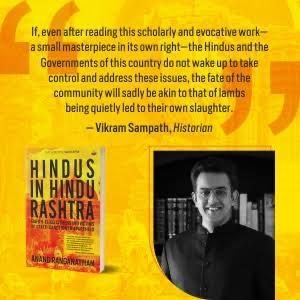
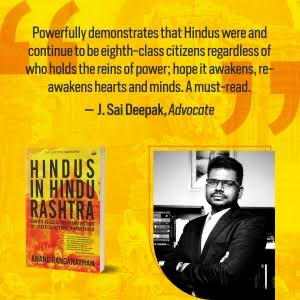
The work maintains perfect momentum, and from the first page to the end, there is a clear representation of devoted passion. The roughly 135-page book Hindus in Hindu Rashtra, with a foreword by Supreme Court advocate J. Sai Deepak and an afterword by historian Dr Vikram Sampath, is a case study of how Hindus have been made victims in their home country while also being painted as “fascists” and “bigots” by the ecosystem for transforming India into what the propagandists now refer to as “Hindu Rashtra.” The book’s depiction of Hindu society pushes the reader to ponder the question, “Is this what I get in my Hindu Rashtra?”
The author also gets right to the point, making the book quick to read. On that topic, those who primarily watch videos or those who want to start reading again will undoubtedly find solace in books. Accessibility to such information is equally as crucial as the information itself at a time when it is Hindus’ only effective weapon and affects future generations. This one should also be checked out by Hindus in Hindu Rashtra.
It is not simple to write the harsh truth knowing that it will upset the same individuals you’re writing for for their good. Speaking the bitter truth is made even more difficult when it calls into question the inaction of the ruling party, which is widely believed to be pro-Hindu but has exercised restraint in defending its own, as in the cases of Nupur Sharma and the handling of anti-Hindu violence in Nuh, to name a few.
It is now more crucial than ever to read and understand what Anand Ranganathan is trying to say in his most recent book and what Hindus can do to fight the Left’s McCarthyism and save the only nation they can call home.