

























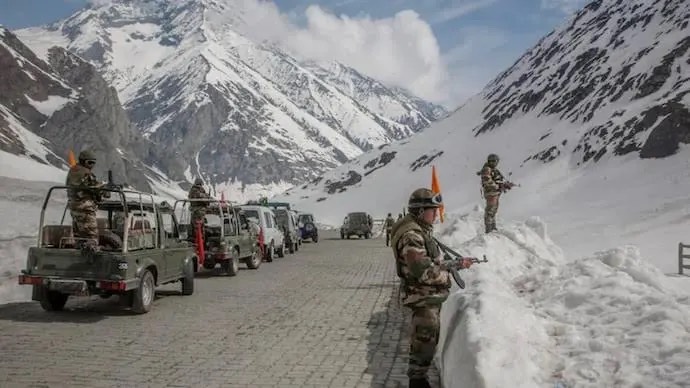
Today, June 15, 2024, is the fourth anniversary of the horrific battles between Indo-China troops in the Galwan Valley, which claimed many lives on both sides and fundamentally changed the course of relations between the two nations. After four years, the two neighbours’ relationship is still tense. The standoff at the border continues despite multiple military and diplomatic initiatives.
Everything began with the border stalemate in Eastern Ladakh, which separates India and China. Chinese soldiers, unaccustomed to being questioned about their ability to slice salami, encountered an armed force determined to hold onto every square inch of their territory and, if necessary, give them a bloody nose. Two months before the pivotal battles in the Galwan Valley, this led to a skirmish between the two armies at Pangong Tso Lake.
Chinese troops attacked Indian troops on June 15, 2020, close to the Ladakh frontier along the Ladakh-Arunachal Pradesh border. India had lost twenty of its soldiers in the battles. At first, China denied that any people had been hurt in the incident. After months of denial, China eventually admitted that at least five of its soldiers had died in the fighting, however, independent accounts said Beijing may have lost as many as 35–40 soldiers.
The government commemorated the slain Indian soldiers, gave them the proper status of martyrs, and performed their death rites in front of official leaders. In addition, PM Modi and the COAS paid the wounded soldiers a visit to meet and converse with them.
Conversely, China took great care to conceal the ambiguous facts of the conflicts to prevent Beijing from losing control over domestic affairs. But in February 2021, months after the border conflict, China gave four PLA soldiers posthumous honours, formally acknowledging the Galwan clash losses for the first time. Before this, the first proof of Chinese casualties during the fighting came from a picture of a dead PLA soldier’s tombstone.
There have since been major losses on the Chinese side as well, according to a report released for the first time by The Klaxon, an independent Australian media outlet.
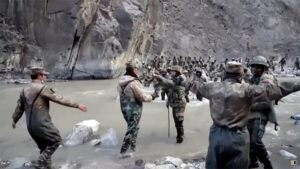
When the fighting occurred along the Galwan River on the evening of June 15, “at least 38 PLA troops were washed away and drowned,” according to the report. It further stated that information has surfaced strongly indicating that the Chinese side purposefully combined photos and facts from two distinct but comparable clashes that happened in Galwan less than a week apart.
The report claims that starting in April 2020, the Chinese military built temporary structures in the Galwan Valley, such as dugouts, tents, and equipment. By May, there were clashes between Indian and Chinese forces at several points on the frontier between China and India, notably Pangong Lake in Ladakh.
Social media experts claimed in a report titled “Galwan Decoded” that the majority of China’s public accounts were false. After a year-long investigation, the report was released. The researchers, who opted to remain anonymous for security reasons, spoke with mainland Chinese bloggers and obtained material from Chinese residents. They also removed media reports that were later removed by Chinese officials.
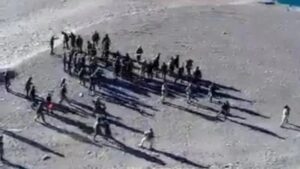
The investigation pointed out that digital archives from mainland China tell a different reality, even if numerous blogs and pages were taken down by Chinese officials. It asserted that many Chinese soldiers lost their lives trying to cross the swiftly moving Galwan River. Only Junior Sergeant Wang Zhuoran’s drowning death was recognised by China; the deaths of Private Chen Xiangrong, Major Chen Hongjun, and Junior Sergeant Xiao Siyuan were attributed to Indian forces.
A since-deleted document that stated Wang Zhuoran’s unit was given instructions to “perform a support mission” in June 2020 was also included in the report. According to the record, Wang Zhuoran saved four friends from being washed downstream by a river before becoming stuck by stones at its bottom and eventually succumbing from weariness.
According to the Klaxon report, the conflict in Galwan started on May 22, 2020, when Indian soldiers tried to construct a makeshift bridge across the Galwan River. According to the report, to make it easier to watch Chinese activity, Indian troops, under the direction of Colonel Santosh, commander of the 16th Bihar Regiment, built a temporary bridge across a Galwan River stream on this date. In the buffer zone, the Chinese were building their infrastructure, and the construction of the Indian bridge incited a strong response from the Chinese side.
About 100 Indian troops and 80 PLA soldiers engaged in combat on June 6 when the PLA soldiers arrived to demolish the bridge. Both parties agreed to remove personnel from the buffer zone and demolish any installations that had crossed the border after this impasse.
Instead of tearing down their infrastructure, the Chinese, according to their word, started demolishing the Indian bridge. In retaliation, Col. Santosh Babu and his soldiers entered the disputed Galwan Valley region at night on June 15, 2020, to drive out Chinese incursion. About 150 soldiers, including the Chinese side’s Col. Qi Fabao, were present.
Fabao gave the order for his forces to enter a war formation, disobeying the mutual agreement reached on June 6, 2021, instead of holding talks. Indian troops swiftly surrounded Fabao after his onslaught. In an attempt to save him, PLA battalion commander Chen Hongjun and soldier Chen Xiangrong physically fought Indian forces, concealing their leader’s escape with steel pipes, sticks, and stones.
Colonel Qi Fabao was apparently “hit in the head by an Indian army soldier and rushed back with serious injuries,” according to the article, which is interesting to read. Furthermore, “the Indian army immediately neutralised China’s Hongjun and Xiangrong.” An Indian soldier attacked and seriously injured another Chinese soldier, Xiao Siyuan, who was filming the event; Siyuan ultimately passed away from his wounds. The PLA soldiers are said to have panicked and withdrew after Col. Fabao left and they spotted the bodies of their top commanders.
Following an order to support the mission, Wang Zhuoran and his companion Ma Ming moved forward to assist their dispersed, retreating comrades by leading them to safety. It is said that the PLA forces hastily chose to cross the frigid waters of Galwan at night to carry out their attack since they did not have time to put on water trousers. “The river rose suddenly, causing injured comrades to slip and be washed downstream,” the report claims at this point. Attendees at Wang’s burial told stories of Junior Sergeant Wang Zhuoran pushing four of his friends across the river, but he lost his legs in the stones at the bottom of the river.
Along with other accounts of the extraordinary bravery displayed by India’s uniformed soldiers, ‘India’s Fearless 3: New Military Stories of Unimaginable Courage and Sacrifice,’ written by India Today journalist Shiv Aroor and HT’s Rahul Singh, verified the clear betrayal and treachery connected to the Chinese forces.
The book focused on Chinese duplicity in the Galwan Valley, which continues to affect the Indian Armed Forces’ wary posture towards China. It became clear that the Chinese planned the attack on the outnumbered Indian soldiers to change the status quo unilaterally and cause significant casualties to push them into retreat.
But instead of seeing the Chinese intentions through, they faced resolute and determined Indian forces who caused serious damage. The authors were informed by Havildar Dharamvir Kumar Singh, a soldier in the 16th Bihar Regiment, that the Chinese forces in the Galwan Valley numbered at least three times as many as the Indian soldiers.
We numbered fewer than 400. We soon learned that there were perhaps three times as many Chinese soldiers moving in our direction. Before that, we had been fighting smaller groups of Chinese for two hours. But this was their major weapon, an all-out onslaught against us,” Havildar Dharamvir Kumar Singh was cited in the book as stating.
China’s history of severing its neighbours’ territories with a salami-slicing manoeuvre, maintaining an iron grip over information, and using domestic repression to quell dissent and challenges to the CCP’s supremacy highlights the challenges facing the Modi administration as it enters its third term. This nation is hostile and run by an authoritarian who is determined to overthrow the “rules-based world order” to “restore” China’s hegemony on the international stage.
The 15th of June is not only a sombre day to remember the supreme sacrifices made by our soldiers and the unscrupulous army they face, but also a day to reflect on the challenges that our nation may face as Xi Jinping tightens his authoritarian grip on power over China and amid a highly volatile world plagued by invasions, terror attacks, wars, and climate change. This is PM Modi’s third term in office.