






















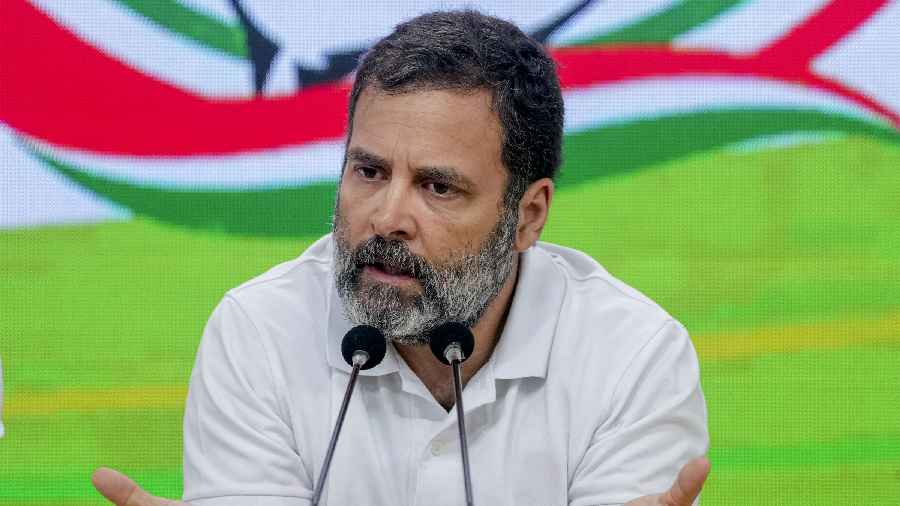
Rahul Gandhi has been looking for a chance to address the Lok Sabha over the BJP’s claim that he insulted India during a recent trip to the UK and its demand that he apologise, showing that he is determined to call the ruling party’s bluff.
On Thursday, Rahul was present in Parliament, but he was unable to address the government’s claim that he had disparaged India because Speaker Om Birla adjourned the Lok Sabha.
Thereafter, Rahul went to the Speaker’s office and requested that the House give him a chance to respond to the accusations. In a press conference thereafter, Rahul stated: “Four ministers spoke against me in the Lok Sabha. I have the right to reply to them. Since there is no certainty, I don’t believe I will be given the chance to speak. I’m hoping they’ll let me. I would be allowed to speak in Parliament if Indian democracy is working.
“What you are seeing is a test of Indian democracy,” Rahul said. Is a member of Parliament going to be afforded the same breathing room as those four ministers after four BJP leaders have levelled accusations against them? Or will he be instructed to stop talking? The main issue facing the nation at the moment is that.
As members of parliament are permitted to reply to accusations made against them in the Chambers, Rahul has put moral pressure on the Speaker by adopting this stance in public. Rahul refused to go into specifics about the matter in front of the media because he believed it was first his responsibility to defend his stance before Parliament, but he made a commitment to return and talk about the problems at hand after that.
The Congress leader’s request to address the topic in Parliament presents a problem for the administration since it is likely that he will take advantage of the chance to bring up the Adani debate in the House. If that occurs and the Speaker strikes the comments from the record, as he has done previously, it would once again bring attention to the restrictions on the freedom of speech of opposition leaders in India.
Rahul has previously claimed that there was a danger to Indian democracy and claimed that in Parliament, microphones were often turned off to avoid government criticism. Rahul said on Thursday that the debate around his meetings in London was stoked in order to draw attention away from the accusations against the Adani Group, whose close ties to Prime Minister Narendra Modi have been the focus of the Congress’s criticism of the government on the matter.
“The narrative began with my comments on the Adani problem. The Adani controversy has the prime minister on edge. They won’t let me talk again because of this, he continued. “But, the major concern, which is why Adani was handed the full India-Israel defence deal, is still up for discussion. Whose money is in the shell businesses and what occurred in Sri Lanka, Australia, and Bangladesh? The underlying issue about Modi’s connection to Adani remains unresolved. Rahul’s words about the UK were used by the administration to divert attention away from the Adani crisis, but the Congress intends to flip the script by using the same remarks to delve even further into the scandal.
The party wants a full-fledged discussion on Rahul’s views to underline the danger to Indian democracy, which is certain to bring up difficult topics beyond merely the Adani dispute and the government’s unwillingness to launch a probe. By choosing, at the Congress’s insistence, to focus on the Adani dispute rather than bringing the abuse of central agencies to the forefront, the Opposition has blocked the government’s escape path. The impasse in the legislature has also contributed to the notion that the administration prioritises protecting a businessman from accusations of misconduct above upholding the accountability concept.
As long as it seems like the administration is avoiding examination, the Opposition has no particular reason to support keeping Parliament in session. Also, the opposition parties are coming up with inventive tactics to emphasise that point. After the unsuccessful march to the Enforcement Directorate headquarters on Wednesday, which may have helped them in terms of optics and message, opposition Lawmakers on Thursday protested the rigidity of the administration by forming a human chain on the grounds of Parliament.
The BJP’s criticisms have already been softened by the Congress’s willingness to have a parliamentary discussion on Rahul’s remarks from the UK. The government is seen as avoiding discussion, in part because Modi has a history of disparaging previous Indian administrations abroad. The Congress is eager for an opportunity to make the case that debating current affairs and criticising the administration does not offend India.